Critically Endangered
Fatuhiva Monarch
Pomarea whitneyi
The Fatu Hiva monarch (Pomarea whitneyi), called Oma'o in Marquesan, is a glossy black flycatcher found only on Fatu Hiva in French Polynesia. The IUCN Red List rated it Critically Endangered in 2019. Black rats and feral cats took it from several hundred pairs to a few dozen birds.
How to recognise it
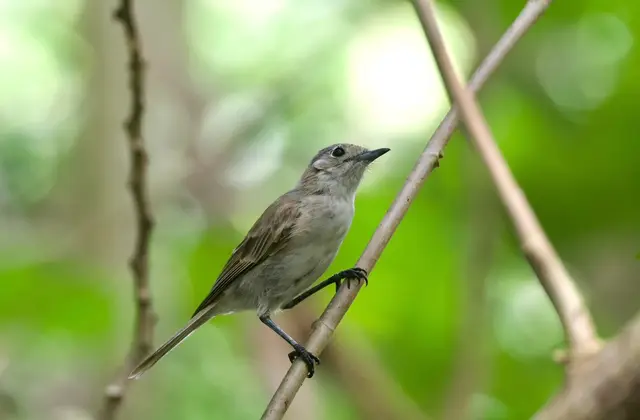
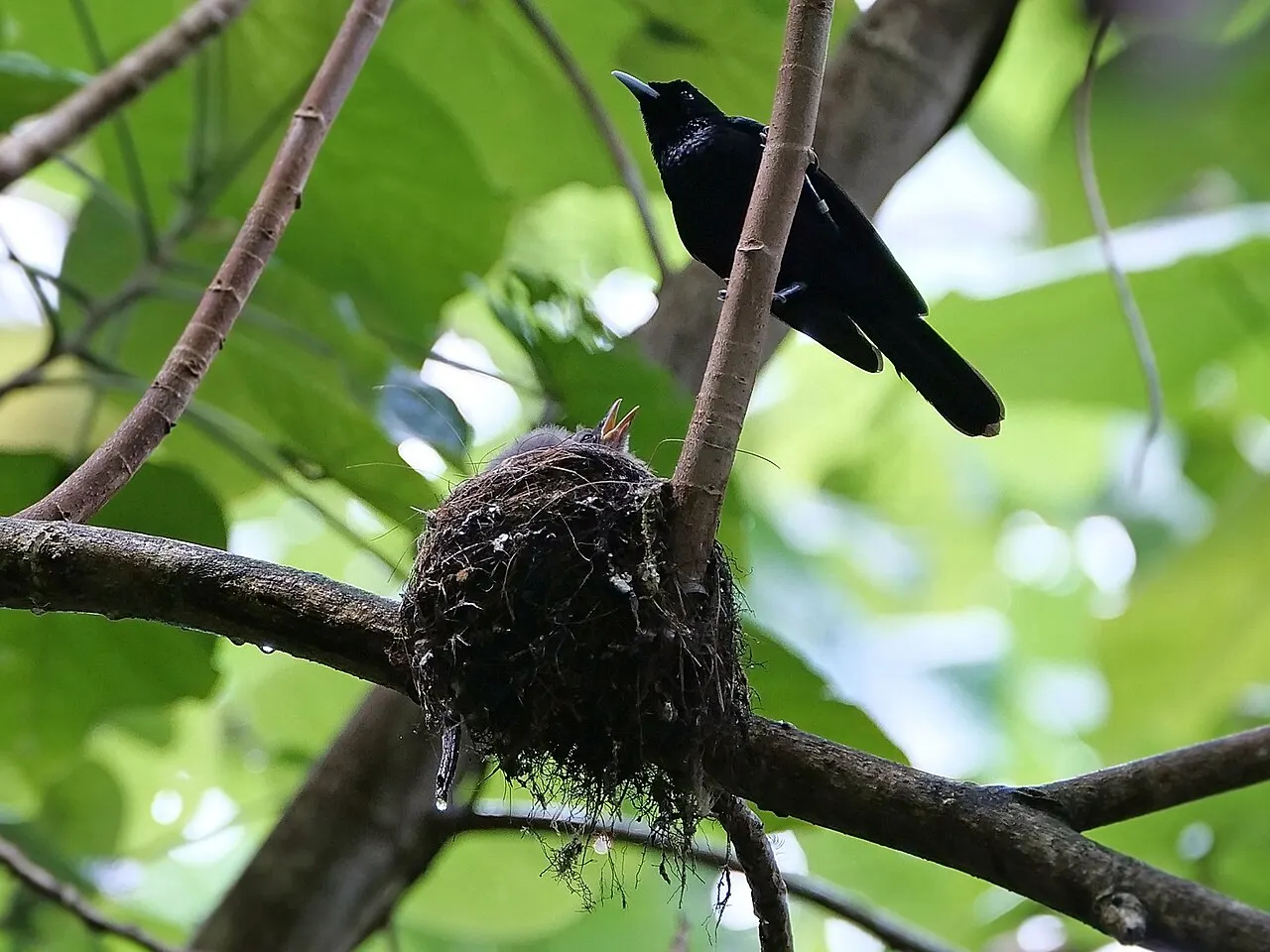
This is the largest bird in its genus, with an average weight of 43.5 g (40 to 49 g in a sample of 17) and a length of roughly 19 cm. Adults older than three years are entirely black, with a purplish gloss and plush-like feathers on the forehead. Three-year-old sub-adults are a mix of black and brown, and birds under three are brown and light grey, with a fleshy-yellow bill base in juveniles.
Young birds are famously naive. Researchers have had them come within 1.5 m, and one was seen approaching a dog to within a metre. They also feed on or near the ground, which is a poor fit for an island with introduced predators.
Where it lives
Fatu Hiva is the southernmost island of the Marquesas, about 80 square kilometres, steep, very wet and fairly well forested. The Red List gives a single location and an elevation range of 50 to 775 m, and lists lowland moist forest, moist shrubland and montane forest as habitat.
Territories sit along streams in narrow valleys, in vegetation dominated by native Hibiscus tiliaceus. The last breeding pairs are concentrated in the Omoa valley system on the island's west side.
Pins are Wikidata “endemic to” fields. Orange dots, when present, are GBIF occurrence tiles — survey bias included.
How it lives
The monarch is an insect eater and fiercely territorial, with a loud call. It breeds at any time of year and can raise up to two broods in 12 months. A clutch is one egg, incubated for about 17 days. Chicks stay in the nest for three weeks, and parents keep feeding fledglings for at least 2.5 months, sometimes up to 10 months. A bird is thought to live 20 to 30 years.
Why it is in trouble
In 1975 the population was put at several hundred breeding pairs, and the bird was still considered common in 1990. Black rats arrived by accident in the late 1980s. By 2000 the species had been moved to Critically Endangered, and birds had disappeared from the mango groves where they were once seen.
Surveys tell the rest. The island-wide encounter rate fell from 0.58 birds per point count in 2002 to 0.11 in 2007 and 2009, and known territories dropped from 32 in 2007 to seven in 2014. A 2009 extrapolation put the island's total at 64 birds. The Red List's 2019 assessment gave 33 mature individuals and a decreasing trend, and in 2024 the whole world population was reported as 20 birds, so estimates differ by year and method.
Rats were the first cause. Cats became the focus when rat control alone did not bring recovery, and the 2019 paper's working view is that cats taking young birds limit it. Fire, small-holder farming and, more recently, avian malaria add to the pressure.
What is being done
The Ornithological Society of Polynesia (SOP Manu) began rat control in monarch territories in 2007, using bait stations that grew to 712 across 143 hectares by 2016. Cat control began in 2010. By 2017, 327 cats had been trapped, 27 more killed by other methods, and 104 village cats sterilised or euthanised. After leg-hold traps replaced kill traps at the end of 2015, every fledgling in 2016 and 2017 survived its first two months.
The monarch population in the managed area rose from 11 birds in 2007 to 22 in 2017, but breeding has stayed fragile. Four pairs made 10 failed breeding attempts in 2023. In February 2024 a five-day-old chick was rescued from a tilting nest and hand-reared on the island, described as a first breakthrough for the species, and it is due to move to a mosquito-screened aviary after fledging. SOP Manu and Auckland Zoo announced a joint plan in 2023 to collect eggs for incubation and raise young in a predator-proof aviary.
Sources
Written for this catalog in our own words from the sources below, checked against them on 12 November 2026. Population figures are estimates and carry the year they were made. Status and assessment year: IUCN. 2026. The IUCN Red List of Threatened Species. Version 2026-1. iucnredlist.org.
- IUCN Red List assessment, Pomarea whitneyi
- Ghestemme et al. 2019, Catastrophic decline and subsequent conservation management of the Critically Endangered Fatu Hiva Monarch, Bird Conservation International 29:598-615
- Auckland Zoo, first breakthrough for bird on the brink (5 March 2024)
- Fatu Hiva monarch, English Wikipedia