Critically Endangered
Erepta stylodon
Erepta stylodon
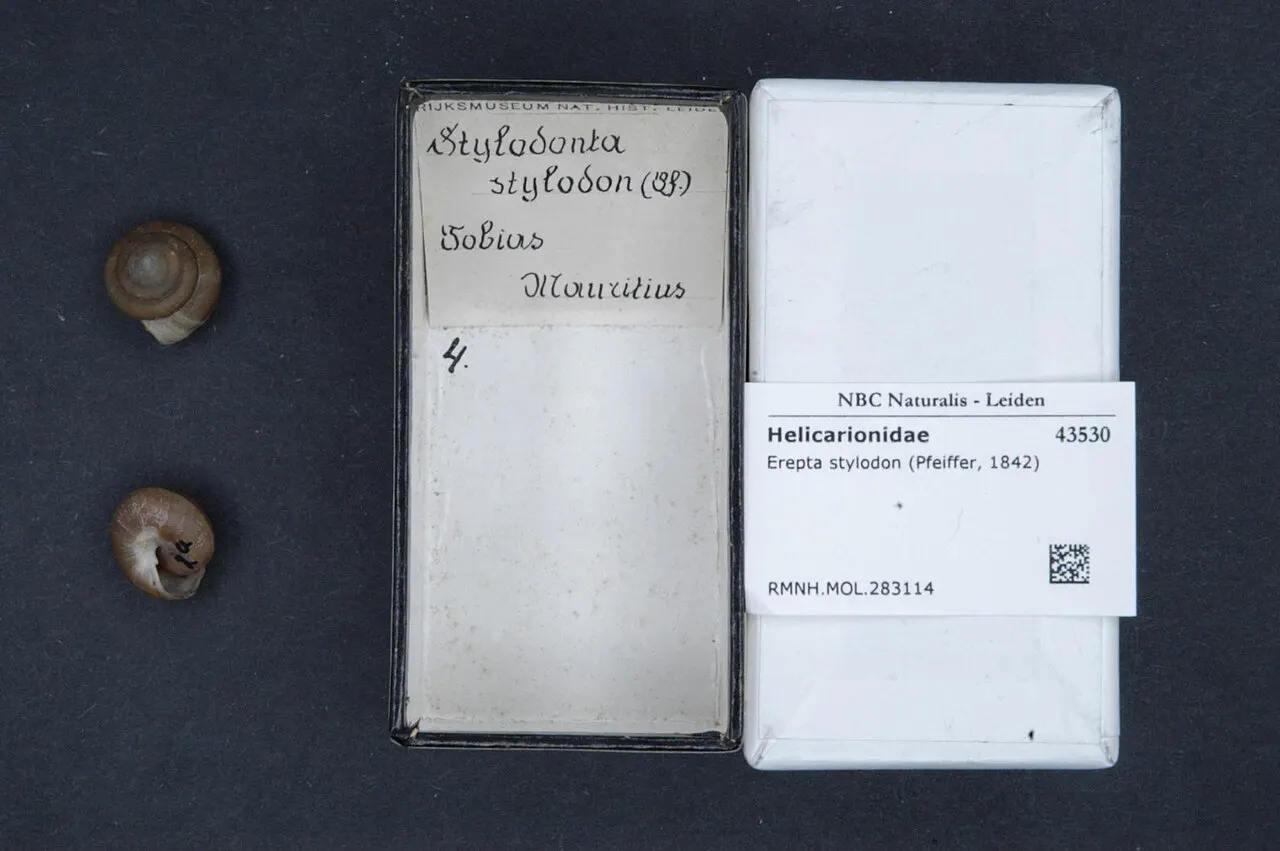
Erepta stylodon is a small land snail found only on Mauritius, in the Indian Ocean. Ludwig Pfeiffer described it in 1842, and it is the type species of its genus. The IUCN Red List rates it Critically Endangered, but that assessment dates from 1996, and recent field information is scarce.
How to recognise it
It is an air-breathing snail of the family Helicarionidae. A German reference gives the shell as roughly 8 to 12.5 mm high and 12 to 18.5 mm wide. The shell is sturdy and nearly cone-shaped, with six whorls and no teeth in the aperture, and it carries fine spiral grooves. Its colour is dark brown with a broad yellowish-brown band below the middle.
The tentacles, head, body and tail tip are reportedly black, while the base of the foot is white.
Taxonomy
Pfeiffer described it in 1842 as Helix stylodon. Johann Albers set up the genus Erepta in 1850, and a 2019 paper in Ruthenica by Schileyko, on a related species (Erepta odontina), lists Helix stylodon as the type species. The genus is a small group of Mauritian snails.
Where it lives
The species is endemic to Mauritius, an island that has lost much of its original forest. Records from the 1840s and 1860s place it in the Moka district, including near Le Pouce.
The Mauritius Institute reportedly made the last collection of living snails in the Bambou Range in 1958. The only site where living animals are still thought to occur is Montagne Brise Fer, in an area of about 10 hectares. These details come from a single reference, so they are best treated as provisional.
Pins are Wikidata “endemic to” fields. Orange dots, when present, are GBIF occurrence tiles — survey bias included.
Why it is in trouble
The IUCN rated it Critically Endangered in 1996, under criteria B1+2a, which cover a very small range that is shrinking or fragmented. The assessment predates the current IUCN system. The snail has long been described as rare in the literature.
The rodent poison brodifacoum, used to control rats, is reported to be the main current threat. The sources reviewed give no population figure and no recent field survey, so its present status is unclear.
Sources
Written for this catalog in our own words from the sources below, checked against them on 12 November 2026. Population figures are estimates and carry the year they were made. Status and assessment year: IUCN. 2026. The IUCN Red List of Threatened Species. Version 2026-1. iucnredlist.org.




