Endangered
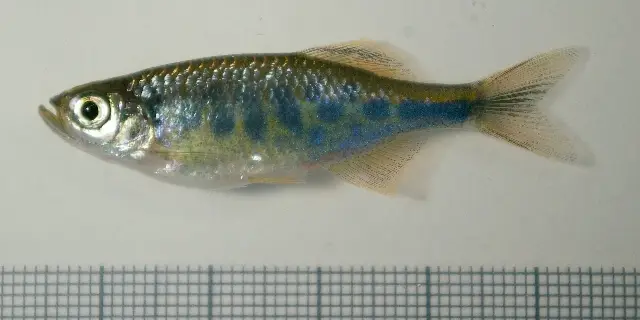
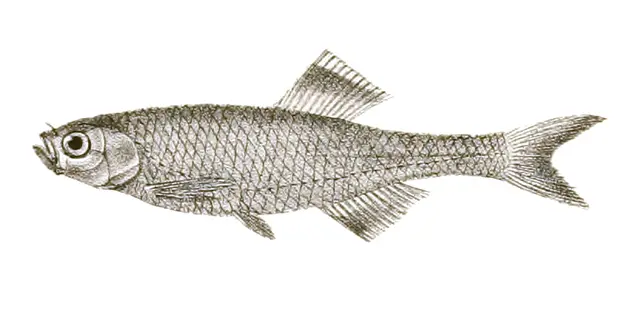
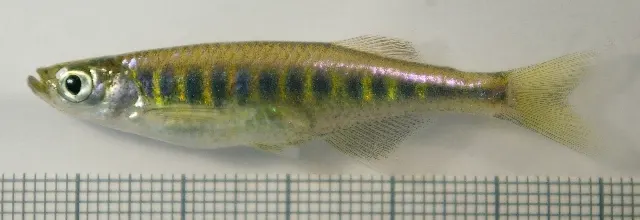
Inlecypris auropurpurea
Devario auropurpureus
The Inle danio (Inlecypris auropurpurea, listed by the IUCN under the older name Devario auropurpureus) is a small, striped, schooling fish found only in Lake Inle and its streams in Myanmar. It is rated Endangered on the Red List (assessed 2011) and is also collected for the aquarium trade.
How to recognise it
It's a slim, danio-like minnow with vertical stripes on a golden band, and the number and shape of the stripes differ from fish to fish. The belly is keeled, which separates it from true danios. Sources give a maximum length of 6 to 10 cm, though wild fish over 5 cm are rarely found. Females are paler and rounder in the belly than males.
Nelson Annandale described it in 1918 as Barilius auropurpureus. In 1980 Gordon Howes showed it did not belong in Barilius, which led to its own genus, Inlecypris, named after the lake. The IUCN still lists it under Devario, a placement most scientists now reject.
Where it lives
Its whole known range is the Inle Lake basin in Shan State, Myanmar. It turns up in the lake itself and in the streams that feed it, and it feeds mainly at the surface. The IUCN treats it as a single location at about 880 m above sea level, in a permanent freshwater lake.
Inle's water is hard and slightly alkaline, with a pH of roughly 7.6 to 8.8 in the middle of the lake and about 7.1 to 7.2 in tributaries. The lake is home to nine endemic fish species.
Pins are Wikidata “endemic to” fields. Orange dots, when present, are GBIF occurrence tiles — survey bias included.
How it lives
It lives in schools around dense submerged vegetation and eats mostly insects and other small aquatic invertebrates. In aquariums it spawns freely, laying eggs on or near fine-leaved plants and giving the young no care. Breeders report broods of up to 200 fry that grow slowly.
Why it is in trouble
Everything depends on one lake. The IUCN lists soil erosion and sedimentation, herbicides and pesticides, and small-scale harvesting among the threats, and records the population as decreasing. A water-quality study of Inle by Akaishi and colleagues, published in 2006, found the lake eutrophic, meaning overloaded with nutrients. A fish-keeping reference also names introduced fish such as tilapia, which prey on and compete with native species, and invasive water hyacinth as threats to the lake.
The fish is also taken for the aquarium trade and is sold as the Lake Inle danio or Lake Inle trout danio. It is bred in captivity by hobbyists. No figures on wild collection are available, and one reference judges the effect on wild populations to be slight.
Sources
Written for this catalog in our own words from the sources below, checked against them on 12 November 2026. Population figures are estimates and carry the year they were made. Status and assessment year: IUCN. 2026. The IUCN Red List of Threatened Species. Version 2026-1. iucnredlist.org.