Endangered
Barred danio
Devario pathirana
The barred danio (Devario pathirana) is a small stream fish found only in the wet zone of southwestern Sri Lanka, in the Nilwala River watershed. The IUCN Red List rated it Endangered in 2019. Forest clearing, plantations and sand mining are changing the streams where it lives.
How to recognise it
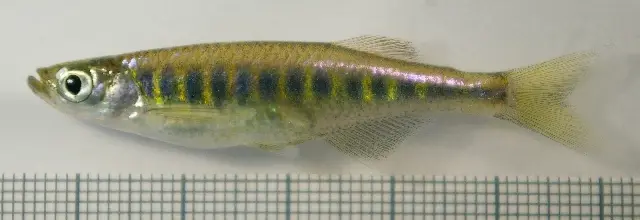
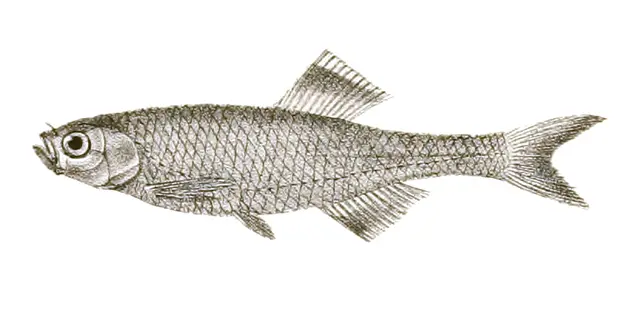
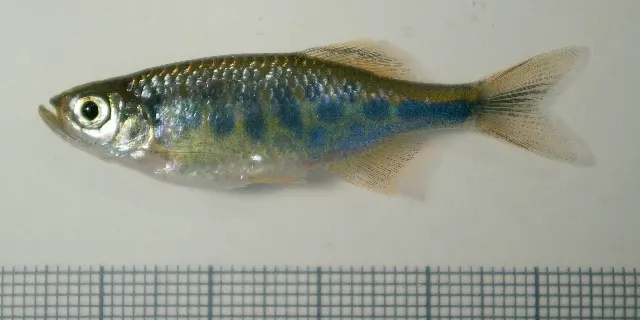
It carries seven to eleven irregular, dark blue vertical bars on the front half of each flank, plus a short horizontal stripe on the base of the tail that runs into the central tail rays. Mature females are rounder-bellied, less colourful and slightly bigger than males.
Sources disagree on size. Figures range from 5.1 cm to 6 cm, and the largest is 80 mm standard length.
Where it lives
It is endemic to Sri Lanka and known only from small streams in the Nilwala River watershed, including those draining the Kanneliya Forest Reserve and the Opatha Ela. The IUCN counts a single location, an elevation range of 37 to 357 m, and estimates the occupied area at 52 square kilometres within a range of 204.
When the species was described in 1990, the type locality was a slow, low-gradient stream over laterite clay, 4 to 8 m wide and up to 3 m deep, with very clear water and smooth sandstone boulders.
Pins are Wikidata “endemic to” fields. Orange dots, when present, are GBIF occurrence tiles — survey bias included.
How it lives
In the wild it eats mostly insects and their larvae. The Rainforest Protectors Trust, a Sri Lankan conservation group, says it is usually found in groups of three to five in shaded, clear streams. It is a schooling fish by nature.
It scatters its eggs and gives no parental care. In aquariums the eggs hatch in about 24 to 36 hours. Aquarium notes also describe it as more combative than most danios, mostly toward its own kind.
Why it is in trouble
At least 70 percent of the Nilwala watershed is now cultivated, and parts of it are heavily mined for sand. The 2019 IUCN assessment lists small-holder and industrial plantations, housing, mining and small-scale harvesting among the threats, and records a continuing decline in habitat area.
The Rainforest Protectors Trust adds that private mini-hydro projects can destroy streams, and that many of the streams the fish needs are privately owned.
What is being done
The IUCN reports the species occurs in at least one protected area and is held in captivity. It lists harvest management, resource and habitat protection, and site management as conservation actions needed, and records no recovery plan or monitoring scheme.
The Rainforest Protectors Trust buys privately held forest along such streams and designates it as permanent conservation forest. Breeders also produce the fish in limited numbers for aquariums, where it is sold as the tiger or Ceylon danio.
Sources
Written for this catalog in our own words from the sources below, checked against them on 12 November 2026. Population figures are estimates and carry the year they were made. Status and assessment year: IUCN. 2026. The IUCN Red List of Threatened Species. Version 2026-1. iucnredlist.org.