Endangered
Darevskia kopetdaghica
Darevskia kopetdaghica
Darevskia kopetdaghica is a small rock lizard known from the Kopet Dagh mountains on the Iran and Turkmenistan border. It was described only in 2013. The IUCN Red List assessed it as Endangered in 2017, citing a small, fragmented range and declining habitat.
How to recognise it
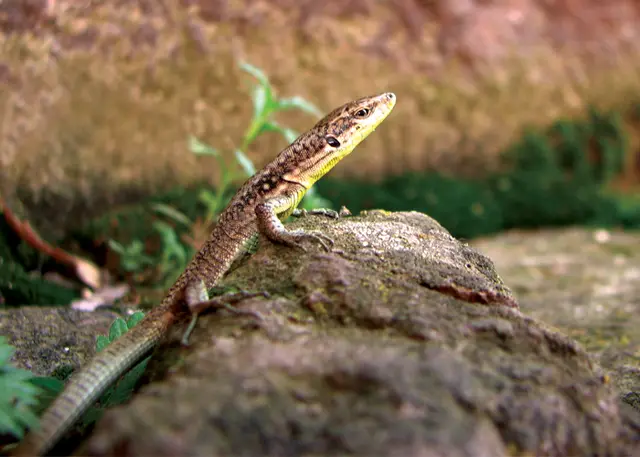
This is a small lacertid lizard. The largest known male, the holotype, measured 57.2 mm from snout to vent (its tail had regrown). The holotype was an adult male collected in 2010. It had a fawn-brown back with dark blotches, brownish flanks with blurred, dark-edged spots, reddish-brown belly plates, and a bright blue spot on each outermost belly plate.
The describers pointed to a reddish snout tip and chin as a feature no other lizard in its group shows. It also has smooth back scales and a collar edge without serrations, traits that place it in the Darevskia defilippii complex of rock lizards.
Where it lives
The species is named for the Kopet Dagh range. The type locality is in the Sarani Protected Area in Iran's North Khorasan Province, at about 2,159 m. A paratype collected in 1978 came from Turkmenistan's Ahal Province, and the IUCN lists both countries. The Reptile Database gives Iran alone.
Its habitat is grassy alpine vegetation, including cushion plants such as Acantholimon and Astragalus, and rocky outcrops. The IUCN also records temperate forest, grassland, shrubland and streams, with an upper elevation limit of 2,015 m. The estimated extent of occurrence is about 1,476 square kilometres.
Pins are Wikidata “endemic to” fields. Orange dots, when present, are GBIF occurrence tiles — survey bias included.
Why it is in trouble
The IUCN describes the population as severely fragmented and still declining. Small-holder grazing and farming convert and degrade its habitat, and drought adds stress. Small-scale harvesting can also harm it unintentionally.
Little is known about its biology. Egg laying is presumed, inferred from relatives rather than observed. No population count or detailed trend data have been published.
What is being done
The species occurs in at least one protected area, and it was first collected in the Sarani Protected Area. The 2017 IUCN assessment lists no conservation actions beyond that protection.
Sources
Written for this catalog in our own words from the sources below, checked against them on 12 November 2026. Population figures are estimates and carry the year they were made. Status and assessment year: IUCN. 2026. The IUCN Red List of Threatened Species. Version 2026-1. iucnredlist.org.