Endangered
Owens pupfish
Cyprinodon radiosus
The Owens pupfish is a tiny desert fish from the Owens Valley of eastern California, where it once lived along the length of the valley. It was assessed as Endangered on the IUCN Red List in 2013. Today it survives mainly in a handful of managed refuge populations that biologists keep alive.
How to recognise it
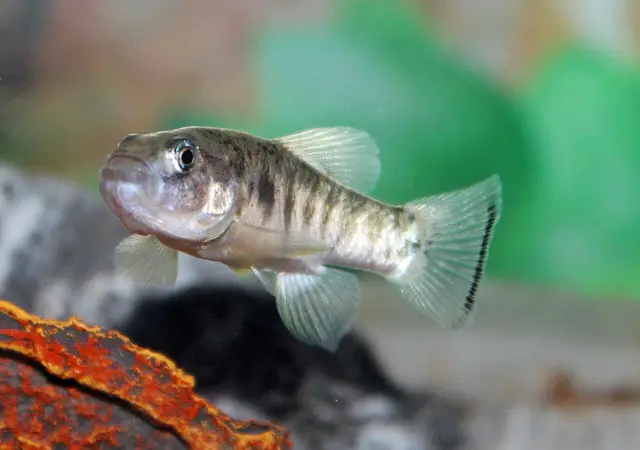
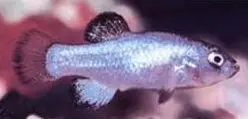
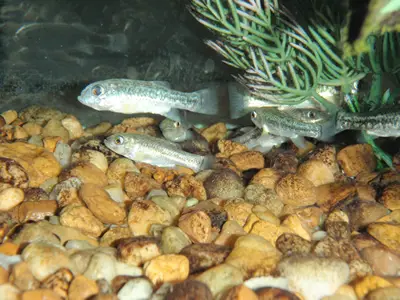
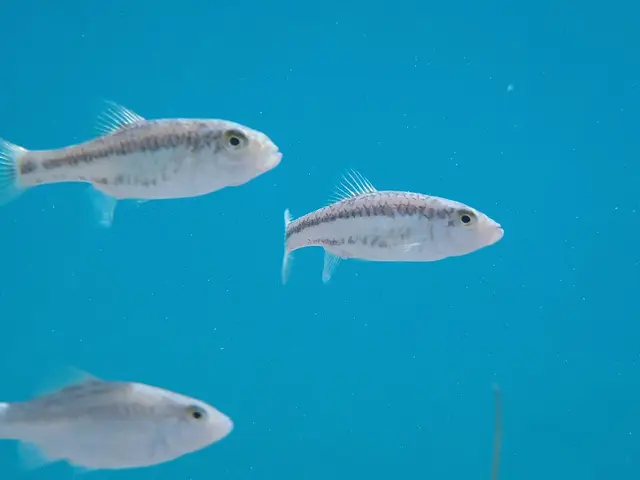
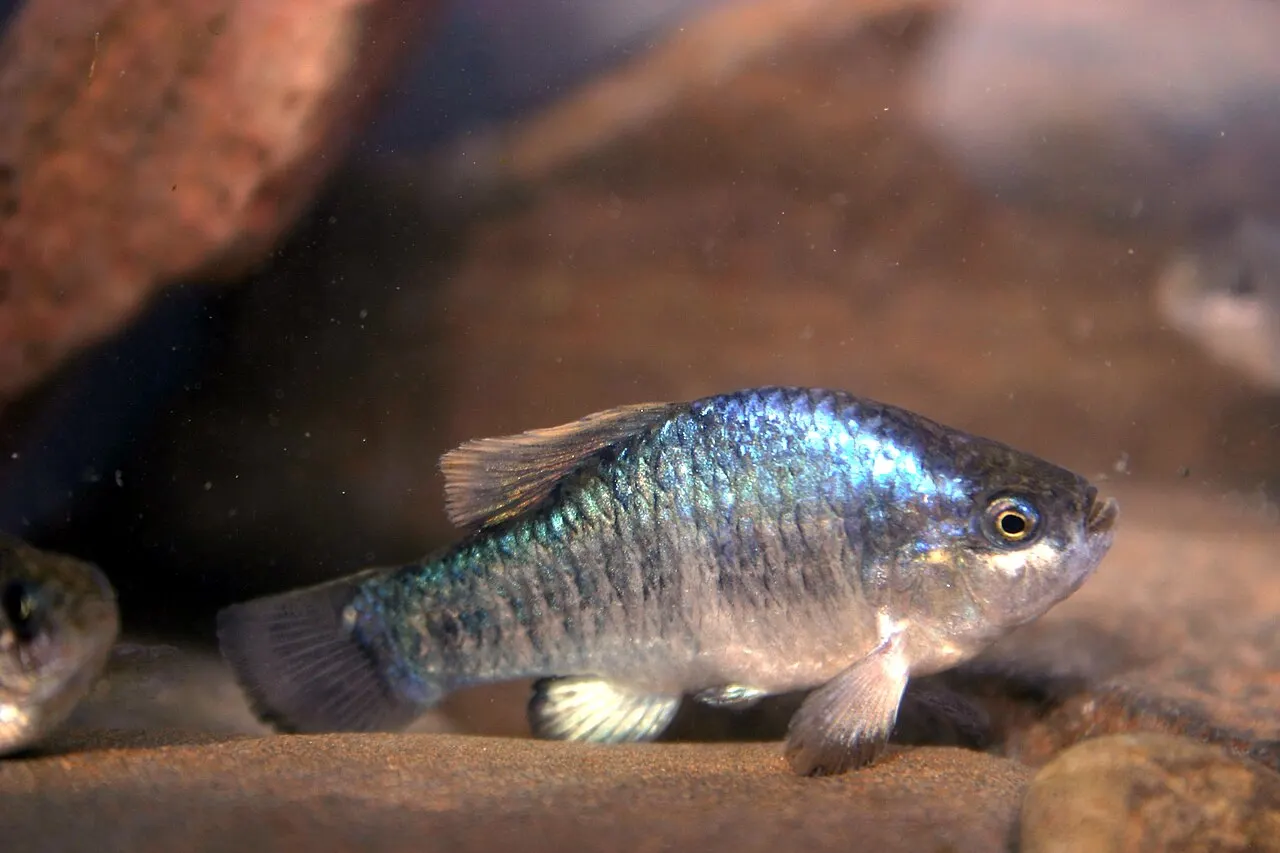
This is a small, deep-bodied, flattened fish, about 5 cm long at most (state accounts say under 2.5 inches), with males larger and deeper-bodied than females. Breeding males are bright blue with broad vertical bars along the sides. Females are greenish brown above, with a silvery or whitish belly and irregular brownish bars. Males outside the breeding season look much like females.
Pupfish live in small schools, and the males are the more colourful and territorial sex.
Where it lives
The Owens pupfish is found only in the Owens Valley, in Inyo and Mono counties. Its original range ran from Fish Slough in the north to the Lone Pine area in the south, roughly 70 miles by one account, and took in the Owens River and its sloughs and marshes. It used shallow spring pools, sloughs, irrigation ditches, swamps and flooded pastures.
These are hard places to live. Water can reportedly reach 33 degrees Celsius in summer and freeze over in winter, and in some pools the salt content is around four times that of the ocean, with little oxygen. The pupfish tolerates all of it.
Pins are Wikidata “endemic to” fields. Orange dots, when present, are GBIF occurrence tiles — survey bias included.
How it lives
It feeds mostly on aquatic insects, especially midge larvae, along with small crustaceans, algae and sometimes fish eggs. Spawning runs over a long season, from about January to September in state accounts. Males defend small territories, and some reportedly hang around as satellites or sneak in to fertilise eggs. A female may spawn daily, laying a few eggs at a time.
The Paiute people reportedly collected and dried these fish for winter food.
Why it is in trouble
Water was the problem. Diversion of Owens Valley water to Los Angeles and groundwater pumping dried much of the habitat, and introduced fish finished off many of the remaining populations. Largemouth and smallmouth bass, trout, bluegill, crayfish and bullfrogs are named as predators or competitors. Illegal bass releases wiped out the fish at two Fish Slough sites, BLM Spring and the Owens Valley Native Fishes Sanctuary. Cattails can reportedly choke the shallows, and a genetic bottleneck from the population crash is a further concern. Drought and shrinking snowpack threaten the aquifers that feed the springs.
The species was presumed extinct from the 1940s. It was found again in the 1960s, when the only known population lived in a pond that was drying out.
What is being done
In 1969 the fisheries biologist Phil Pister carried the remaining fish, in two buckets, to safer water. Refuge populations were then set up from them. The species was listed as federally endangered in 1967 and by California in 1971, and a recovery plan covering Owens Basin wetland species appeared in 1998. The California Department of Fish and Wildlife describes the fish as confined to five populations. Fish Slough is managed as an Area of Critical Environmental Concern by several agencies, and BLM Spring there was restored in 2002 and restocked in 2003.
Newer work includes a habitat restoration in 2020, with landowners, followed by a transfer of fish to the restored system. A population was reportedly established in 2021 at the River Spring Lakes Ecological Reserve in Mono County, and the Bishop Paiute Tribe has reportedly worked with state and federal agencies on a refuge, since the fish matters culturally to the tribe. IUCN lists the population trend as stable.
Sources
Written for this catalog in our own words from the sources below, checked against them on 12 November 2026. Population figures are estimates and carry the year they were made. Status and assessment year: IUCN. 2026. The IUCN Red List of Threatened Species. Version 2026-1. iucnredlist.org.