Endangered
Corallus annulatus blombergi
Corallus blombergi
The Ecuadorian annulated tree boa, Corallus blombergi, is a medium-sized boa of lowland rainforest canopy in western Ecuador, coloured light brown to bright orange, with an uncertain record from southern Colombia. The IUCN Red List assessed it as Endangered in 2016, when only two locations were known.
How to recognise it
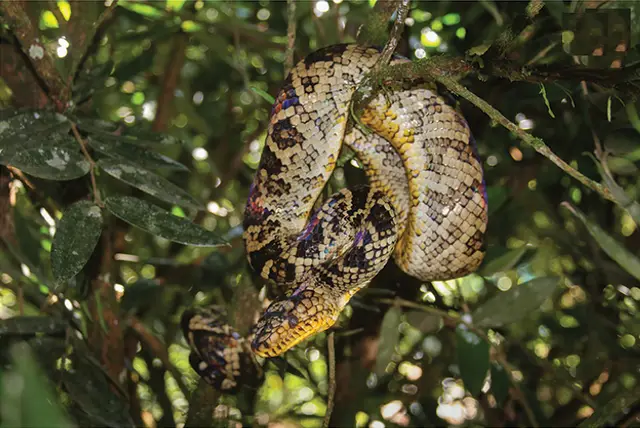
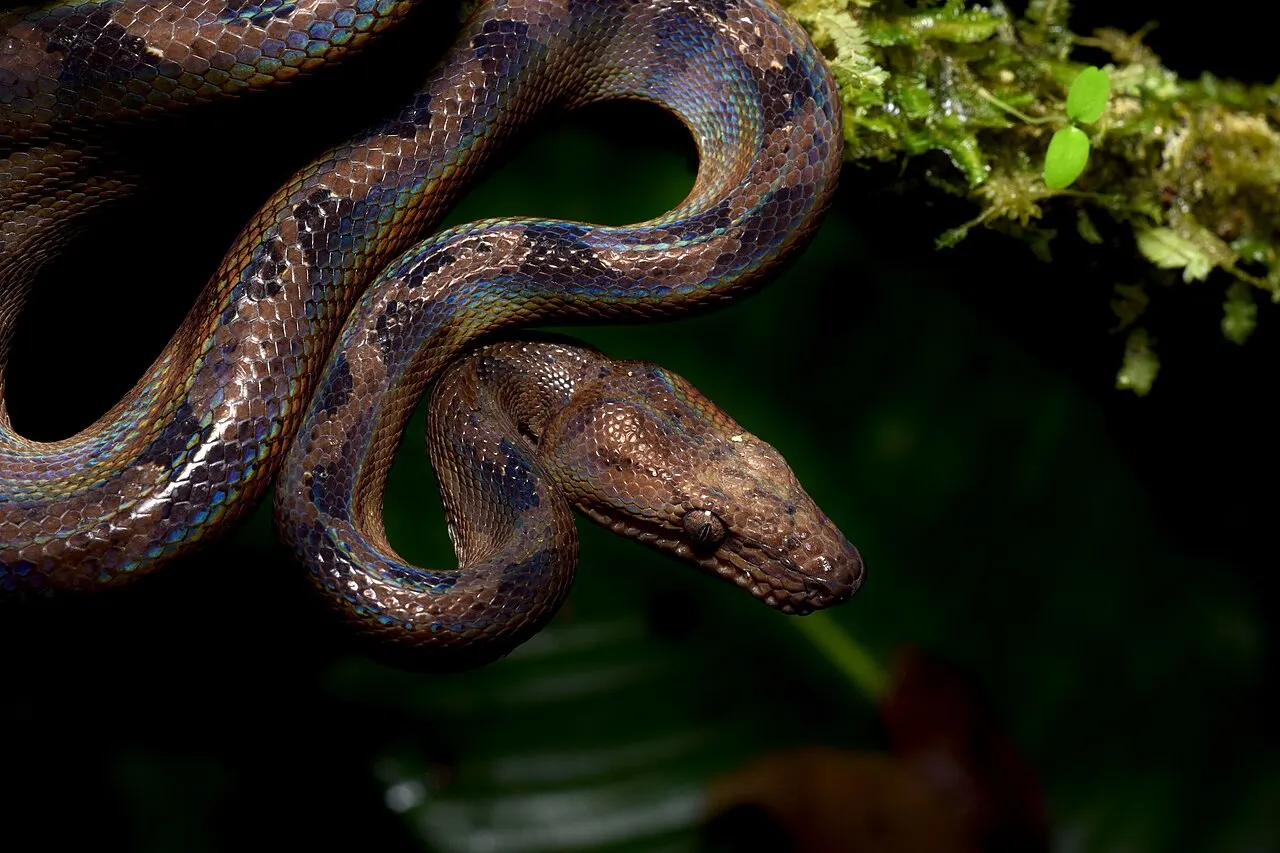
This is a medium-sized, fully arboreal boa with a triangular head, a dark vertical pupil, a reddish iris and heat-sensing pits along the lips. Colour runs from light brown to bright orange, with irregular blotches about 7 to 8 scales wide that are paler in the centre. At night a snake can look greyish brown with reddish spots, then turn almost entirely orange by day.
Males reach about 143 cm and females about 191 cm, snout to tail tip. Boa imperator looks similar, but this species has prominent lip pits. Scale counts help separate it from relatives: it has 251 to 269 belly scales, against 186 to 209 in the emerald tree boa, and 76 to 86 tail scales, against 94 to 137 in the Amazon tree boa group.
A species of its own
Swedish explorer Rolf Blomberg collected the first specimen, and the snake was named in his honour. It was described in 1941 as a subspecies of the annulated tree boa, Corallus annulatus. A 2001 revision of the genus by Henderson and colleagues is the basis for treating it as a full species, reportedly because of differences in bone structure, colour and scalation. The Red List entry still carries the old subspecies name as a synonym.
Where it lives
The Red List describes it as a snake of the lowlands west of the Andes in northwestern Ecuador, below 200 m, with an extent of occurrence of about 4,000 square kilometres. Records come from Esmeraldas (most of them), Azuay, Guayas, Los Rios, Manabi and Pichincha. Three isolated localities lie further south, and the species has almost certainly been lost from at least two of them because no primary forest remains. A single specimen has been reported from southern Colombia, and the Red List counts its presence there as uncertain. The Canande Biological Reserve in Esmeraldas holds the most recent observations. The original type locality, on the Rio Zamora in eastern Ecuador, is thought to be an error.
It lives in the upper canopy and understory of tropical rainforest and foothill semideciduous forest, especially along rivers. One regional account says it also uses selectively logged forest, but the Red List says it does not enter disturbed habitats. Snakes use vegetation from 1.6 to 10 m above the ground, and sometimes turn up in wooden cabins in forest. They do not persist where trees are absent, in planted forest or in oil palm plantations.
Pins are Wikidata “endemic to” fields. Orange dots, when present, are GBIF occurrence tiles — survey bias included.
How it lives
It is most active on moonless nights between sunset and midnight, especially after heavy rain, and hunts both by moving through the canopy and by ambush. Bats, rodents and birds are its recorded prey. The species is ovoviviparous, meaning the eggs hatch inside the mother. In captivity, mating was recorded in March and April. After a gestation of 5 to 7 months, females gave birth to 13 or 14 young averaging 41.3 cm in length. Little else is known about its natural history.
Why it is in trouble
The 2016 assessment rates it Endangered under criterion B1ab(iii,iv,v), a small range with two locations and continuing decline in habitat and numbers, and records the population trend as unknown. The Red List calls it very rare and says nothing is known about wild populations. Deforestation is the serious threat: agricultural expansion, grazing and large-scale logging drive the loss of forest in the region. The species appears to be more widespread than first thought, but roughly 70 percent of its habitat in Ecuador is reported destroyed.
The Red List has no reports of trade in this snake, though boas attract the international pet trade and illegal trade is possible. It is known from at least one protected area, the Cotacachi Cayapas Ecological Reserve, where illegal logging continues. It is covered by CITES Appendix II under its old name, and the assessor suggests captive breeding may be the only realistic conservation measure. Diego Cisneros-Heredia of Universidad San Francisco de Quito carried out the assessment.
Sources
Written for this catalog in our own words from the sources below, checked against them on 12 November 2026. Population figures are estimates and carry the year they were made. Status and assessment year: IUCN. 2026. The IUCN Red List of Threatened Species. Version 2026-1. iucnredlist.org.