Endangered
Corallus cropanii
Corallus cropanii
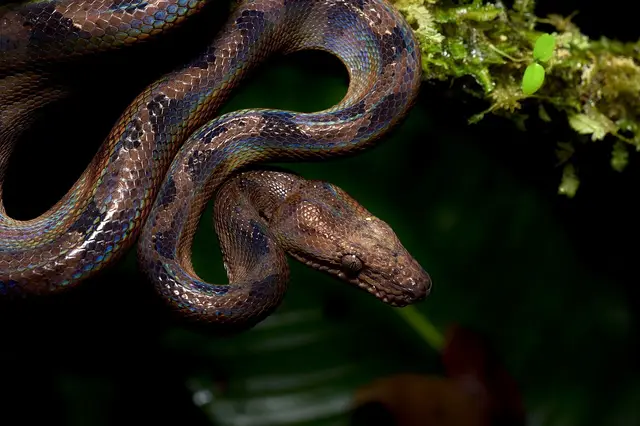
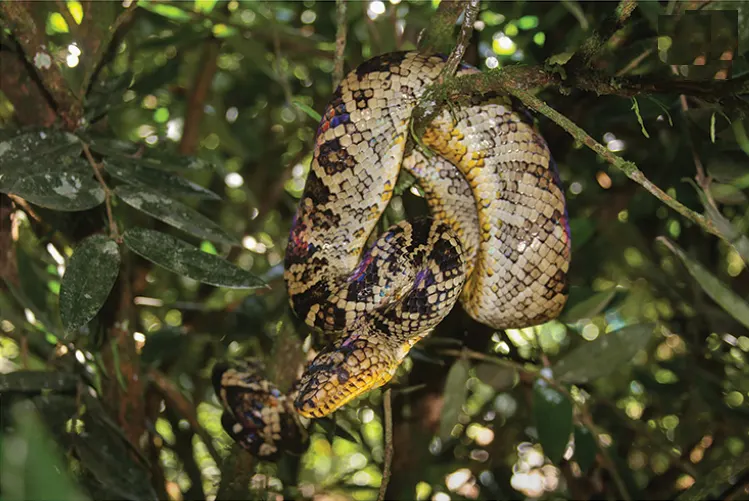
Cropan's tree boa (Corallus cropanii) is a rarely seen, non-venomous snake from the lowland forest of São Paulo state, Brazil. No live one was recorded between 1953 and 2017. The IUCN Red List rated it Endangered in 2021, based on a tiny range and shrinking habitat.
How to recognise it
Like all boas it isn't venomous. The adult female found in 2017 measured about 1.7 metres. Specialists count more than 30 but fewer than 36 rows of dorsal scales at midbody, and most or all of the upper lip scales carry deep sensory pits.
The snake was first described in 1953 by Alphonse Richard Hoge, in the genus Xenoboa, and named for Ottorino de Fiore, Baron of Cropani, an Italian geologist.
Where it lives
The species is endemic to Brazil and known only from São Paulo state, in moist lowland forest near the coast. Records come from around Miracatu (the type locality), Pedro de Toledo, Santos and Sete Barras. The IUCN gives an elevation of 0 to 60 metres, counts four locations and estimates the extent of occurrence at about 2,400 square kilometres.
Pins are Wikidata “endemic to” fields. Orange dots, when present, are GBIF occurrence tiles — survey bias included.
How it lives
Almost nothing is known. Diet and breeding in the wild haven't been documented, though the species is reportedly ovoviviparous, meaning the eggs hatch inside the mother. Tracking the 2017 female with a radio transmitter reportedly showed that the snake often climbs, so it is thought to be at least partly arboreal.
Rediscovery in 2017
For decades only dead specimens existed, between three and six depending on the count, and some had been killed by local residents. Researchers from the Butantan Institute and the University of São Paulo's Museum of Zoology ran talks in the Ribeira Valley explaining that the snake is harmless to people. In late January 2017 residents of Sete Barras brought in a live female. The team fitted her with a radio tag and released her.
Why it is in trouble
The IUCN lists three threats that each cover most of the range: agro-industrial farming, deliberate killing or taking of the snake, and a catch-all category of unrecorded scale. It couldn't score their impact. The area occupied is still declining. The population trend is unknown and no population estimate exists.
What is being done
The only action the IUCN lists is site and area management. Whether the species occurs in a protected area is recorded as unknown. The outreach talks to residents are the one documented effort, and a 2017 news report said no species-specific conservation measures were in place.
Sources
Written for this catalog in our own words from the sources below, checked against them on 12 November 2026. Population figures are estimates and carry the year they were made. Status and assessment year: IUCN. 2026. The IUCN Red List of Threatened Species. Version 2026-1. iucnredlist.org.