Endangered
Clanwilliam Sandfish
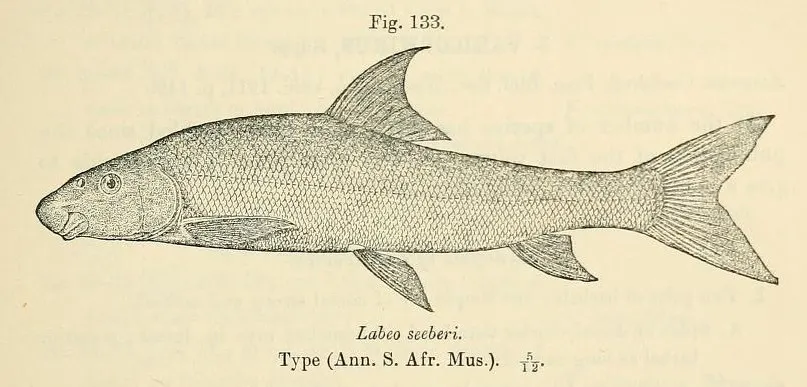
Labeo seeberi
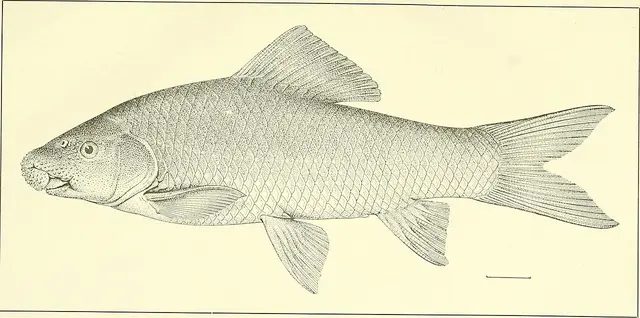
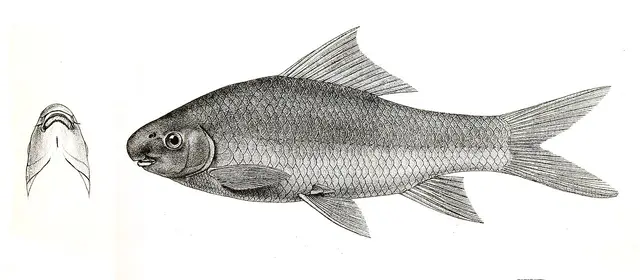
The Clanwilliam sandfish (Labeo seeberi) is a bottom-feeding carp relative from the Olifants-Doring river system of South Africa's Western and Northern Cape. Listed as Endangered by the IUCN in 2017, it survives in seven fragmented subpopulations, hit hard by alien bass and drying rivers.
How to recognise it
It's a member of the carp family, Cyprinidae, and the genus Labeo. Published measurements reach about 35 cm in standard length, and the heaviest recorded fish weighed 269 g.
It was described in 1911 by Gilchrist and Thompson.
Where it lives
The species is endemic to South Africa, recorded in the Western Cape and Northern Cape. It favours pools and deep runs in larger rivers and their bigger tributaries. Today it survives mainly in the Doring River catchment and tributaries such as the Biedouw and Oorlogskloof rivers, in seven subpopulations that the Red List describes as severely fragmented. Its estimated extent of occurrence is about 3,600 square kilometres, with an area of occupancy of only 48 square kilometres.
It has reportedly disappeared from its original type locality, a loss linked to introduced fish.
Pins are Wikidata “endemic to” fields. Orange dots, when present, are GBIF occurrence tiles — survey bias included.
How it lives
Sandfish graze algae and detritus off rocks and pick small invertebrates from soft sediment. Adults migrate upstream in groups to spawn. In the Oorlogskloof River this happens in August and September, and in September 2021 researchers counted about 180 adults moving up the Biedouw River and saw several spawning events.
Why it is in trouble
Smallmouth bass were stocked in the Olifants-Doring system in the 1930s as a sport fish, and bluegill sunfish and banded tilapia were introduced later as fodder for the bass. Small sandfish are almost absent from invaded stretches of the Oorlogskloof but fairly common where the aliens are missing. The Red List also names groundwater abstraction, dams, and small-holder grazing and farming.
Numbers have fallen hard. Between 2013 and 2018, relative abundance in the Oorlogskloof dropped by 92.6 percent and young-of-the-year numbers by 99.6 percent. Summer-surviving pools there are about half as common as before the drought that began in 2015, and extreme rain on top of drought has hindered recovery.
What is being done
A rescue project takes juveniles from drying Biedouw pools and holds them in alien-free farm dams that landowners converted into sanctuaries. About 7,599 juveniles were moved in November 2020. Fish are PIT-tagged and meant to be released once they reach a bass-proof size of about 20 cm.
Alien fish were also removed with rotenone from a 4 km stretch of the Rondegat River in the Cederberg, described as the first South African river section cleared this way. The Red List lists protection, habitat restoration, reintroduction, invasive control, awareness and training among actions in place or needed, and records an action plan and monitoring scheme.
Sources
Written for this catalog in our own words from the sources below, checked against them on 12 November 2026. Population figures are estimates and carry the year they were made. Status and assessment year: IUCN. 2026. The IUCN Red List of Threatened Species. Version 2026-1. iucnredlist.org.