Endangered
Champsochromis spilorhynchus
Champsochromis spilorhynchus
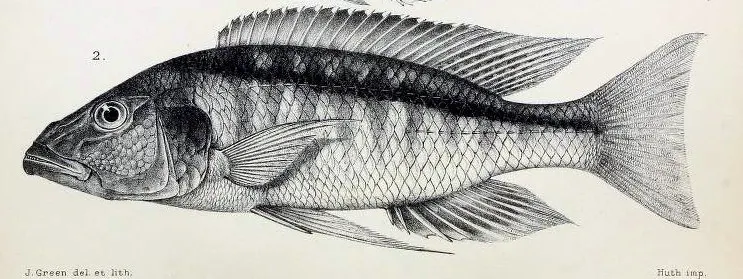
Champsochromis spilorhynchus is a large, fish-eating cichlid from Lake Malawi, Lake Malombe and the upper Shire River, in Malawi, Mozambique and Tanzania. The IUCN Red List rated it Endangered in 2019 because its numbers have been falling under fishing pressure. Local names include Tabwa and Njeruwa.
How to recognise it
It's a long, streamlined cichlid with a dark oblique bar running down in front of the eye and a distinct black blotch on the snout, an enlarged version of the facial bar most African cichlids carry. The outer teeth are well spaced. Males develop trailing soft rays on the dorsal and anal fins. The genus name comes from Greek roots meaning roughly "crocodile" and "fish", a nod to a voracious predator.
FishBase gives a maximum length of 30 cm. Aquarium specialist Ad Konings reports fish longer than 35 cm, so sizes vary by source.
Where it lives
The species is native to Malawi, Mozambique and Tanzania. It lives in the water column near the bottom, mainly over sandy and muddy substrates, in warm water of roughly 24 to 26 degrees C. Besides Lake Malawi it occurs in Lake Malombe and the upper Shire River. The IUCN puts its estimated area of occupancy at 3,150 square kilometres.
Pins are Wikidata “endemic to” fields. Orange dots, when present, are GBIF occurrence tiles — survey bias included.
How it lives
This is a pursuit predator. Rather than lying in ambush, it chases prey over long distances, and young utaka (small Copadichromis cichlids) are its main food. Its trophic level of about 4.2 marks it as a top-order fish eater.
Females brood their young in the mouth, and FishBase says a female can carry more than 100 young at once. The IUCN uses a generation length of about 3 years.
Why it is in trouble
The IUCN lists small-scale and subsistence harvest as the threat, and records a decreasing population with a continuing decline. FishBase scores its fishing vulnerability as low to moderate, with medium resilience (a minimum population doubling time of 1.4 to 4.4 years).
FishBase lists commercial fisheries and the aquarium trade as human uses. The species has been exported under the invalid trade name Haplochromis Mbwanae. No conservation actions are listed in the IUCN record.
Sources
Written for this catalog in our own words from the sources below, checked against them on 12 November 2026. Population figures are estimates and carry the year they were made. Status and assessment year: IUCN. 2026. The IUCN Red List of Threatened Species. Version 2026-1. iucnredlist.org.




