Critically Endangered
Jamaican giant galliwasp
Celestus occiduus
The Jamaican giant galliwasp (Celestus occiduus) is a large, stout lizard found only in Jamaica, with no confirmed live animal recorded since the mid-1800s. The IUCN's 2020 assessment lists it as Critically Endangered and possibly extinct, with a single location and a population size recorded as 40.
How to recognise it
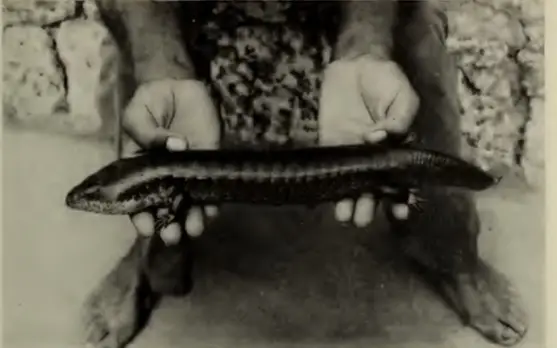
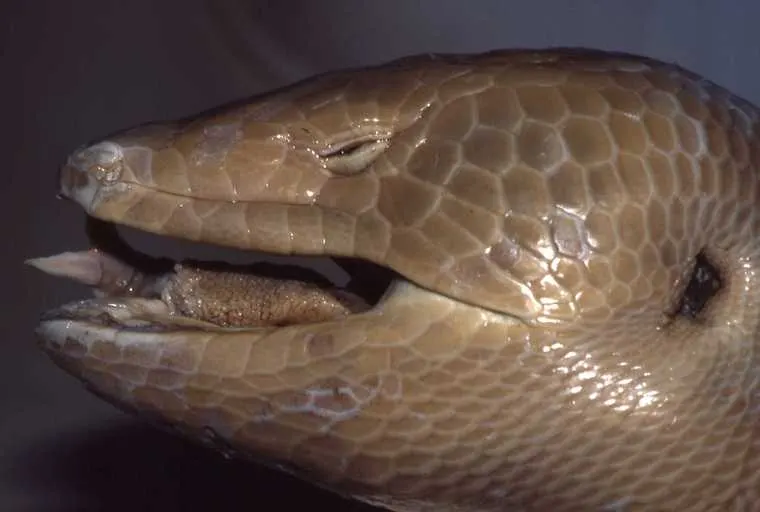
This was the largest galliwasp on Jamaica, with a head-body length of about 32 cm, and lengths of 15 to 20 inches are reported for the species. It was stout, with a light brown body marked by about fifteen darker cross bands and a tail that was flattened from side to side.
George Shaw described it in 1802 as Lacerta occidua. It is also known as the sinking galliwasp, and it belongs to the family Diploglossidae. Galliwasps in general are shy and not venomous; they bite only in defence, and the old tale that a bite is fatal is false.
Where it lived
The species is endemic to Jamaica. The IUCN lists its habitat as inland wetlands and subtropical swamp forest, and the assessment counts one location and one subpopulation. Surveys of the Black River Morass, a hard-to-enter wetland, have been extensive but not exhaustive, which is why some hope remains that it survives there.
Early observers wrote that it lived in holes near swamps and ate crabs. A later view holds that it more likely lived among rocks and ate insects, so its real habits are poorly known.
Pins are Wikidata “endemic to” fields. Orange dots, when present, are GBIF occurrence tiles — survey bias included.
Why it is in trouble
After England gained formal possession of Jamaica in 1670, sugarcane farming spread across the island. The Indian grey mongoose was later brought in to prey on rats in the cane fields, and it quickly became a major threat to the galliwasp and other native species. It is the most likely cause of the lizard's disappearance, though that is an inference rather than something proved. The IUCN assessment also names a specific problem species as an ongoing threat across the whole range, along with housing, small-holder farming and accidental killing by people.
About 30 specimens are known in collections around the world. The date of the last record differs between sources: one gives 1840, while a specimen held in Glasgow is dated to the 1850s. Jamaican specimens once kept at the Institute of Jamaica were probably lost in the 1907 Kingston earthquake.
What is being done
The assessment lists site protection and control of invasive species among the actions needed, and research into population size, distribution and life history. It records a population size of 40, an estimate used for the assessment rather than a count of animals seen.
In April 2024 scientists from the Natural History Museum of Jamaica and the University of the West Indies, Mona, received a preserved female galliwasp from the University of Glasgow, where it had been kept at the Hunterian Museum since 1888. Nicknamed Celeste, it came home after a repatriation process that took 19 months, under a 2019 agreement between the two universities. It is on permanent loan at the Natural History Museum of Jamaica.
Sources
Written for this catalog in our own words from the sources below, checked against them on 12 November 2026. Population figures are estimates and carry the year they were made. Status and assessment year: IUCN. 2026. The IUCN Red List of Threatened Species. Version 2026-1. iucnredlist.org.