Critically Endangered
Caribicus anelpistus
Celestus anelpistus
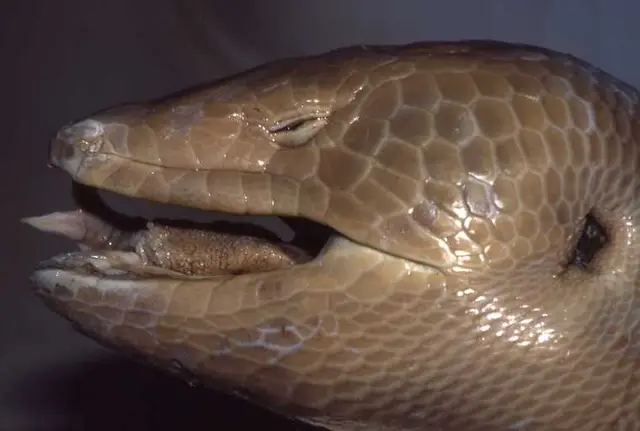
The Altagracia giant galliwasp (Caribicus anelpistus) is a big, secretive lizard known only from one patch of humid lowland forest near Villa Altagracia in the Dominican Republic. The IUCN Red List classed it as Critically Endangered, possibly extinct, in 2016. A living animal was caught again in 2020, after decades without a record.
How to recognise it
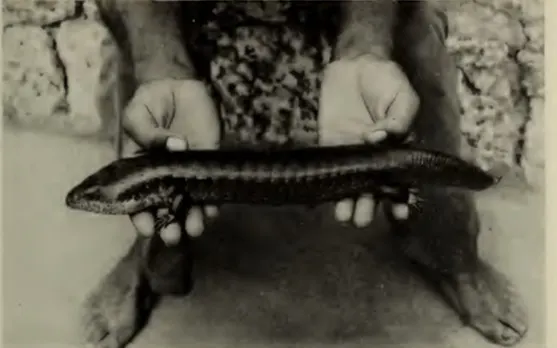
Galliwasps are long-bodied lizards in the family Diploglossidae, and this is a large one. The adult male caught in 2020 measured 283.5 mm from snout to vent, with a head 134.2 mm wide. The original 1979 description gave an adult snout-vent length of 279 mm.
A reptile database entry separates it from its two close relatives in the genus mainly by its banded back pattern, body size and scale counts, with 81 to 107 rows of belly scales. It was first described in 1979 as Diploglossus anelpistus, then moved to Celestus and more recently to Caribicus. The species name comes from a Greek word for 'unexpected'.
Where it lives
It is endemic to the Dominican Republic, on the island of Hispaniola. The type locality is Ingenio Catarey, Villa Altagracia, San Cristobal Province. The IUCN counts a single location and an extent of occurrence of about 12 square km, in subtropical or tropical moist lowland forest.
The 2020 animal turned up at La Lomita, roughly 7 km southwest of Villa Altagracia. A possible record from near Jarabacoa in 2004 has also been mentioned, but nothing else is firmly established about where else it might occur.
Pins are Wikidata “endemic to” fields. Orange dots, when present, are GBIF occurrence tiles — survey bias included.
How it lives
Almost nothing is known. A 2023 paper in Reptiles & Amphibians notes the lizard has been associated with the root systems of large trees, such as sandbox trees (Hura crepitans). The paper describes giant galliwasps of this kind as semi-fossorial, meaning they spend much of their time in burrows and under cover, and as feeding on arthropods and land snails. Local residents near the 2020 find said they had mostly seen similar animals at night. A reptile database entry says the species bears live young, with eggs developing inside the mother.
The IUCN gave its population trend as unknown and gave no population estimate.
Why it is in trouble
The last record for 43 years was in July 1977. The IUCN names small-holder farming as a past threat and lists introduced predators as an ongoing one: the small Indian mongoose, feral cats and feral dogs. Habitat loss and a single known site are the main reasons for its Critically Endangered listing, and with a range this small, one clearing could do serious harm.
That risk showed in the way the 2020 lizard was found. Farmers were clearing a plot to plant cacao when a local resident caught it on the ground in daylight. People there said they had seen similar animals before, which suggests a small population is still present.
What is being done
The species is listed as Critically Endangered on the Dominican Republic's own red list (2018) as well as the IUCN list. The IUCN assessment records no conservation measures in place.
The 2020 animal was deposited in the herpetological collection of the national natural history museum in Santo Domingo and reported in 2023.
Sources
Written for this catalog in our own words from the sources below, checked against them on 12 November 2026. Population figures are estimates and carry the year they were made. Status and assessment year: IUCN. 2026. The IUCN Red List of Threatened Species. Version 2026-1. iucnredlist.org.