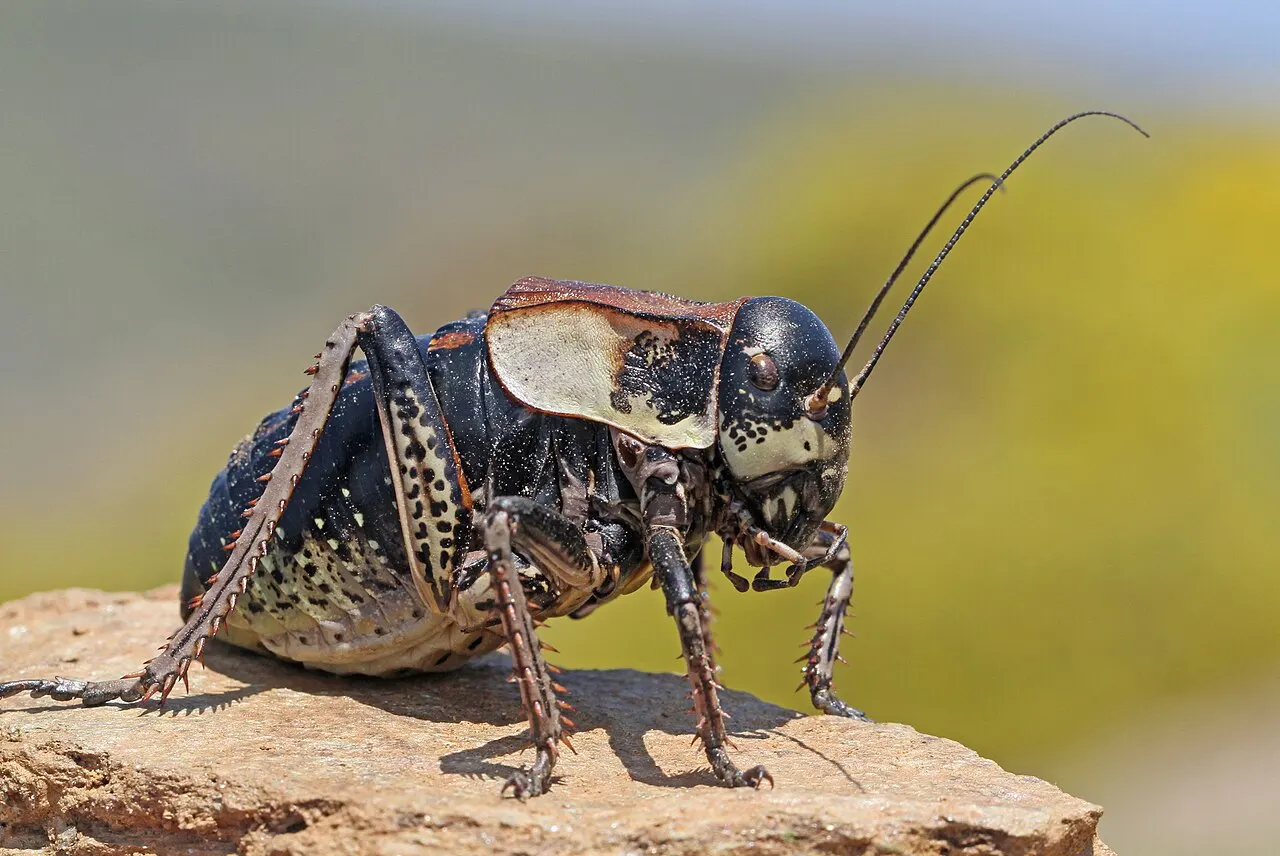
Endangered
Big-Bellied Glandular Bush-Cricket
Bradyporus macrogaster
The big-bellied glandular bush-cricket (Bradyporus macrogaster) is a large, stout bush-cricket of dry shrubland and grassland in the Balkans and Turkey. Its populations are broken into small pockets, and the IUCN Red List assessed it as Endangered in 2013, with a decreasing trend.
What it is
This is a bush-cricket in the family Tettigoniidae and the subfamily Bradyporinae, a group of heavy, ground-dwelling species. Lefebvre described it in 1831 under the name Ephippiger macrogaster. It sits in the subgenus Callimenus, and older literature often calls it Callimenus macrogaster.
Its classification has changed since the Red List assessment. A 2017 revision of the genus by Mustafa Unal in Zootaxa reinstated a Balkan form, Bradyporus skopjensis, as a full species after it had been folded into macrogaster, and the Orthoptera Species File now lists macrogaster with subspecies. The 2013 assessment predates this revision, so it may cover more than one of the animals now recognised, and its range and trend figures may mix them.
Where it lives
The Red List gives its range as Romania, Bulgaria, mainland Greece, North Macedonia, Serbia and Turkey, from sea level up to about 1,270 metres. It records the species as present in Bulgaria, Greece and Turkey, and as possibly extinct in Romania, North Macedonia and Serbia. It names dry shrubland, dry forest and temperate grassland as habitat.
The overall extent of its range is large, about 200,000 square kilometres, but the area it actually occupies is estimated at only 140 to 500 square kilometres. GBIF holds 35 occurrence records, most of them from Bulgaria (21), then Greece (7) and Serbia (4).
Pins are Wikidata “endemic to” fields. Orange dots, when present, are GBIF occurrence tiles — survey bias included.
Why it is in trouble
The Red List counts housing and urban development, commercial and industrial land, tourism and recreation areas, plantations, and farming and grazing among the pressures. All of them take or degrade the open, dry ground the insect relies on, and the assessment records continuing decline in both the area it occupies and the extent of its range.
The population as a whole is decreasing and severely fragmented, and the number of mature animals is not known. The assessment is based on the small occupied area and on that decline in habitat.
What is being done
The Red List asks for site protection and management. At the time of the 2013 assessment there was no recovery plan, no monitoring scheme, no captive breeding and no awareness programme, and it was not covered by international legislation or trade controls. Whether an area-based management plan exists was recorded as unknown.
Sources
Written for this catalog in our own words from the sources below, checked against them on 12 November 2026. Population figures are estimates and carry the year they were made. Status and assessment year: IUCN. 2026. The IUCN Red List of Threatened Species. Version 2026-1. iucnredlist.org.




