Endangered
Bokermannohyla vulcaniae
Bokermannohyla vulcaniae
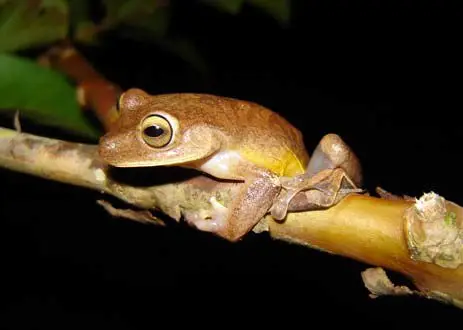
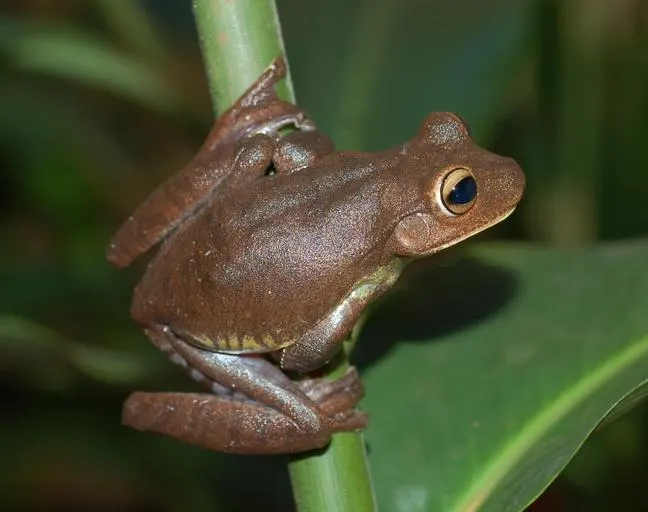
Bokermannohyla vulcaniae is a medium-sized brown tree frog known only from the hills around Poços de Caldas in Minas Gerais, Brazil. It has no English common name in general use. The Red List moved it from Vulnerable to Endangered in 2023, with a small range and a declining area of habitat.
How to recognise it
This is a tree frog in the family Hylidae, roughly 40 to 53 mm from snout to vent. The back is brown and the underside paler. The snout is rounded, the eardrum is distinct, and a clear fold runs above it.
Fingers and toes both end in adhesive discs and are webbed, the toes more heavily. The toe discs are smaller than those on the fingers. Males call with two pulsed notes, given together or separately. The first has about 4.5 pulses at around 840 Hz and the second about 10 pulses at around 1,240 Hz. Tadpoles measured at an early stage of development are 29 to 38 mm long.
Where it lives
The frog is endemic to Brazil and known only from the region of its type locality, Morro do Ferro at Poços de Caldas. The name vulcaniae refers to the volcanic origin of that area. It was described in 2005 as Hyla vulcaniae and later placed in Bokermannohyla.
The Red List gives an elevation range of 1,000 to 1,300 m and an extent of occurrence of only 183 to 957 square kilometres, across three to five locations. Records come from gallery forest beside a stream at about 1,000 m and from a temporary swamp at a forest edge at 1,248 m. Frogs were found on vegetation 0.65 to 1.5 m above the ground. The Red List lists montane forest, permanent and seasonal streams, and marshes as habitat.
Pins are Wikidata “endemic to” fields. Orange dots, when present, are GBIF occurrence tiles — survey bias included.
Why it is in trouble
The Red List treats the population as severely fragmented, with the area of suitable habitat still shrinking and the population trend decreasing. The threats it records are farming and grazing, mining and quarrying, housing and urban growth, plantations and water abstraction. Pollution from fertiliser, pesticides, sewage, run-off and seepage from mining is also listed.
The 2008 assessment rated the species Vulnerable. The 2023 assessment places it one step higher, at Endangered, under the range-size criterion.
What is being done
The Red List records the species in at least one protected area and notes recent awareness programmes. Two populations are reportedly in protected sites, the Serra de São Domingos Municipal Park and the Botanical Garden of Poços de Caldas.
Conservation actions the Red List lists include site protection and management, habitat restoration, species recovery work and captive breeding. Research on population size, distribution, trends and threats is also listed, since the frog is poorly known.
Sources
Written for this catalog in our own words from the sources below, checked against them on 12 November 2026. Population figures are estimates and carry the year they were made. Status and assessment year: IUCN. 2026. The IUCN Red List of Threatened Species. Version 2026-1. iucnredlist.org.