Critically Endangered
Bokermannohyla izecksohni
Bokermannohyla izecksohni
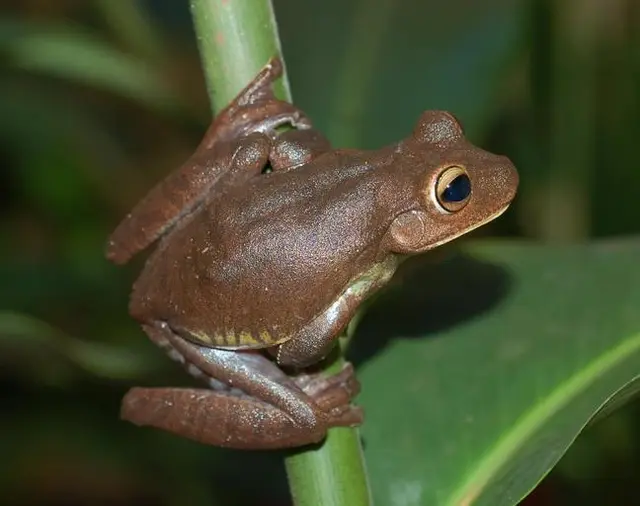
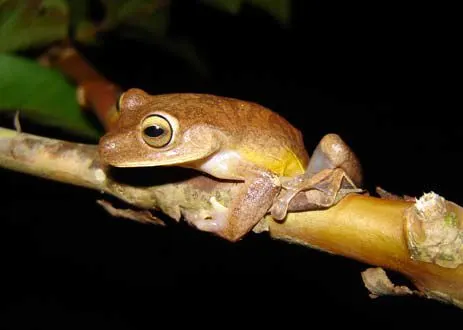
Izecksohn's treefrog is a medium-sized tree frog known only from forest streams in the Brazilian state of São Paulo. The IUCN lists it as Critically Endangered (assessed 2021, published 2023) with a decreasing population. It was considered possibly extinct in 2004, until living frogs turned up in 2005 and 2006.
How to recognise it
It is a medium-sized frog, about 45 millimetres from snout to vent. It belongs to the tree frog family Hylidae and was first described in 1979 by Jim and Caramaschi under the name Hyla izecksohni. The species name honours the Brazilian herpetologist Eugênio Izecksohn.
Where it lives
The frog occurs only in São Paulo state. It was first known from Rubião Júnior, near Botucatu, and the original collecting site has since been lost to farming and human settlement. Later finds come from forest between roughly 700 and 900 metres above sea level, including a population reported from Serra do Mar State Park.
The IUCN counts the species as known from one location and describes its range as small and severely fragmented, with an area of occupancy of just 4 to 8 square kilometres. It lives in lowland moist forest near streams, and it breeds in temporary pools.
Pins are Wikidata “endemic to” fields. Orange dots, when present, are GBIF occurrence tiles — survey bias included.
Why it is in trouble
Habitat loss is the main threat. The IUCN lists small-scale farming, small-scale grazing and housing as ongoing pressures, along with unintended losses from large-scale harvesting of forest products. It records continuing decline in the extent and quality of habitat, in the number of mature individuals and in the area the frog occupies. That assessment says the frog is not known from a protected area, although a state park population is reported elsewhere.
The 2004 assessment treated the frog as possibly extinct. Three living frogs found in 2005 and 2006 changed that picture, and the species has since been recorded again in Serra do Mar State Park. A rediscovery is not a recovery, though. Few animals have been found, and the species still meets the criteria for Critically Endangered.
What is being done
The assessment calls for protection of the sites and the habitat where the frog lives, and it flags research on population size, distribution and trends. The IUCN lists no species-specific conservation programme.
Sources
Written for this catalog in our own words from the sources below, checked against them on 12 November 2026. Population figures are estimates and carry the year they were made. Status and assessment year: IUCN. 2026. The IUCN Red List of Threatened Species. Version 2026-1. iucnredlist.org.