Critically Endangered
Emirati leaf-toed gecko
Asaccus caudivolvulus
The Emirati leaf-toed gecko (Asaccus caudivolvulus) is a small, shy, rock-dwelling gecko found only in the north-east of the United Arab Emirates, and it is the country's only endemic vertebrate. The Red List rated it Critically Endangered in 2021, with a tiny range and a falling population.
How to recognise it
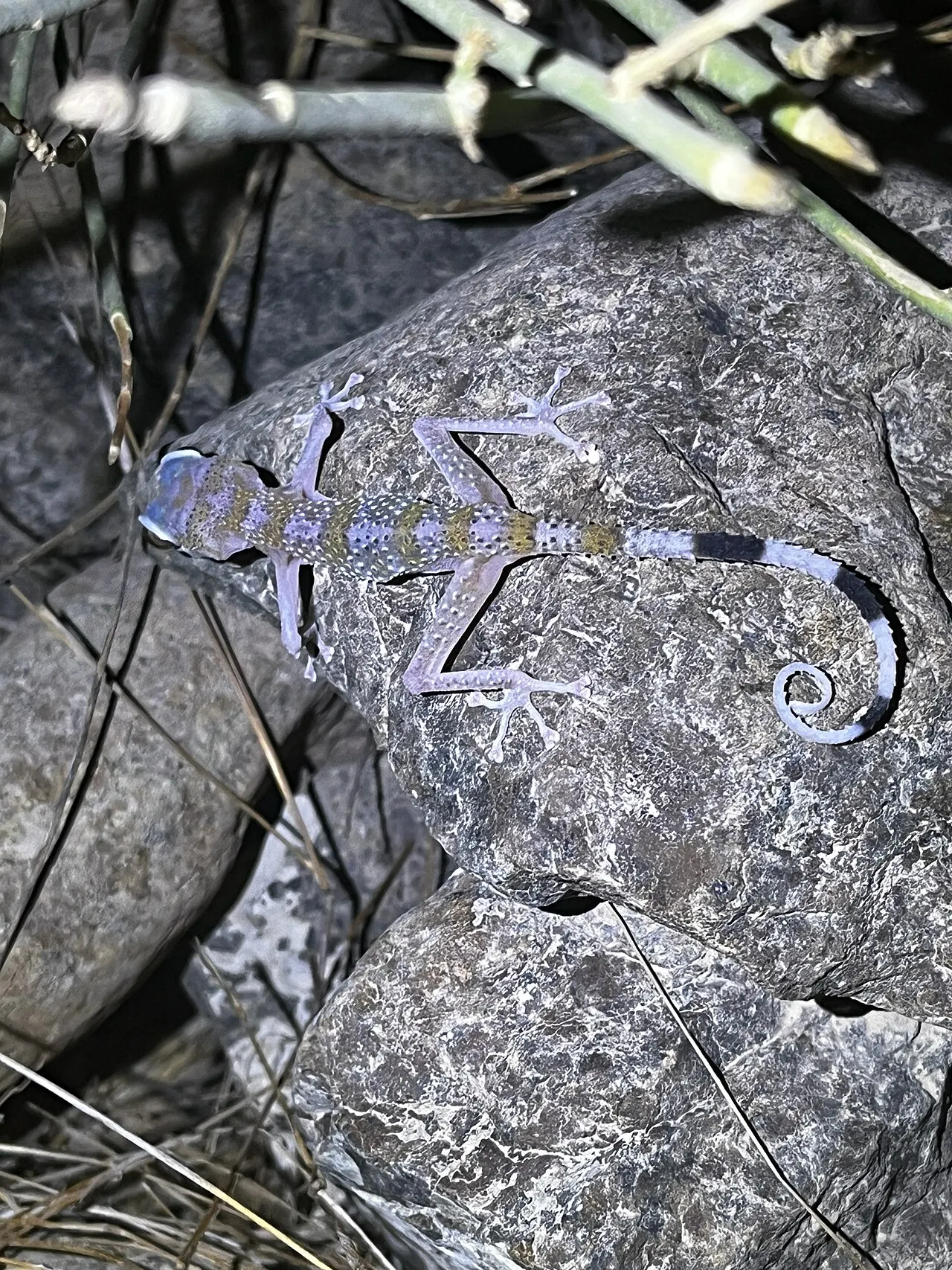
This is a medium-sized gecko, up to about 63 mm from snout to vent and around 11 cm with the tail. The body is pale and slightly translucent, with orange eyes and orange-to-brown markings on the back. The tail is whitish-ivory with four or five wide darker bands, and the tip is flattened from side to side. The gecko can coil and wave the tail. The toes carry leaf-like pads, which give the group its name, and the legs are long and thin for climbing.
Where it lives
The species is native to a small part of the Hajar Mountains in the north-east UAE, according to a 2023 news report. Its type locality is Jebel Ra's, about 2.5 km south of Khawr Fakkan, on the Gulf of Oman side. It is not recorded from Oman, which sets it apart from some relatives that range across the border.
The Red List counts a single location and gives both its extent of occurrence and its area of occupancy as about 8 square km, and at least part of the range lies in a protected area. Those figures date from an assessment made in 2018, before the 2022 survey described below. Sources also disagree on habitat: the Red List lists sea cliffs and rocky offshore islands near sea level, while news accounts describe mountain slopes.
Pins are Wikidata “endemic to” fields. Orange dots, when present, are GBIF occurrence tiles — survey bias included.
How it lives
It is nocturnal. By day it hides deep in cracks and crevices, and at night it hunts insects. It is very shy and retreats at once when a torch is shone on it. It is more active on nights with little moonlight. Females lay eggs, and reportedly only one at a time.
Why it is in trouble
Development and habitat loss have reduced numbers, according to the 2023 report. The Red List lists tourism and recreation areas, commercial and industrial development, and oil spills as threats, and records a continuing decline in the population.
In late May and early June 2022, a six-person team led by Salvador Carranza of Pompeu Fabra University in Barcelona searched the UAE's east coast over 15 nights. They found 52 adult geckos at five locations. Genome work found reduced genetic diversity, which the team linked to a severe and continuing decline. A team member warned that inbreeding could lead to an extinction vortex.
What is being done
The 2022 expedition was funded by a $9,000 grant from the Mohamed bin Zayed Species Conservation Fund and included a specialist from the Breeding Centre for Endangered Arabian Wildlife in Sharjah. Authorities were told where the geckos live so they can be considered in development plans. The Red List's recommended actions include site protection and management, habitat protection, and captive breeding and benign introduction, though no recovery plan or systematic monitoring is recorded.
Sources
Written for this catalog in our own words from the sources below, checked against them on 12 November 2026. Population figures are estimates and carry the year they were made. Status and assessment year: IUCN. 2026. The IUCN Red List of Threatened Species. Version 2026-1. iucnredlist.org.




