Endangered
Arianta chamaeleon
Arianta chamaeleon
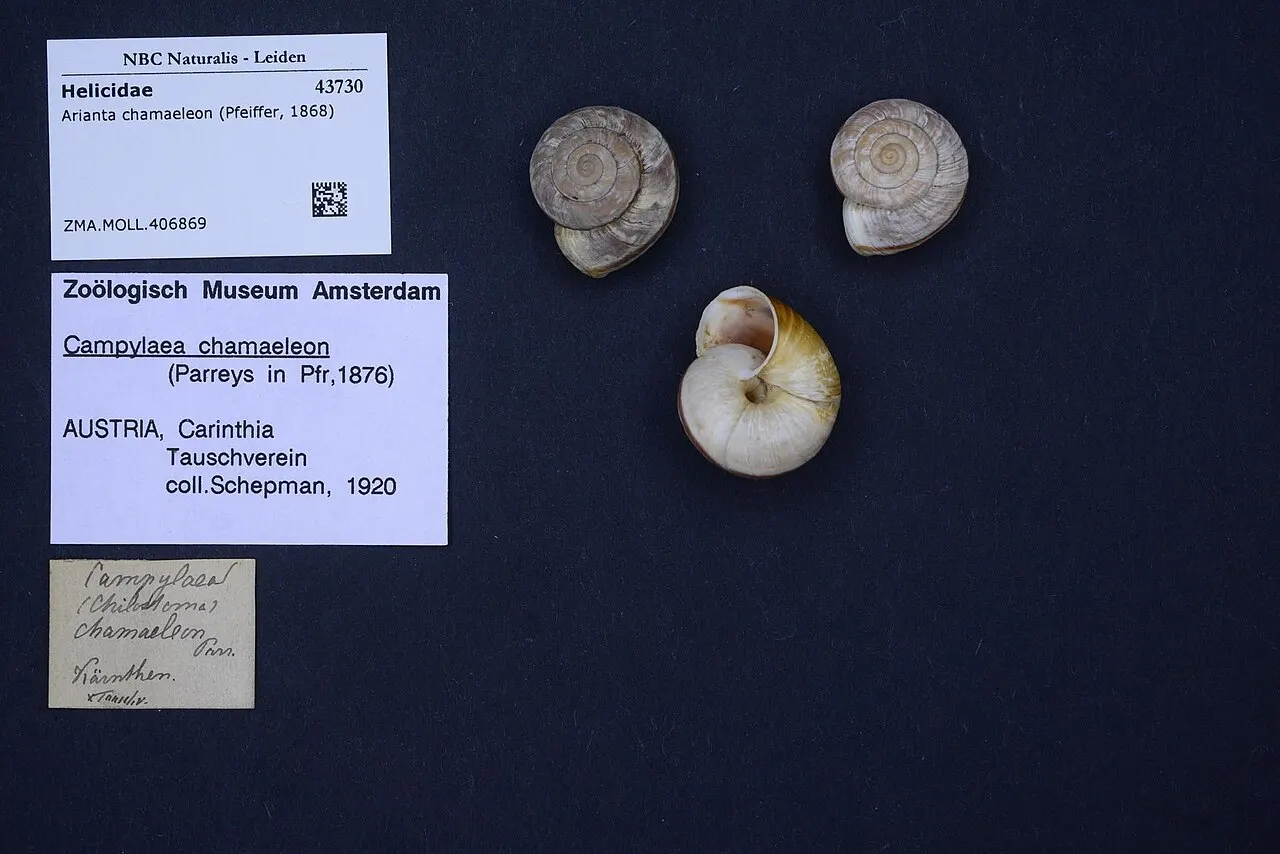
The chameleon snail (Arianta chamaeleon) is a land snail of the south-eastern Alps, with records from Austria, Slovenia and northern Italy. The IUCN Red List classed it as Endangered in 2025, with a decreasing trend. It lives on high alpine grassland and rock, where grazing and tourism are among the pressures.
Where it lives
Arianta chamaeleon belongs to the Helicidae, the family of typical land snails, and shares its genus with the much commoner copse snail (A. arbustorum). The IUCN lists it from Austria, Slovenia and Italy, and gives its habitat as temperate grassland.
Museum and survey records collected through GBIF fit that picture. In Austria, records that name a region come mostly from Carinthia, with a few from Tyrol. Those that carry an elevation range from 626 m to 2,680 m, with a middle value around 2,000 m. Slovenian records are mostly from the Julian Alps (Trenta, Bohinj, the Vršič pass, Triglav National Park), with others from the Karawanks and the Kamnik-Savinja Alps. Italian records are few, from the Julian Alps of Friuli and a site near Bergamo.
Pins are Wikidata “endemic to” fields. Orange dots, when present, are GBIF occurrence tiles — survey bias included.
How it lives
The species is little studied. A workshop at Lake Wolay in the Carnic Alps of Carinthia (about 1,950 m) in July 1995 compared it with the copse snail, which lives there too. In a 24-hour count, about 40 chameleon snails were seen on average per round against about 120 copse snails. Both species were active at similar times, with peaks around midnight and early morning.
On the rocky slope, chameleon snails were found more often on rock, while copse snails favoured plants. Groups of resting snails were mostly of one species or the other on a patchy slope, but mixed on a more uniform one. One chameleon snail was seen eating lichen and two were seen on unidentified leaves. In captivity its eggs have hard, round, white shells, unlike the soft eggs of the copse snail.
Why it is in trouble
The Endangered listing rests on criterion B2ab(iii,v): a small area of occupancy, estimated by the IUCN at 260 square kilometres within an extent of about 10,000, with continuing decline in habitat quality and in numbers of mature animals. The population is judged to be decreasing.
The threats named are farming and grazing, tourism and recreation areas, recreational activities, and habitat shifting and alteration.
What is being done
The species occurs in at least one protected area. It is not covered by international legislation or trade controls, and the IUCN assessment lists no specific conservation actions in place.
Sources
Written for this catalog in our own words from the sources below, checked against them on 12 November 2026. Population figures are estimates and carry the year they were made. Status and assessment year: IUCN. 2026. The IUCN Red List of Threatened Species. Version 2026-1. iucnredlist.org.




