Endangered
Beebe's rocket frog
Beebe's rocket frog
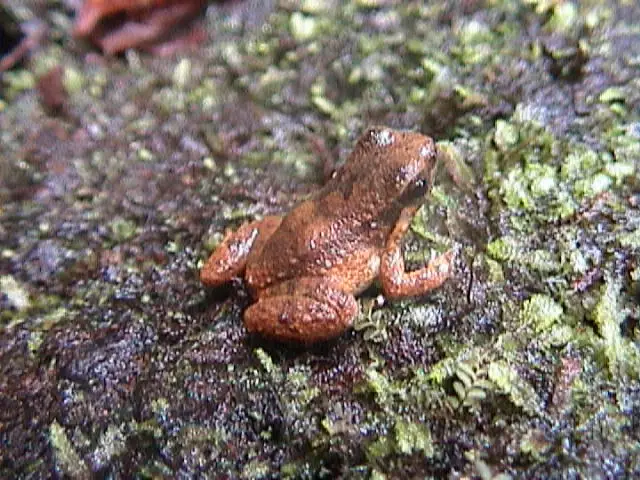
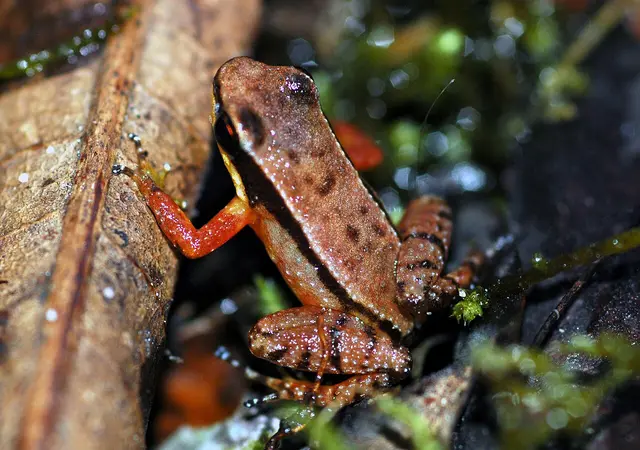
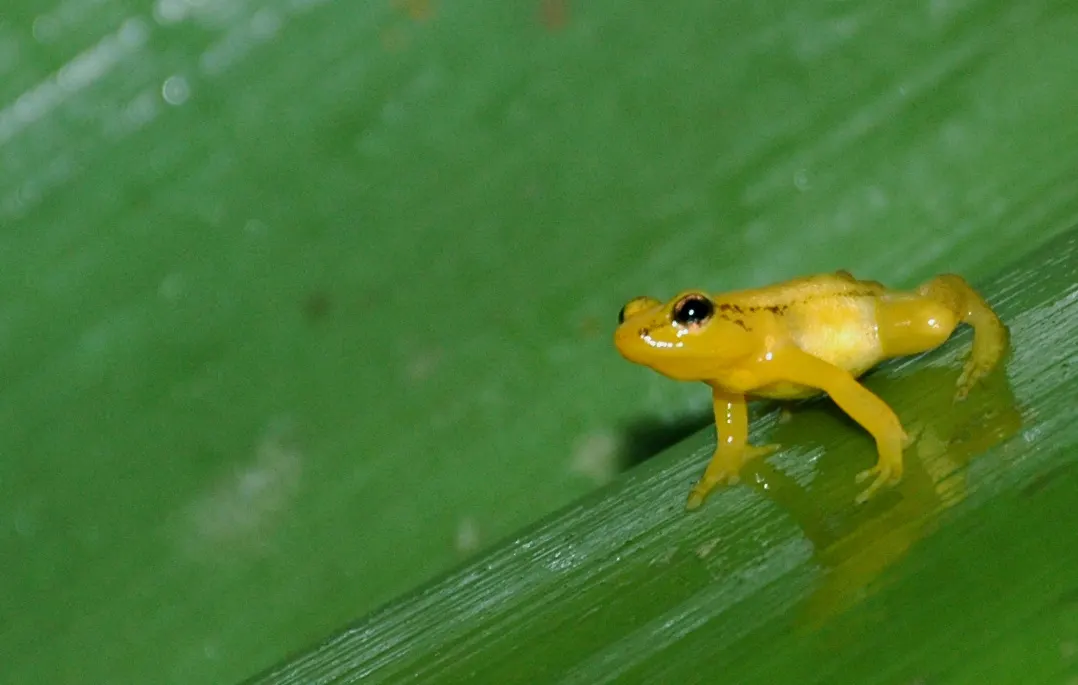
Beebe's rocket frog, also called the golden rocket frog (Beebe's rocket frog), is a tiny frog of Guyana's highlands that breeds in giant bromeliads. The IUCN Red List rated it Endangered in 2019, having listed it as Vulnerable in 2008. Females are reportedly the brighter sex, and both parents care for the young.
How to recognise it
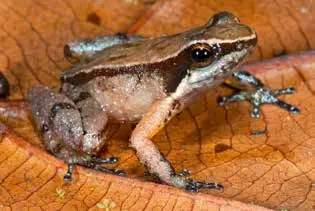
This is a very small frog. A 2018 ZooKeys description of a related species gives the largest of 18 measured male Beebe's rocket frogs as 16.8 mm from snout to vent. The skin is granular and the toes have moderate webbing at the base.
The sexes reportedly differ in colour the opposite way to most frogs: females are bright golden, while males are a duller tan with brown markings on the back, flanks and legs.
Where it lives
The species is endemic to Guyana. Its stronghold is the Kaieteur plateau in Kaieteur National Park, where a 2013 to 2017 field study found it common. The same ZooKeys paper also reports it from the Wokomung Massif and Mount Ayanganna, which fits the IUCN's elevation range of 450 to 1,600 m.
The IUCN counts three locations and puts the extent of occurrence at roughly 2,042 square kilometres. One summary reportedly gives the area it actually occupies as under 20 square kilometres. The two figures measure different things, but both describe a small range. The IUCN lists lowland and montane moist forest and moist savanna as its habitats.
Pins are Wikidata “endemic to” fields. Orange dots, when present, are GBIF occurrence tiles — survey bias included.
How it lives
The frog lives and breeds in the giant tank bromeliad Brocchinia micrantha, which grows near Kaieteur Falls. Eggs and tadpoles develop in the small pools of water that collect in the plant's leaf bases, and a study of 132 bromeliads found that parents choose different pools for egg laying and for rearing tadpoles. Pools used for laying were cooler, held less water, had more dissolved oxygen and more crabs.
Both parents care for the young. Males guard the eggs and carry tadpoles on their backs to other pools. Breeding goes on all year and peaks in the rainy season (May to July in a 2013 to 2017 study, June to August in another summary). Females reportedly lay about 4 to 6 eggs at a time.
Males defend bromeliad territories with calls. A 2012 study of recorded calls separated three types, for advertisement, courtship and aggression, each a short series of rapid pulses. Males also recognise their neighbours' calls and respond less aggressively to them than to strangers, a behaviour its close relative the Kai rocket frog lacks. Tadpoles reportedly graze algae and catch small prey, and cannibalism between tadpoles has been recorded.
Why it is in trouble
The Red List gives the population trend as decreasing and records a continuing decline in the area the frog occupies. The IUCN lists mining and quarrying and other changes to its ecosystem among the threats. No population count exists.
It breeds only in one kind of bromeliad and has a small range.
What is being done
Much of its known range lies inside a national park, and the IUCN records that it occurs in at least one protected area. The IUCN lists site and resource protection and awareness work as the relevant conservation actions.
Sources
Written for this catalog in our own words from the sources below, checked against them on 12 November 2026. Population figures are estimates and carry the year they were made. Status and assessment year: IUCN. 2026. The IUCN Red List of Threatened Species. Version 2026-1. iucnredlist.org.
- IUCN Red List assessment 2019
- Kok et al. 2018, ZooKeys 759, Anomaloglossus meansi
- bioRxiv 2020 preprint on neighbour recognition in golden and Kai rocket frogs
- Pettitt et al. 2018, Biotropica, microhabitat selection (abstract)
- Vocal repertoire of the golden rocket frog, JASA 2012 (abstract)
- Identity signaling and social recognition in a Neotropical frog, Evolution 2022 (abstract)
- Wikipedia, Beebe's rocket frog
- GBIF