Endangered
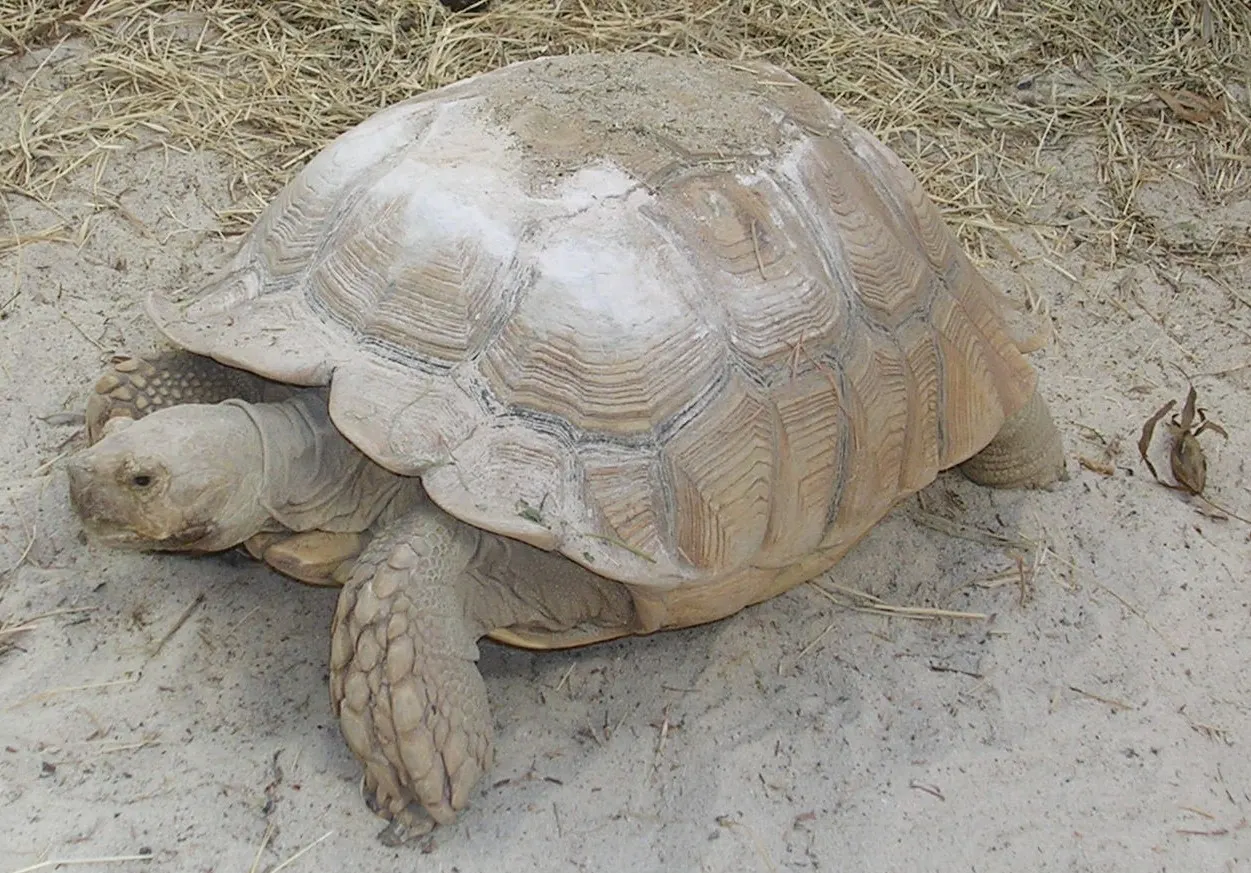
African spurred tortoise
Centrochelys sulcata
The African spurred tortoise (Centrochelys sulcata) is the largest tortoise on mainland Africa, with big males passing 100 kg. It lives along the southern edge of the Sahara and across the Sahel in dry scrub and grassland. The IUCN Red List rated it Endangered in 2021, after ongoing declines across its range.
How to recognise it
It's the biggest mainland tortoise in Africa and reportedly the third biggest in the world, behind the Galapagos and Aldabra giants. Males average about 81 kg and some top 100 kg, while females are smaller. Hatchlings are only about 44 mm long and weigh around 40 g.
It is the only living member of its genus, Centrochelys, and it is also known as the sulcata tortoise.
Where it lives
The IUCN lists it as native and present in Senegal, Mauritania, Mali, Burkina Faso, Niger, Nigeria, Chad, the Central African Republic, Sudan, Ethiopia and Eritrea, with Cameroon and Benin as possible. Records from Togo and Algeria are uncertain or possibly extinct. Saudi Arabia, Yemen, Djibouti and Somalia are listed with an uncertain origin. The overall extent of occurrence is around 6.1 million square km, but the population is severely fragmented.
The habitats are dry shrubland and dry grassland. It uses hills, stable dunes and flat ground with shrubs and grass.
Pins are Wikidata “endemic to” fields. Orange dots, when present, are GBIF occurrence tiles — survey bias included.
How it lives
Spurred tortoises dig deep burrows, reportedly up to 15 m deep, to escape the heat. They eat mostly grasses and succulents. Mating follows the rainy season, from September to November. A female may lay two or three clutches of 14 to 40 eggs, which take 90 to 120 days to hatch.
Sexual maturity comes at 10 to 15 years. The wild lifespan is unknown but is believed to be well over 75 years, and reports for captive animals range from about 54 to 70 years. The IUCN uses a generation length of 30 years.
Why it is in trouble
The IUCN estimates an ongoing reduction of 50 to 75 percent, judged from indices of abundance, from exploitation and from the loss of range and habitat quality. It says the causes are understood but not reversible. Farming and the habitat change it brings are the main drivers, with intensive farming, shifting agriculture and small-holder farming each affecting over half the population. Grazing, fire and collection affect smaller shares.
A 2018 study in Oryx, led by Fabio Petrozzi, tested three suspected causes across the West African Sahel. Places with more cattle were less likely to hold tortoises, and the effect grew worse where fire was also intense. Fire alone showed no significant effect.
The same study checked trade records from 1990 to 2010. Reported exports of wild tortoises fell from about 859 a year in the 1990s to about 49 a year after export quotas began in 2000. The researchers warned the figures should be read with caution, since about three quarters of the traded animals had no recorded country of origin. They judged livestock a greater threat than fire or trade. In the wild, adults flipped onto their backs, mostly in fights between males, are reported to be a leading cause of death because they often can't right themselves.
What is being done
The species is covered by international trade controls, occurs in at least one protected area, and is subject to captive breeding. The IUCN notes that it has been reintroduced, and lists reintroduction and captive breeding among conservation actions.
In Senegal, the organisation SOPTOM has run a reintroduction programme tied to a 1,200 hectare reserve at Katane, with a breeding nursery near Dakar. A 2018 appeal by the British Chelonia Group said funding gaps threatened to pause that work. Elsewhere in the Ferlo region, 20 tortoises were reintroduced in 2017 and 46 juveniles were transferred in 2022. Reintroduction work in Ferlo has reportedly seen about 80 percent of released animals survive.
Sources
Written for this catalog in our own words from the sources below, checked against them on 12 November 2026. Population figures are estimates and carry the year they were made. Status and assessment year: IUCN. 2026. The IUCN Red List of Threatened Species. Version 2026-1. iucnredlist.org.




