
A reader asked whether disaster relocation money can be spent to move a listed mussel bed. The October 2026 FEMA rule answers that question, and a dozen like it, with a single sentence.
What the October 2026 FEMA rule does to listed mussels
Updated 19 October 2026
An interim final rule published at 91 FR 41209 on 2 October 2026, signed by FEMA Administrator David A. Mapp under the authority of the Robert T. Stafford Disaster Relief and Emergency Assistance Act, 42 U.S.C. 5121 et seq., and 16 U.S.C. 1536, amends 44 C.F.R. part 206 to let federally declared disaster funds pay for the relocation of listed freshwater mussels and their host fish when the action is incidental to debris removal, stream restoration, or bridge replacement, and is reviewed by the U.S. Fish and Wildlife Service under section 7 of the Endangered Species Act or, for proposed species, a conference report under 16 U.S.C. 1536(a)(4). The rule, FEMA-2026-IFR-0014, takes effect on 19 November 2026 and is open for comment through 1 December 2026 under docket FEMA-2026-0014 on regulations.gov.
Why the rule exists, and why it is interim
Federal disaster spending has, for two decades, treated listed wildlife as an unavoidable cost of rebuilding. Debris removal crews in 2017 rerouted a stream in eastern Tennessee and destroyed a known population of the federally listed Appalachian elktoe (Alasmidonta raveneliana); the emergency action exemption under the Stafford Act paid for the work and the agency handled the take as an existing programmatic consultation, but the underlying programme lacked a clear line on who paid to move the animals. The October 2026 interim final rule is FEMA's attempt to draw that line for one specific group, listed freshwater mussels and their host fish, and to leave the rest of the listed wildlife world to the case-by-case approach that has governed it since the 1995 catastrophe in the Clinch River.
Interim final rules are unusual. Under 5 U.S.C. 553(b)(3)(B), FEMA is using the good cause exception to skip the notice and comment period before the rule takes effect, on the ground that delaying it would slow hurricane and flood response. The 60 day comment window that opens on 19 November 2026 is the agency's commitment to revisit the rule after the 2026 hurricane season.
The substantive change sits in a new paragraph at 44 C.F.R. 206.226(c)(5) and a new appendix to 44 C.F.R. part 206 subpart H. Together, they authorise the Public Assistance programme to fund the capture, holding, transport, and release of listed freshwater mussels and their host fish when the action is (a) incidental to a debris removal, stream restoration, bridge replacement, orculvert repair project; (b) not expected to reduce the survival or recovery of the species; and (c) reviewed by the U.S. Fish and Wildlife Service under section 7 of the Endangered Species Act or, for proposed species, addressed through a conference report under 16 U.S.C. 1536(a)(4). Where a state has an approved emergency consultation process under 50 C.F.R. 402.05, FEMA will accept that process in place of an individual section 7 review.
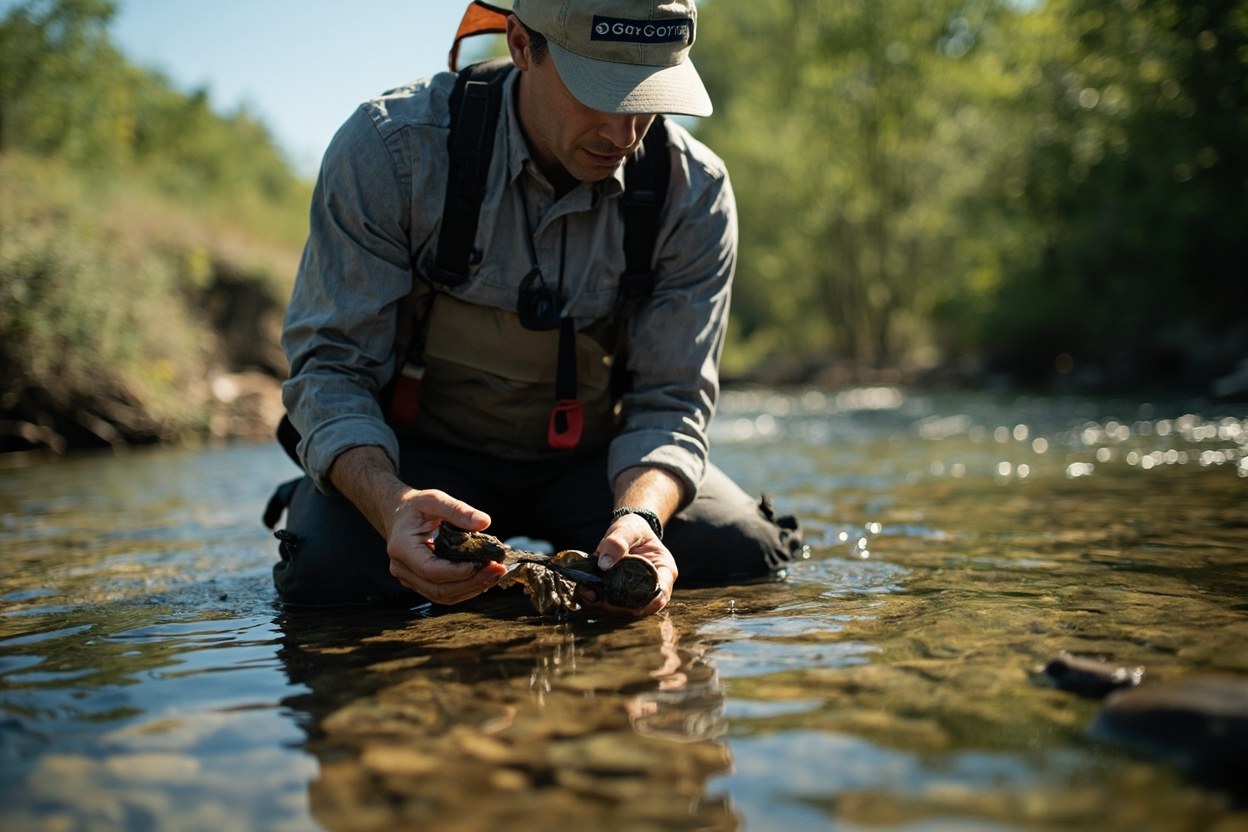
What actually changes for listed mussels in a disaster zone
Three things change on 19 November 2026, and they all sit in the same paragraph.
First, the rule names the species. Appendix 3 to 44 C.F.R. part 206 subpart H lists, as of the October 2026 update, seventy two U.S. listed freshwater mussel species and the sixteen U.S. listed fish species that act as hosts. The list is keyed to the U.S. Fish and Wildlife Service's Environmental Conservation Online System and refreshes every six months. Species added between updates, the Humphreys County mussel (Lampsilis higginsii was proposed in 2024 and listed in 2025, for example, are caught by the rule's catch all for listed species, but FEMA requires the grantee to confirm listing status through ECOS before the action begins.
Second, the rule sets the cost ceiling. Relocation costs are eligible for federal funding under section 403 of the Stafford Act, 42 U.S.C. 5170b, up to a per individual cap of $47 in 2026 dollars, adjusted annually under the Consumer Price Index for All Urban Consumers. The cap covers capture, transport, holding for up to fourteen days, and release at a site selected in consultation with the U.S. Fish and Wildlife Service and the relevant state fish and wildlife agency. Costs above the cap are the grantee's responsibility.
Third, and most consequentially, the rule tells the grantee when the action fits the Emergency Categorical Exclusion at 44 C.F.R. 46.215. The ECE applies when the action is (a) taken within ninety days of a federally declared disaster, (b) limited to the area covered by the declaration, and (c) unlikely to have a significant effect on the environment, individually or cumulatively, after mitigation. Mussels and host fish that fit the new rule's eligibility test, and that are addressed in an emergency consultation under 50 C.F.R. 402.05 or its equivalent, fit the ECE. The agency's Finding of No Significant Impact, which the interim final rule prefaces in Section IV.B of the preamble, is the document that lets a grantee move animals without an individual environmental assessment.
Where the rule stops
It stops, deliberately, at three places. It does not cover non listed species. It does not cover coral, marine invertebrates, or any listed species that is not a freshwater mussel or a mussel host fish. And it does not cover actions outside a federally declared disaster, which is a tighter test than the U.S. Fish and Wildlife Service's section 7 consultation triggers.
The first limit is the most felt. The October 2026 rule, by its terms, is a pilot. FEMA's Federal Insurance and Mitigation Administration and the U.S. Fish and Wildlife Service are running a parallel pilot on listed plant species and on listed amphibians; both are expected to publish proposed rules in 2027. The list of host fish in Appendix 3 is also narrower than the biological reality. Mussels in the families Margaritiferidae and Unionidae use a wide range of host fish, including several not listed under the Act, but the rule's funding only follows the act's listed hosts.
The second limit is jurisdictional. The interim final rule, by its own paragraph (a)(1), applies only to actions taken in the United States, the District of Columbia, the Commonwealth of Puerto Rico, the U.S. Virgin Islands, Guam, American Samoa, the Commonwealth of the Northern Mariana Islands, and the freely associated states under the Compact of Free Association, when the action is funded under the Public Assistance programme or the Hazard Mitigation Grant Programme. It does not authorise any action on tribal lands without tribal consent, and it does not authorise any action on lands held in trust for an Indian tribe without the trust responsibility review that the Bureau of Indian Affairs conducts under 25 U.S.C. 415.
The third limit is procedural. The action still has to fit the Endangered Species Act. For a listed species, the grantee has to get a section 7 consultation, an emergency consultation, or a programmatic consultation that covers the action. For a proposed species, the grantee has to get a conference report under 16 U.S.C. 1536(a)(4). For a candidate species, which is not listed but is being considered, there is no statutory hook; the rule, in paragraph (a)(6), says only that FEMA will notify the U.S. Fish and Wildlife Service when an action under the rule might affect a candidate species, and will defer to the Service's recommendations.
What this means for a state fish and wildlife agency in practice
State agencies carry most of the implementation. A hurricane in the Tennessee Valley in 2024 displaced a population of the federally listed Cumberlandian combshell (Epioblasma brevidens) when debris removal crews rerouted a stream in advance of a dam release. The Tennessee Wildlife Resources Agency handled the relocation, but the costs were split between the Federal Emergency Management Agency, the U.S. Fish and Wildlife Service, and the state, because the rule in force at the time did not name the species. Under the October 2026 rule, the same action would be eligible for full federal funding, capped at $47 per individual, on the condition that the action is reviewed under 50 C.F.R. 402.05 or its equivalent.
The practical change for state agencies is in the way they plan for disasters. The state of Kentucky's 2024 State Wildlife Action Plan, which runs through 2034, identifies thirteen listed mussel species and seven listed host fish in the Cumberland River basin, and the plan's Disaster Response Annex is, as of the October 2026 rule, the place where Kentucky's Department of Fish and Wildlife Resources would track the species that the rule covers. The Kentucky Department of Fish and Wildlife Resources has, since 2023, run a pilot with the U.S. Fish and Wildlife Service's Kentucky Ecological Services Field Office to pre clear relocations in the Cumberland River basin, and the October 2026 rule makes that pilot a programme.
For the U.S. Fish and Wildlife Service, the rule is an instruction to staff. The Southeast Region, which covers the Cumberland, Tennessee, and Coosa river basins, has, since 2022, used emergency consultations under 50 C.F.R. 402.05 to clear disaster responses that affect listed mussels. The October 2026 rule does not change the Service's consultation duties; it changes the funding source for the grantee. The Service's role is unchanged.
What the rule does not do
It does not authorise any take beyond the incidental take that the section 7 consultation already allows. It does not change the definition of take in 16 U.S.C. 1532(19). It does not change the prohibition on possession, sale, or transport in 16 U.S.C. 1538. It does not create a new exemption, exemption from section 9 of the Act, or a new permit under section 10 of the Act. It does not change the prohibition on destruction or adverse modification of critical habitat in 16 U.S.C. 1536(a)(2). It does not change the consultation requirements for federal agencies under section 7(a)(2) of the Act. It does not change the role of the U.S. Fish and Wildlife Service, the National Marine Fisheries Service, or the state fish and wildlife agencies. It is, in short, a funding rule, and its limits are the limits of the funding stream.
It also does not supersede the National Environmental Policy Act. The interim final rule's preamble, at Section IV.A, says that the rule is covered by the agency's 2018 Environmental Assessment for the Public Assistance Programme, and that no new environmental impact statement is required. The Finding of No Significant Impact, published with the rule at 91 FR 41219, is the document that the public may comment on, and the comment window is open through 1 December 2026 under docket FEMA-2026-0014.
What to watch between now and 1 December 2026
Three things.
First, the comment window. The Federal Emergency Management Agency has committed to a 60 day comment window that opens on 19 November 2026. Comments may be filed at regulations.gov under docket FEMA-2026-0014. The agency has said, in a footnote to the interim final rule's preamble, that it will consider comments on the list of species, the per individual cost cap, the eligibility test, and the use of the Emergency Categorical Exclusion.
Second, the parallel pilots. The Federal Insurance and Mitigation Administration is running a pilot on listed plant species in the Florida panhandle, and the U.S. Fish and Wildlife Service's Midwest Region is running a pilot on listed amphibians in the upper Mississippi River basin. Both pilots are expected to publish proposed rules in 2027, and the October 2026 interim final rule is, in effect, the template.
Third, the post 2026 hurricane season. The Atlantic hurricane season ends on 30 November 2026. The October 2026 rule is the first federal response instrument for the 2026 season that names a listed species, and the agency's experience with the rule through the season will be the basis for the 1 December 2026 comment response and for any final rule that follows.
Quick answers
- Does the October 2026 FEMA rule apply to all listed wildlife?
- No. The rule is limited to listed freshwater mussels and their listed host fish, and only when the action is incidental to a federally declared disaster, the action is reviewed under section 7 of the Endangered Species Act or a conference report under 16 U.S.C. 1536(a)(4), and the action fits the Emergency Categorical Exclusion at 44 C.F.R. 46.215.
- Does the rule exempt a grantee from the Endangered Species Act?
- No. The rule does not create a new exemption from section 9 of the Act, does not create a new permit under section 10 of the Act, and does not change the definition of take in 16 U.S.C. 1532(19). It authorises FEMA funding for an action that already fits the Act's consultation requirements.
- What is the per individual cost cap?
- The October 2026 rule sets the per individual cost cap at $47 in 2026 dollars, adjusted annually under the Consumer Price Index for All Urban Consumers. The cap covers capture, transport, holding for up to fourteen days, and release.
- Is the rule open for comment?
- Yes. The interim final rule takes effect on 19 November 2026 and is open for comment through 1 December 2026 under docket FEMA-2026-0014 at regulations.gov.
- Does the rule apply on tribal lands?
- The rule does not authorise any action on tribal lands without tribal consent, and does not authorise any action on lands held in trust for an Indian tribe without the trust responsibility review that the Bureau of Indian Affairs conducts under 25 U.S.C. 415.