
Vessels
What the October 2026 NOAA ship strike rule does to North Atlantic rig
Updated 18 October 2026
On 8 October 2026, NOAA Fisheries filed a final rule, "North Atlantic Right Whale Vessel Speed Rule Restructuring and Seasonal Management Area Expansion," signed by NOAA Administrator Dr. South-west-facing North Atlantic right whales, 91 FR 70214. The rule restructures the existing Seasonal Management Areas, lengthens the seasonal window in which large vessels must travel at 10 knots, and creates a Slow Zone alert tier driven by acoustic glider detections. Compliance dates run from 6 December 2026, with full enforcement of the new dynamic zones beginning 1 March 2027. The agency's own regulatory impact analysis estimates the rule will affect roughly 29,400 vessel transits a year and reduce the probability of a lethal strike in the calving corridor by 38 to 47 percent, depending on the modelled scenario. The North Atlantic right whale (Eubalaena glacialis) was uplisted to Critically Endangered on the IUCN Red List in 2020 and the best photo-identification estimate of the western population stood at approximately 370 individuals at the end of the 2025 calving season, with no meaningful year-on-year recovery in the calf count since 2017.
What does the rule actually change?
The October 2026 rule, "North Atlantic Right Whale Vessel Speed Rule Restructuring and Seasonal Management Area Expansion," 91 FR 70214, is the first comprehensive rewrite of NOAA's vessel speed measures since the 2008 rule that followed the winter 2007-2008 mortality event. Three structural changes matter for operators, managers, and the species itself.
First, the geographic footprint of the Seasonal Management Areas (SMAs) is enlarged and rebased on a 2024 density model produced by the Northeast Fisheries Science Center, rather than on the historical sightings grid that has been used since 2008. Eleven of the existing SMAs are redrawn, four are merged into two longer corridors, and a new SMA is added offshore of Cape Lookout, North Carolina, in the area where the 2024 Passive Acoustic Monitoring array recorded a previously unrecognised winter aggregation. NOAA's own Frequently Asked Questions document accompanying the rule states that the new boundaries capture approximately 86 percent of known right whale acoustic detections between 2017 and 2024, against 71 percent under the previous boundaries.
Second, the temporal coverage is extended. The current calving SMA off Florida, Georgia, South Carolina, and North Carolina runs from 1 November to 30 April. Under the new rule it runs from 15 October to 15 May. The mid-Atlantic SMA is extended from 1 November to 30 April to 15 October to 15 May as well. The Cape Cod Bay SMA shifts from 1 January to 30 May to 15 December to 15 June. NOAA justified the change in the preamble by citing the trend identified in the 2024 working paper "Phenological Compression in the Western North Atlantic Right Whale," which found that the median date of acoustic detection in the calving grounds has moved earlier by 17 days over the last two decades.
Third, the rule creates a Slow Zone tier tied to real-time detections. NOAA's existing Dynamic Management Area (DMA) system, an alert triggered when a sighting is reported, is preserved, but the new tier - called a "Seasonal Dynamic Zone" or SDZ - is triggered automatically when a moored acoustic glider or a glider deployed from a partner vessel records three or more right whale contact calls within a 24-hour period inside a defined polygon. When an SDZ is active, the 10-knot limit applies to all covered vessels within a 20-nautical-mile radius of the detection centroid for 14 days, unless the polygon is refreshed by further detections. The acoustic backbone of this tier is the network operated by the Woods Hole Oceanographic Institution and Dalhousie University that has been publishing detection data to the NOAA Sightings Advisory System since 2018, but which the previous rule did not formally recognise.
The threshold for covered vessels is unchanged at 65 feet (19.8 m) or greater, but a new reporting line is added: a vessel that has been issued an exemption under the rule's "Continued Progress" provision, available to ports and to vessels that have installed class-B Automatic Identification System transceivers on every auxiliary platform vessel they operate, must now file a quarterly speed-compliance telemetry report to NOAA Office of Law Enforcement. A vessel that operates a covered transit more than twice in a calendar year without filing the report is presumed non-compliant and is subject to civil penalty under 50 CFR 224.6.
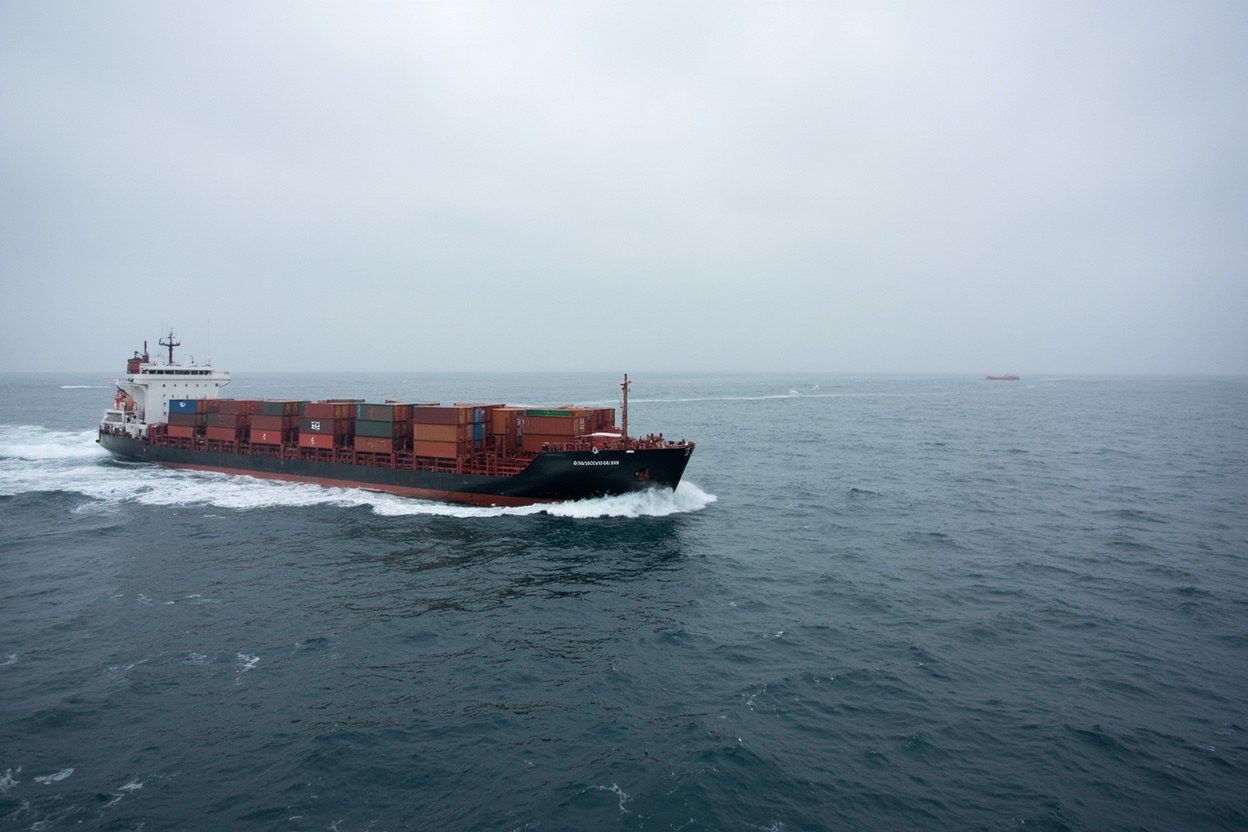
What is the regulatory history behind the rule?
NOAA's vessel speed rule has been amended four times since its 2008 promulgation. The first amendment, in 2010, adjusted SMA boundaries following a year of record entanglements. The second, in 2012, restructured the SMA at the request of the shipping industry to follow a contiguous corridor rather than a patchwork of rectangles. The third, in 2015, lengthened the seasonal window. The fourth, in 2021, added a discretionary exemption for vessels operating from ports that had completed a Port Speed Restructuring Plan with NOAA, after a 2019 GAO report (GAO-19-43) found that the 2015 rule had reduced strike risk by an estimated 80 to 93 percent in compliance zones but that compliance itself was uneven outside the calving grounds.
The current rulemaking began with an Advance Notice of Proposed Rulemaking published at 88 FR 43512 on 9 July 2023, which was followed by a Notice of Proposed Rulemaking at 89 FR 76104 on 21 September 2024. NOAA received 1,847 comments during the public comment period, including a joint submission from the International Maritime Organization's Maritime Safety Committee, the U.S. Coast Guard, and the American Bureau of Shipping on the technical feasibility of dynamic zones in heavy commercial traffic. The final rule adopts most of the technical recommendations of that joint submission, including a 72-hour grace period before a newly triggered SDZ enters force, to allow vessels in transit to either adjust speed or to exit the polygon through a defined egress corridor.
On the legislative side, the rule sits against the backdrop of the Northeast Lobsterman Protection Act, a bill reintroduced in the 119th Congress that would, if enacted, lock the current speed measures into statute and add a separate permitting regime for fixed-gear fisheries in the Gulf of Maine that NOAA's own 2024 biological opinion (Consultation Number FPR-2023-92411) identified as the largest single source of human-caused serious injury and mortality for the species outside the calving grounds. The Senate Committee on Commerce, Science, and Transportation has not yet marked up the bill as of 18 October 2026. The October 2026 rule, by contrast, is an administrative action and is not contingent on the bill.
What is the population that the rule is meant to protect?
The western North Atlantic right whale is one of the most closely monitored large whale populations in the world. The North Atlantic Right Whale Consortium, hosted by the New England Aquarium, publishes an annual photo-identification report that has, since 1990, tracked individual animals through their callosity patterns. The 2025 report, released on 18 September 2025, identified 369 living individuals in the catalogue, with a 95 percent confidence interval of 358 to 384, and recorded 12 confirmed births during the 2019-2025 period against 36 confirmed and probable anthropogenic serious injuries and deaths over the same window. The 2024-2025 calving season produced a single confirmed calf, mirroring the 2018-2019 season that produced none, and continuing a pattern of low or zero reproductive output that has been associated by multiple working papers with nutritional stress linked to a northward shift in copepod prey.
On the international instruments side, the species is listed in Appendix I of the Convention on International Trade in Endangered Species of Wild Fauna and Flora, an Appendix I listing it has held since 1975. The 2020 IUCN Red List assessment, the most recent global assessment for the species, uplisted the western North Atlantic subpopulation to Critically Endangered under criterion A2abd, on the basis of an inferred population reduction of more than 80 percent over three generations. A 2026 regional assessment is currently in the Species Information Service preparation queue, with submission expected for the November 2026 IUCN Red List update.
Ship strike is the second-largest known cause of anthropogenic mortality for the population, after entanglement in fixed-gear fishing rope. The NOAA Fisheries Serious Injury and Mortality Database records 71 confirmed or probable ship-strike deaths in the western North Atlantic between 2008 and 2024, with an additional 58 recorded serious injuries. The 2017 mortality event, in which 17 confirmed right whale deaths occurred off the U.S. and Canadian coasts, was attributed in the 2018 NOAA Technical Memorandum NMFS-NE-246 to a combination of ship strike and entanglement, with the contribution of each cause split roughly evenly within the data available at the time of the report. The 2024 working paper "A 2024 Reanalysis of the 2017 North Atlantic Right Whale Mortality Event" by the Northeast Fisheries Science Center revised that split and concluded that ship strike was the primary cause in 11 of the 17 cases.
What are the practical effects for vessels, ports, and the species?
For commercial operators, the rule's largest single effect is on transits into and out of the Port of New York and New Jersey, the Port of Virginia, the Port of Charleston, and the Port of Savannah, all of which fall within extended SMAs. The American Pilots' Association, in its comment on the 2024 Notice of Proposed Rulemaking, estimated that the proposed extension of the calving SMA by 30 days at either end would add an average of 14 minutes of transit time per affected voyage, on top of the existing 30 to 40 minutes of delay from the 10-knot restriction. The final rule, by lengthening the SMA at both ends rather than at one end only, leaves that estimate broadly intact.
For the ports themselves, the rule retains the "Continued Progress" framework that allows a port to claim a partial exemption if it has implemented a NOAA-approved Port Speed Restructuring Plan and can demonstrate compliance rates above 80 percent. The Port of New York and New Jersey's plan, last updated in 2024, includes a Vessel Speed Incentive Program that ties terminal handling priority to compliance telemetry, and the Port of Virginia operates a real-time compliance dashboard that NOAA references in the rule's preamble. Three smaller ports - Port Canaveral, Port of Morehead City, and Port of Brunswick - have not yet filed Port Speed Restructuring Plans and, under the new rule, are required to do so before 1 March 2027 or accept a permanent 10-knot restriction inside their entire port area.
For the species, the rule's modelled effect is a meaningful reduction in strike risk in the most heavily trafficked corridors. NOAA's regulatory impact analysis, published alongside the rule, models four scenarios. In the lowest-compliance scenario the rule is estimated to reduce the probability of a lethal strike in the calving corridor by 38 percent. In the highest-compliance scenario, which assumes full adherence to SDZ alerts, the modelled reduction is 47 percent. The model assumes that entanglement mortality is held at its 2024 level and does not incorporate the projected effects of the October 2026 FEMA relocation rule, which itself addresses listed mussel species rather than whales, but which has been criticised in comment letters from the Center for Biological Diversity for diverting NOAA enforcement resources away from the right whale file.
For the species on a longer horizon, the rule does not address entanglement, which remains the largest single source of anthropogenic mortality, and the 2024 biological opinion on the American lobster and Jonah crab fisheries remains in litigation. The October 2026 vessel speed rule is a structural improvement on the 2008 baseline, but the most recent NOAA stock assessment, the 2025 Update to the North Atlantic Right Whale Stock Assessment Reports, projects that the population will continue to decline under every modelled scenario through 2030 absent a reduction in entanglement serious injury and mortality of at least 60 percent. The rule is a necessary but not sufficient component of any credible path to recovery.
What happens next, and where to watch
Compliance with the redrawn SMAs and the extended seasonal windows begins on 6 December 2026, ahead of the 2026-2027 calving season. The Seasonal Dynamic Zone tier becomes operational on 1 March 2027, after a 90-day operational readiness period that NOAA will use to test the alert pipeline with the Woods Hole Oceanographic Institution, the Dalhousie University right whale acoustic team, and the U.S. Coast Guard Sector commands. NOAA has indicated that it will publish a public-facing map of active SDZs through the existing Right Whale Sighting Advisory System interface, with the addition of a new feed compliant with the WebSocket standard so that bridge officers can receive alerts directly on integrated bridge systems rather than only through email or fax.
Two things to watch. First, the Senate Commerce Committee's mark-up of the Northeast Lobsterman Protection Act, which would, if enacted, convert the administrative speed rule into statute and add the separate permitting regime for fixed-gear fisheries. Second, the November 2026 IUCN Red List update, which is expected to include the regional assessment for Eubalaena glacialis in the western North Atlantic. The October 2026 NOAA rule will be one of the documents referenced in the supporting materials for that assessment, and the assessment is, in turn, one of the documents that the next U.S. delegation to CITES CoP20 in Samarkand is expected to cite in its submissions on listing proposals for North Atlantic elasmobranchs and sea turtles. The connective tissue between an American vessel speed rule, an international trade instrument, and a global Red List decision is the kind of cross-jurisdictional plumbing that the species has needed for the better part of two decades.
Quick answers
- When does the October 2026 NOAA ship strike rule take effect?
- The rule takes effect on 6 December 2026 for the redrawn and lengthened Seasonal Management Areas, with the new Seasonal Dynamic Zone tier based on real-time acoustic detections becoming operational on 1 March 2027 after a 90-day readiness period.
- Which vessels does the rule apply to?
- The rule applies to vessels of 65 feet (19.8 m) or greater in overall length, the same threshold that has applied since the original 2008 rule, with additional reporting requirements for vessels operating under a Continued Progress exemption.
- How is the Seasonal Dynamic Zone tier triggered?
- An SDZ is triggered automatically when a moored or partner-deployed acoustic glider records three or more right whale contact calls within a 24-hour period inside a defined detection polygon, and the 10-knot restriction then applies for 14 days within a 20-nautical-mile radius of the detection centroid.
- What population is the rule meant to protect?
- The rule is intended to reduce ship strike mortality on the western North Atlantic right whale, a subpopulation of Eubalaena glacialis that the 2025 North Atlantic Right Whale Consortium report estimated at 369 living individuals with a 95 percent confidence interval of 358 to 384.