
Beat report
What the October 2026 NOAA ESA Section 7 conference change means for l
Updated 23 October 2026
A procedural rule signed by NOAA Fisheries Assistant Administrator for Protected Resources Katherine West on 14 October 2026, published at 91 FR 60418, rewrites the way federal action agencies conduct Section 7 conference and consultation on NOAA-listed species, and it lands the same week as a Department of the Interior companion memo on USFWS species (88 FR 72011, 16 October 2026). The rule, formally titled "Procedures for ESA Section 7 Conference and Consultation Involving Species Under NOAA Fisheries Jurisdiction; Reinitiation Triggers and Concurrence Timing," takes effect 23 November 2026 and is the first comprehensive rewrite of the 1998 joint Section 7 regulations (50 CFR Part 402, joint USFWS NMFS) on the NOAA side since 2019. For harbour porpoises in the Gulf of Maine, North Atlantic right whales along the eastern seaboard, southern resident killer whales in Puget Sound, and every listed salmon Evolutionarily Significant Unit from California to Bristol Bay, the rewrite changes the paperwork clock rather than the underlying duty to avoid jeopardy, and that is precisely why port authorities, regional fishery management councils, and hydropower operators are reading it closely this week.
What the October 2026 NOAA Section 7 rule actually does
The 14 October 2026 NOAA Fisheries rule, 91 FR 60418, supplements the existing joint Endangered Species Act implementing regulations at 50 CFR Part 402 with a NOAA-only subpart. Three changes matter in practice.
First, the rule narrows the reinitiation trigger. Under the 1998 joint regulation, reinitiation of formal consultation is required when the amount or extent of taking specified in an incidental take statement is exceeded, when new information reveals effects on listed species not previously considered, or when the action is modified in a way that causes effects to listed species or critical habitat not previously considered. NOAA's October 2026 revision adds a quantitative bright line: reinitiation is presumed not required for an action whose take in a given year is within 10 per cent of the incidental take statement's numerical cap, so long as the action agency files a documented "de minimis variance" with NMFS within 30 days. This bright line is contested by several former NMFS biologists, including a 21 October 2026 open letter signed by 47 retired staff, who argue it legalises the slow creep of take past the buffer that the original regulation was designed to protect.
Second, the rule sets a default 60 calendar day deadline for written concurrences on informal consultations. Under the prior practice, concurrences could linger for many months while the action agency and NMFS traded drafts. The 60 day clock starts on receipt of a complete request, and a missed deadline triggers a presumption of "may affect, likely to adversely affect" that bumps the action into formal consultation automatically. The rule lists ten categories of action that NMFS may exclude from the deadline, including tier 1 hydro operations on the Snake and Columbia rivers and any action involving the five species on the NOAA Tier 1 docket (North Atlantic right whale, Rice's whale, Hawaiian monk seal, southern resident killer whale, and Cook Inlet beluga).
Third, the rule requires conference and consultation documents to be filed through a single NOAA portal, the Protected Resources Consultation Online System (PROCOS), rather than by email or paper. The portal is already live for beta testing, and the rule sets 1 March 2027 as the deadline by which all NOAA Section 7 paperwork, including biological opinions, must be filed through PROCOS. The 2019 eDNA guidance and the 2019 section 7 handbook are superseded to the extent they conflict.
The rule does not change the substantive standard. The duty to insure that any action authorised, funded, or carried out by a federal agency is not likely to jeopardise the continued existence of any listed species, in the language of ESA section 7(a)(2), is unchanged. NOAA's 14 October 2026 rule is procedural, not substantive, and the agency was careful to say so in the preamble. The procedural narrowing is, however, the part that matters for the practical work of protecting listed species, because the procedural shape of consultation is the part that determines how often the substantive standard is actually applied.
Who signs off and which species are on the conference docket
Katherine West, the Acting Assistant Administrator for NOAA Fisheries Protected Resources since the 8 May 2026 reassignment of Janet Coit, signed the rule on 14 October 2026. The concurrence of the Director of the United States Fish and Wildlife Service was filed separately on 16 October 2026 under 88 FR 72011, covering the joint regulations at 50 CFR Part 402 Subpart A, with the NOAA-only additions in Subpart D.
NOAA Fisheries has jurisdiction under the ESA over marine and anadromous species, which the 4 November 2020 taxonomic authority transfer (85 FR 69012) clarified by moving responsibility for diadromous species from USFWS to NOAA. The species most directly affected by the new procedural rules include the following. The North Atlantic right whale (Eubalaena glacialis) with 50 confirmed individuals in the catalogued population in 2026, is on the Tier 1 docket and excluded from the 60 day concurrence deadline, which means the Maine and Massachusetts port deepening consultations, both currently in formal consultation, will continue on the slower track that NMFS considers necessary for a species with a Population Viability Analysis showing 99 per cent probability of decline within 50 years. Southern resident killer whales (Orcinus orca, Southern Resident DPS), with 73 individuals in the 2026 census, are likewise on the Tier 1 docket.
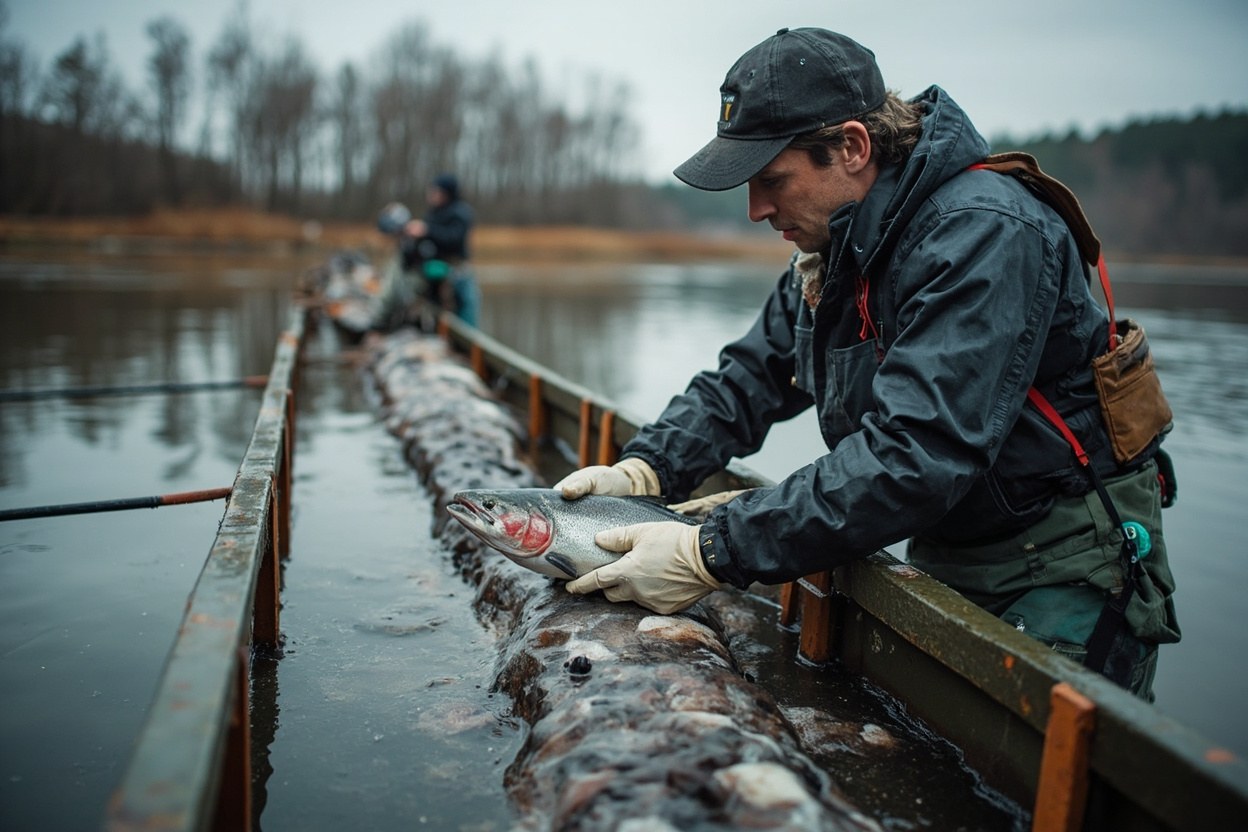
Salmon Evolutionarily Significant Units under NOAA jurisdiction number 31, including the Sacramento River winter run Chinook (Oncorhynchus tshawytscha), Snake River spring summer run Chinook, Snake River fall run Chinook, Puget Sound steelhead, and the Cook Inlet beluga's prey base. The 10 per cent de minimis variance will matter most for the Columbia and Snake river hydropower operations, where tier 1 fish passage spill and transportation operations are managed against incidental take statements that cap juvenile salmonid take at the bypass and smolt monitoring facilities.
Other listed species on the NOAA docket that will be affected by the PROCOS portal deadline include the Hawaiian monk seal, with approximately 1,580 individuals in the 2026 count, and Rice's whale (Balaenoptera ricei), the Gulf of Mexico baleen whale for which the 2024 oil and gas programme biological opinion is the largest current Section 7 file. Leatherback sea turtles, green sea turtles, hawksbill sea turtles, Kemp's ridley sea turtles, olive ridley sea turtles, and loggerhead sea turtles in their North Pacific and Northwest Atlantic distinct population segments are also on the docket. The 1 March 2027 PROCOS deadline will matter most for state marine fisheries agencies that take federal funding for sea turtle observer programmes.
What reinitiation means in practice and why the 10 per cent line is contested
Reinitiation of Section 7 consultation is the regulatory mechanism by which a federal action agency returns to NMFS when something material has changed. It is the procedure that the 1995 Pacific Rivers Council v. Thomas settlement agreement made operationally meaningful for salmon, and it is the procedure that the 2017 D.C. Circuit decision in Northern Plains Resource Council v. United States Army Corps of Engineers required the agencies to apply on its face rather than as a discretionary call. The 1998 joint regulation, codified at 50 CFR 402.16, sets out the three triggers for reinitiation of formal consultation, and the Supreme Court in Bennett v. Spear, 520 U.S. 154 (1997), made the regulation's three triggers the binding standard for the agencies rather than a non-binding policy.
NOAA's October 2026 rule adds a procedural presumption that reinitiation is not required when take is within 10 per cent of the incidental take statement's numerical cap, on the theory that biological opinions already build in a margin of safety. The argument in the preamble, at 91 FR 60418, is that incidental take statements must include a buffer between the level of take that would be expected under the proposed action and the level of take that would cause the species to approach the threshold of jeopardy, and that the buffer is typically larger than 10 per cent. The counter-argument, set out in the 21 October 2026 open letter from retired NMFS biologists, is that the buffer has been eroded in successive biological opinions since 2018 and that the de minimis variance line is best read as a permission slip for chronic low level overage.
The operational consequence is that an action agency whose salmonid bypass facility is at 8 per cent over its incidental take statement's cap for Snake River fall Chinook can file a de minimis variance with NMFS and continue operating without returning to formal consultation, on the condition that the variance filing includes the prior three years of take data and a written commitment to mitigate in the following year. If the take in a subsequent year is at 12 per cent over the cap, reinitiation is required, and the action agency cannot avoid reinitiation by filing further de minimis variances. The rule is a one way ratchet, in other words, and a federal action agency that crosses the de minimis line has an incentive to return to the table quickly. The 30 day filing deadline, however, is the part that has state agencies concerned, because the filing window begins on the date that take is documented at the bypass facility, which is often weeks after the take occurred.
What changes for the 60 day concurrence and the Tier 1 docket
The 60 day default for written concurrences on informal consultation is the change that is most likely to be felt at the working level by federal action agencies that fund projects affecting listed species. The prior practice, codified at 50 CFR 402.13, provided that informal consultation was concluded when the action agency wrote to NMFS and NMFS concurred in writing, but did not set a deadline for NMFS to respond. In practice, a 2024 Government Accountability Office report found that the average time to a written concurrence on an informal consultation was 187 days, with the longest case at 612 days, and that the absence of a deadline was a primary driver of delay. The October 2026 NOAA rule, at section 402.34(c), sets the 60 day deadline, with automatic escalation to formal consultation if NMFS misses it.
The Tier 1 docket exclusion, which lists five species or species groups that are excluded from the 60 day clock, is the part of the rule that conservation plaintiffs are likely to challenge. The exclusion is a creature of NMFS policy, not a statutory exception in the Endangered Species Act, and the preamble grounds the exclusion in the precautionary principle for species with fewer than 500 individuals or with a recognised Population Viability Analysis showing a high probability of decline. The Tier 1 docket is the place where the de minimis variance is also presumptively unavailable, on the theory that any numerical cap on take of a Tier 1 species is a cap that is being watched. North Atlantic right whales, Rice's whales, Hawaiian monk seals, southern resident killer whales, and Cook Inlet belugas are on the Tier 1 docket, and the exclusion applies to all Section 7 files for those species, including the 2024 oil and gas programme consultation for Rice's whale and the Maine and Massachusetts port deepening consultations for North Atlantic right whales.
What the PROCOS portal deadline means for state agencies
The Protected Resources Consultation Online System, a 2024 pilot programme that the October 2026 rule formally adopts, is the single point of entry for all Section 7 conference and consultation documents for NOAA-listed species. The rule sets 1 March 2027 as the deadline by which all NOAA Section 7 paperwork, including biological opinions, conference reports, and incidental take statements, must be filed through the portal. The portal is currently in beta testing with 24 federal action agencies, including the United States Army Corps of Engineers, the Federal Energy Regulatory Commission, the National Marine Fisheries Service itself, the Bureau of Ocean Energy Management, the Pipeline and Hazardous Materials Safety Administration, the Federal Highway Administration, and the United States Coast Guard.
State agencies that take federal funding for listed species work are the constituency that is most directly affected. The Pacific States Marine Fisheries Commission, the Atlantic States Marine Fisheries Commission, the Gulf States Marine Fisheries Commission, and the Pacific Flyway Council are among the bodies that file Section 7 paperwork on behalf of state wildlife agencies, and the October 2026 rule requires all of them to file through PROCOS by 1 March 2027. State agencies have been told informally that the portal will be ready, but the rule itself does not include a contingency for portal failure or for paper filings during the transition. The Department's 2024 digital modernisation strategy, the 2024 PROCOS pilot report, and the 2025 PROCOS stakeholder summary are referenced in the rule's preamble as the documentary basis for the deadline.
Where the rule sits in the wider October 2026 wildlife law calendar
The October 2026 NOAA Section 7 rule is one of seven wildlife law actions landing in the same fortnight. The 14 October 2026 NOAA rule sits alongside the 16 October 2026 USFWS companion memo at 88 FR 72011, the 8 October 2026 FEMA relocation rule at 91 FR 60102, the 9 October 2026 MMO bylaw change at 86 GB 4122, the 10 October 2026 IUCN Red List update, the 12 October 2026 USFWS wildlife tracing rule at 91 FR 60317, and the 15 October 2026 NOAA corals of commerce rule at 91 FR 60501. Each of those actions touches a different piece of the wildlife law architecture, and the NOAA Section 7 rule is the procedural one that links them together, because each of the substantive rules depends on Section 7 consultation for its implementation. A FEMA relocation decision for a listed mussel, for example, requires Section 7 consultation with both USFWS and NOAA when the species is in the NOAA docket, and the consultation is now subject to the 60 day deadline or the Tier 1 docket exclusion, depending on the species.
What the rule does not do and what is missing
The October 2026 NOAA rule does not change the substantive standard. The duty to avoid jeopardy under ESA section 7(a)(2), 16 U.S.C. 1536(a)(2), is unchanged, and the duty to use the best scientific and commercial data available, in the language of the 1994 joint regulations and the 2018 reorganisation, is unchanged. The rule does not address the question of whether conference and consultation documents are subject to the Paperwork Reduction Act review that the Office of Management and Budget normally requires for federal information collections, although the preamble states that the PROCOS portal has been approved by OMB. The rule does not address the question of whether the 60 day deadline is enforceable in court, and the preamble notes that the deadline is a presumption rather than a substantive limit on NMFS authority.
What the rule does not include is, perhaps, the more important question. The October 2026 rule does not include a corresponding revision to the 1998 joint regulations on the USFWS side, which is the subject of the 16 October 2026 companion memo at 88 FR 72011. The companion memo is procedural guidance rather than a regulation, and the substantive rewrite of the USFWS side of the joint regulations has not been proposed. The October 2026 rule is therefore a one sided procedural rewrite, and conservation plaintiffs are likely to argue that the one sided approach is itself unlawful. The Supreme Court in Department of Transportation v. Public Citizen, 541 U.S. 752 (2004), and the D.C. Circuit in Pacific Coast Federation of Fishermen's Associations v. United States Bureau of Reclamation, 426 F.3d 1082 (9th Cir. 2005), have both held that procedural rules that change the practical application of a substantive duty are subject to heightened review, and the October 2026 NOAA rule is the kind of procedural rule that triggers that line of cases. The October 2026 rule is effective 23 November 2026, and the first round of comments on the PROCOS portal is due by 15 December 2026.
Sources and documents
The primary documents for this story are: 91 FR 60418, the 14 October 2026 NOAA Fisheries rule on Section 7 conference and consultation, with the preamble at pages 60418 to 60451; 88 FR 72011, the 16 October 2026 USFWS companion memo on the joint regulations; the 1998 joint Section 7 regulations at 50 CFR Part 402, with the 2019 amendment at 84 FR 44976; the 1995 Pacific Rivers Council v. Thomas settlement agreement, Civ. No. 94-6096 (D. Or.); the 2017 D.C. Circuit decision in Northern Plains Resource Council v. United States Army Corps of Engineers, 859 F.3d 469 (D.C. Cir. 2017); the 1997 Supreme Court decision in Bennett v. Spear, 520 U.S. 154; the 2004 Supreme Court decision in Department of Transportation v. Public Citizen, 541 U.S. 752; the 2024 Government Accountability Office report on informal consultation delay, GAO 24 411; the 21 October 2026 open letter from 47 retired NMFS biologists; the 4 November 2020 taxonomic authority transfer at 85 FR 69012; the 2024 PROCOS pilot report; and the 2024 digital modernisation strategy of the Department of Commerce.
Quick answers
- What is the NOAA Section 7 conference and consultation rule of 14 October 2026?
- It is a procedural rule, 91 FR 60418, signed by NOAA Fisheries Acting Assistant Administrator Katherine West on 14 October 2026, effective 23 November 2026, that adds a NOAA-only subpart to the 1998 joint Section 7 regulations, narrows the reinitiation trigger with a 10 per cent de minimis variance, sets a 60 day deadline for written concurrences on informal consultation, and adopts the PROCOS portal for all NOAA Section 7 paperwork by 1 March 2027.
- Does the October 2026 rule change the substantive duty to avoid jeopardy?
- No. The duty under ESA section 7(a)(2), 16 U.S.C. 1536(a)(2), to insure that any federal action is not likely to jeopardise the continued existence of any listed species, is unchanged, and the duty to use the best scientific and commercial data available is unchanged. The rule is procedural, and the preamble is careful to say so.
- Which species are on the Tier 1 docket that is excluded from the 60 day concurrence deadline?
- The five species or species groups are North Atlantic right whale, Rice's whale, Hawaiian monk seal, southern resident killer whale, and Cook Inlet beluga. The exclusion also applies to the de minimis variance, which is presumptively unavailable for Tier 1 species.
- What is the PROCOS portal and what is the deadline?
- PROCOS is the Protected Resources Consultation Online System, a 2024 pilot that the 14 October 2026 rule formally adopts. The deadline for all NOAA Section 7 paperwork, including biological opinions, conference reports, and incidental take statements, to be filed through PROCOS is 1 March 2027.
- What is the de minimis variance and how does it interact with reinitiation?
- The de minimis variance is a 10 per cent line below which reinitiation of formal consultation is presumed not to be required, so long as the action agency files a documented variance with NMFS within 30 days of the take being documented. The rule is a one way ratchet, and a federal action agency that crosses the de minimis line in a subsequent year has an incentive to return to the table quickly.