Critically Endangered
Zingel balcanicus
Zingel balcanicus
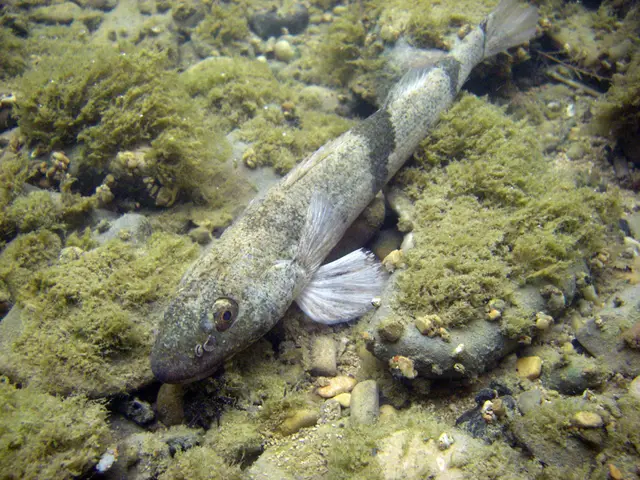
The Vardar streber (Zingel balcanicus) is a small, bottom-living perch relative found only in the Vardar River system of North Macedonia. The IUCN Red List rated it Critically Endangered in 2024. Its known range is tiny, and a 2012 survey found it in just one stretch of one tributary, the Treska.
How to recognise it
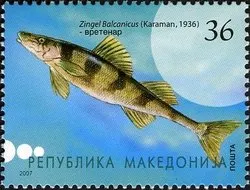
It's an elongated, bottom-dwelling member of the perch family (Percidae) in the genus Zingel. Karaman first recorded the fish in the Vardar in 1937 as a subspecies of the streber, and it was later raised to a full species. The largest recorded fish measured 15.5 cm standard length.
Fish biologists tell it apart from its relatives by counts rather than colour. The first dorsal fin has 7 to 9 spines, the second has 2 simple and 10 to 12 branched rays, there are roughly 73 to 83 scales along the lateral line, and the cheek is either scaleless or has a single short row of 2 to 6 scales behind the eye.
Where it lives
The streber is endemic to the Vardar, known as the Axios in Greece. It has been recorded in the middle Vardar from near Smokvica to near Siricino, and in the Treska tributary up to Makedonski Brod. Whether it reaches the lower river in Greece is uncertain. FishBase says it has not been recorded there, and the IUCN lists its Greek presence as uncertain.
A nationwide search in 2012 found it in only one isolated stretch of the Treska, after about 30 years without a recorded study. The IUCN assessment treats the species as a single subpopulation at a single location, with an estimated area of occupancy of 8 and an extent of occurrence of 117 (square km, the IUCN's standard unit).
Pins are Wikidata “endemic to” fields. Orange dots, when present, are GBIF occurrence tiles — survey bias included.
How it lives
Little has been written about its biology. It is a bottom-dweller that reportedly lives in flowing, well-oxygenated water over gravel and stones, and feeds on small invertebrates. The IUCN lists it as not migratory and as congregating in groups year-round.
Why it is in trouble
The IUCN assessment lists several pressures on the river: sewage, nutrient pollution, mining and quarrying, small dams, sediment from soil erosion, and herbicides and pesticides. Sewage and nutrient loads are recorded as ongoing, and sewage is thought to affect more than 90 percent of the range. Large dams and other channel changes are listed as past impacts unlikely to return. Introduced rainbow trout have also been named as a threat.
The population trend is unknown, and no systematic monitoring scheme is in place, but the area of habitat is still declining. With every fish in one subpopulation, a local pollution problem could reach much of the species.
What is being done
A Global Environment Facility small grant paid for a project in North Macedonia from March 2014 to April 2015, run by the Macedonian Fishing Federation with university departments. It aimed to breed the fish in captivity and reintroduce the offspring to the Treska and other places in the Vardar where it had been recorded. Several fish were caught and kept, residents and fishing association members were trained, and an information brochure was printed.
The IUCN, however, records no recovery plan, monitoring scheme, ex-situ population or successful reintroduction. It does note that the species occurs in at least one protected area.
Sources
Written for this catalog in our own words from the sources below, checked against them on 12 November 2026. Population figures are estimates and carry the year they were made. Status and assessment year: IUCN. 2026. The IUCN Red List of Threatened Species. Version 2026-1. iucnredlist.org.