Endangered
Zingel asper
Zingel asper
The Rhône apron (Zingel asper) is a slim, nocturnal bottom-dweller found only in the Rhône basin of France and Switzerland. The IUCN Red List assessed it as Endangered in 2024. Its few remaining populations are separated by weirs and dams, and one reintroduction in the Drôme has not lasted.
How to recognise it
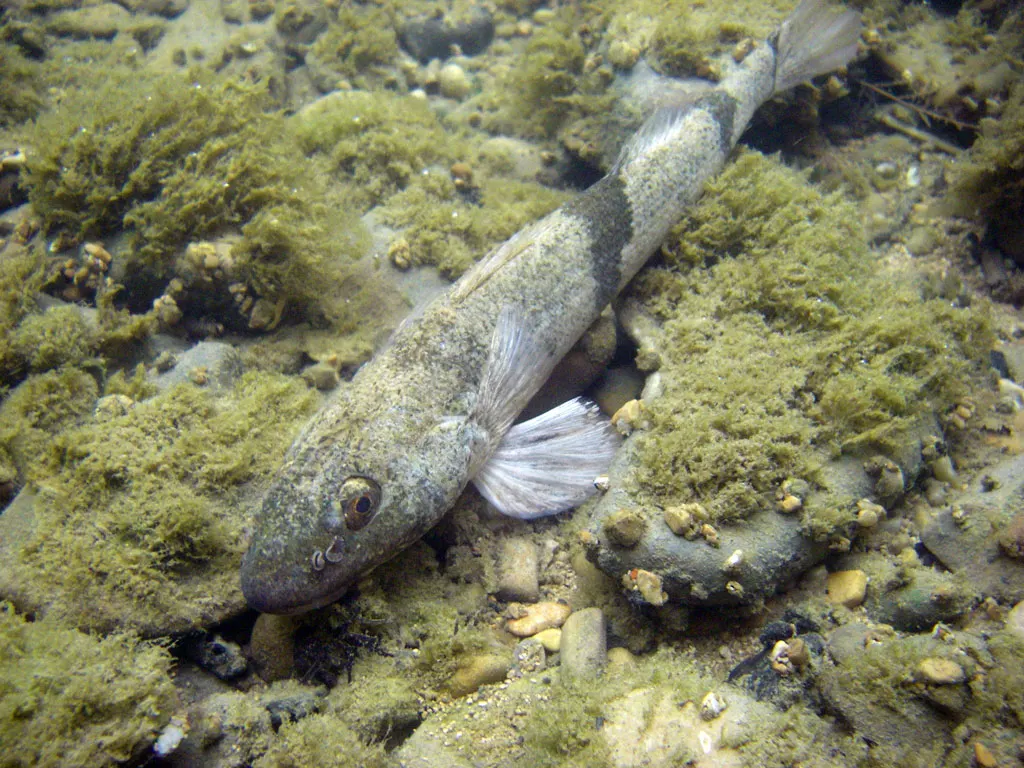
The Rhône apron is a small relative of the perch, usually 13 to 20 cm long as an adult, though FishBase lists a maximum of 22 cm. Its body is slender, with a flattened, widening head, a rounded snout and a mouth set underneath. Colour runs from yellowish brown to pale grey, marked with three or four dark bands. The body is covered in rough, spiny scales, which make the fish feel unusually abrasive, and the thick pelvic fins let it prop itself on the stream bed.
Where it lives
The apron lives in fast, shallow stretches of clean rivers, over gravel and stone. In 1900 it is thought to have occupied about 1,700 km of river (a European LIFE project figure) or 2,200 km (the French national action plan). By the 1980s only 380 km were still occupied. The LIFE project, which ended in 2010, estimated 2,000 to 4,000 fish split into genetically isolated groups.
The two largest populations are in the Durance and the Ardèche basins in southern France, with others in the Verdon, the Loue and the Swiss Doubs. On the Beaume, a tributary of the Ardèche, counts over a 13 km stretch fell from around 1,500 fish in spring 2002 to under 100 in autumn 2004, a sign of how sharply numbers can swing. The Swiss Doubs holds very few animals: in 2018 surveyors from Goumois to Bellefontaine saw a single fish. A 2017 DNA survey in the same area picked up a very faint signal at three of eight sites.
Pins are Wikidata “endemic to” fields. Orange dots, when present, are GBIF occurrence tiles — survey bias included.
How it lives
By day it rests on the bed, and it feeds at dusk and after dark, picking aquatic invertebrates off the stones. The mayfly Baetis fuscatus and flat-bodied insect larvae of the family Heptageniidae are its main prey. It is a weak swimmer, and a 5 cm step or a drop of more than 15 cm can stop it.
It spawns on gravel riffles, where eggs stick to the stones, and a female can lay between 300 and 2,000 eggs depending on her size. FishBase gives a hatching time of about two weeks at 13°C. It is short-lived, averaging three to four years in most populations, although in the Verdon gorges adults of five to seven years have been found.
Why it is in trouble
Barriers are a big part of it. Weirs and dams split the fish into groups that rarely exchange genes, and one of them, the Verdon population, has been cut off from the Durance since 1866. The IUCN lists dams, gravel extraction, silt, pesticides, nutrient and sewage pollution, water abstraction and recreation among the threats. The assessment (criterion B2ab(iii,iv,v)) records five locations, a decreasing population and a continuing decline in range.
What is being done
France has a national action plan for the species, and the IUCN notes a recovery plan and a monitoring scheme are in place. Fish passes designed for the apron's weak swimming have been fitted at weirs on the Ardèche and elsewhere. After the Lanas weir on the Ardèche was fitted with one in 2009, the fish gained about 15 km of river. It has also been seen every year in the Chassezac since 2015, though in small numbers.
Between 2006 and 2009 about 1,700 captive-bred fish were released into the Drôme, after the museum in Besançon first bred the species in captivity. Survival was good two years on, but the Drôme population is now recorded as extinct.
Sources
Written for this catalog in our own words from the sources below, checked against them on 12 November 2026. Population figures are estimates and carry the year they were made. Status and assessment year: IUCN. 2026. The IUCN Red List of Threatened Species. Version 2026-1. iucnredlist.org.