Endangered
Yunganastes bisignatus
Yunganastes bisignatus
Yunganastes bisignatus is a small forest frog known only from the Yungas slopes of La Paz Department, Bolivia, at about 1,850 to 2,700 m. The IUCN Red List rated it Endangered in 2020. It is reported to be abundant at its type locality, but it lives in very few places and its forest is shrinking.
How to recognise it
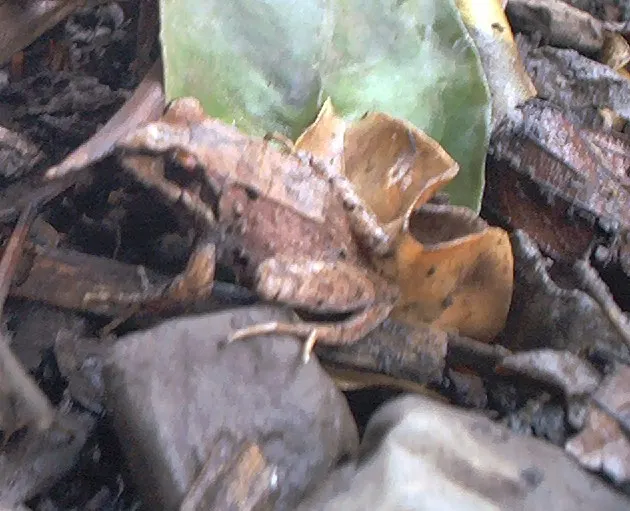
Adult males measure 28 to 35 mm from snout to vent. The only female measured was 47 mm. The head is wider than long, with a short snout, and the eardrum is visible but partly hidden by a prominent fold above it.
The back is dark reddish brown, with paler cream-toned flanks and a narrow dark band running from the snout tip to the eye. The belly is cream, and the throat is densely marked with fine grey mottling. The toes carry small to moderately enlarged discs, with no webbing or fringes.
Where it lives
The species is endemic to Bolivia. It is recorded between the Inquisivi and Nor Yungas provinces of La Paz Department, in tropical and subtropical moist montane forest. The IUCN counts one to five locations and puts the elevation range at 1,850 to 2,700 m. It is not a migrant.
It occurs inside Cotapata National Park and Integrated Management Natural Area, which gives part of its range formal protection.
Pins are Wikidata “endemic to” fields. Orange dots, when present, are GBIF occurrence tiles — survey bias included.
How it lives
This frog is active by day, though males are heard calling at night. They call from low perches, 0.3 to 0.6 m up on tree trunks and bushes, and will also call by day when the weather is foggy and rainy.
Its taxonomic history is tangled. Werner described it in 1899 as a variety of another frog, Hylodes gollmeri. It was later moved through Eleutherodactylus and Pristimantis, and for a time it was treated as a synonym of Pristimantis fenestratus. It is now accepted as a valid species in its own genus.
Why it is in trouble
The IUCN lists the population as decreasing, with the area of suitable forest still shrinking. The threats it records include small-holder farming, mining and quarrying, drought, more frequent and intense fires, water being drawn from streams for farming, and unintentional deaths linked to subsistence harvesting.
A 2017 conservation report from the Critical Ecosystem Partnership Fund also pointed to forested slopes being converted to coca crops.
What is being done
The IUCN lists site and area management as a conservation action, and part of the frog's range lies inside Cotapata National Park and Integrated Management Natural Area. A search reported in March 2017 found the frog had not been recorded in the wild since 2006. A team from the Bolivian group BIOTA, led by three herpetologists, searched Cotapata and the Coroico area. They recorded seven calls in Cotapata and found one frog near Coroico, the first known record there.
The CEPF report adds that some local communities are drawing up water-management rules and creating new protected areas.
Sources
Written for this catalog in our own words from the sources below, checked against them on 12 November 2026. Population figures are estimates and carry the year they were made. Status and assessment year: IUCN. 2026. The IUCN Red List of Threatened Species. Version 2026-1. iucnredlist.org.




