Critically Endangered
Yellow Shiner
Notropis calientis
The yellow shiner (Notropis calientis, also placed in Aztecula) is a tiny minnow native to the western Mexican Plateau. It lives in springs, spring-fed lakes and small mountain streams. The IUCN assessed it as Critically Endangered in 2019, citing an estimated 82 percent decline linked to habitat loss.
How to recognise it
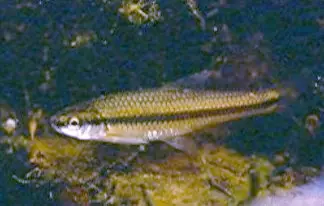
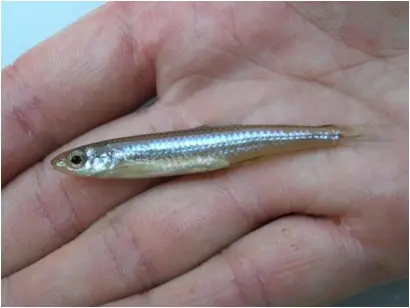
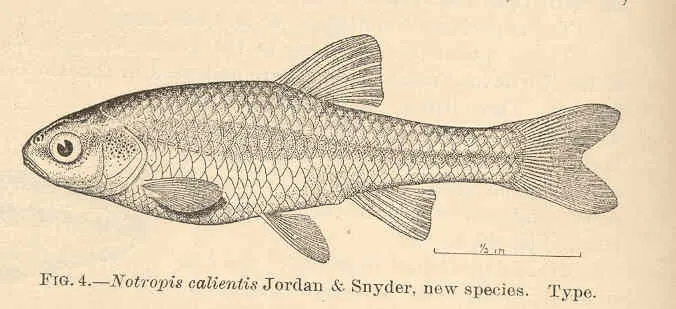
It is a small, deep-bodied minnow that reaches about 5 centimetres at most (FishBase gives 3.8 centimetres standard length). The back is brown, the belly silvery, and a dark band runs from snout to tail base. Females are larger, deeper-bodied and darker than males. In the breeding season males turn a brilliant golden yellow, which gives the species its name. The lateral line is short and incomplete.
Taxonomists have moved the species between genera. FishBase lists it as Aztecula calientis. It forms a species complex with the Ameca shiner and the Durango shiner, which is now extinct.
Where it lives
The species is endemic to Mexico. It is recorded from the Lerma, Grande de Santiago and Pánuco river systems and the Lake Cuitzeo basin. The Red List assessment names the states of Jalisco and Nayarit and estimates the extent of its range at about 74,000 square kilometres.
Its habitats include permanent freshwater marshes and pools, lakes, streams and rivers, and also artificial ponds and reservoirs. At least one population lives inside a protected area.
Pins are Wikidata “endemic to” fields. Orange dots, when present, are GBIF occurrence tiles — survey bias included.
How it lives
Very little has been written about its daily life. Age, diet, growth, movements and breeding are poorly documented, and the assessment lists its movement pattern as unknown. The Red List gives a generation length of 2.5 to 3 years, so generations turn over quickly.
Why it is in trouble
The 2019 assessment estimates a reduction of about 82 percent, attributed to shrinking and degraded habitat, with the decline continuing. Threats recorded include commercial and industrial development and housing around the waters it uses. Habitat in parts of its range degraded heavily during the 20th century.
Introduced fish add to the problem. Guppies, tilapia, sunfish and black bass are named as predators of the shiner, and various birds also take it.
What is being done
Few conservation measures are recorded. The assessment lists a recovery plan, a monitoring scheme and captive breeding as unknown, and the species has no international trade controls.
Sources
Written for this catalog in our own words from the sources below, checked against them on 12 November 2026. Population figures are estimates and carry the year they were made. Status and assessment year: IUCN. 2026. The IUCN Red List of Threatened Species. Version 2026-1. iucnredlist.org.