Endangered
Palezone Shiner
Notropis albizonatus
The palezone shiner (Notropis albizonatus, now placed by some authorities in Miniellus) is a slender minnow of clear upland streams in the eastern United States. Only two populations remain, in Alabama and Kentucky. The IUCN Red List assessed it as Endangered in 2013, and it has been federally listed since 1993.
How to recognise it
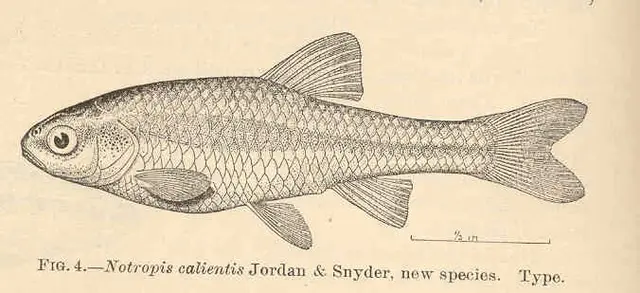
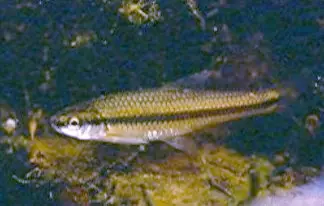
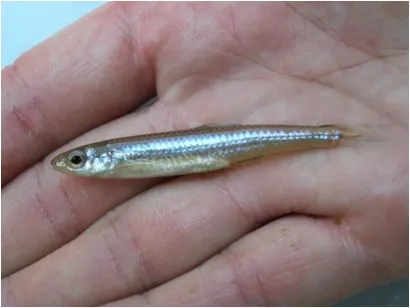
This is a small, slender fish, 30 to 60 mm long as an adult, with a pointed snout and large eyes. A dark band runs from the snout to the tail, and a pale stripe above it gives the fish its name. There is a small dark spot at the base of the tail. The only breeding colour is a faint yellow wash at the base of the pectoral fin rays.
Most individuals live three to four years, going by early studies. Fish of about 35 to 40 mm are old enough to breed.
A fish that was known before it was named
Ichthyologists had known of this minnow for more than 20 years as an undescribed relative of the swallowtail shiner. Carl Hubbs recognised it as distinct from a single specimen collected in Cove Creek, Tennessee, and R. E. Jenkins reached the same view independently from Little South Fork material. It was finally described in 1994 by Melvin Warren and Brooks Burr.
Where it lives
Two disjunct populations survive. One lives in the Little South Fork of the Cumberland River in Kentucky, over a stream reach of about 49 km. The other lives in the upper Paint Rock River system in Alabama, a Tennessee River tributary, over about 40.5 km of the Paint Rock and tributaries such as Hurricane Creek, Estill Fork and Larkin Fork.
It once occurred in three other places. Single old specimens from Marrowbone Creek in Kentucky (1947), Cove Creek in Tennessee (1936) and the Tennessee River at Guntersville Reservoir in Alabama (1972) are the basis for treating it as gone from those waters.
Pins are Wikidata “endemic to” fields. Orange dots, when present, are GBIF occurrence tiles — survey bias included.
How it lives
The palezone shiner favours flowing pools and runs of upland streams with permanent flow, clear water and bottoms of bedrock, cobble, pebble and gravel mixed with clean sand. Gut studies in Kentucky showed it feeds mostly on fly larvae, with some crustaceans and other small animals, picking at sand, gravel and algae tufts. Spawning falls in late spring and early summer, from about mid-May to early July, with a peak in June, though spawning itself has never been watched.
Why it is in trouble
A 2020 federal review described the species' status as stable, but with a restricted range and continuing threats. Counts in the Paint Rock are low, with a study published in 2013 finding 150 fish at 25 sites, so the population there is probably small. In the Little South Fork, a 1998 survey counted 398 fish at nine of 42 sites.
Threats have changed over time but remain. In Kentucky they include legacy coal mining, oil and gas wells (over 500 in the watershed), cattle in the stream, and off-road vehicles. In Alabama they include sediment and nutrients from farming, logging and unpaved roads, and the channelling of upper streams in the 1960s. Dams and mining also appear in the IUCN assessment.
What is being done
The fish was listed as endangered under the US Endangered Species Act on 27 April 1993, and a recovery plan followed in 1997, revised in 2019. In Kentucky, part of the Little South Fork is a state Wild River, and about 3,327 acres have been secured in its watershed. The Nature Conservancy has run roughly 40 restoration projects in the Paint Rock since 2002 and holds over 12,000 hectares there. Two further populations are needed before delisting, and partners are to consider reintroducing the fish to other streams.
Sources
Written for this catalog in our own words from the sources below, checked against them on 12 November 2026. Population figures are estimates and carry the year they were made. Status and assessment year: IUCN. 2026. The IUCN Red List of Threatened Species. Version 2026-1. iucnredlist.org.