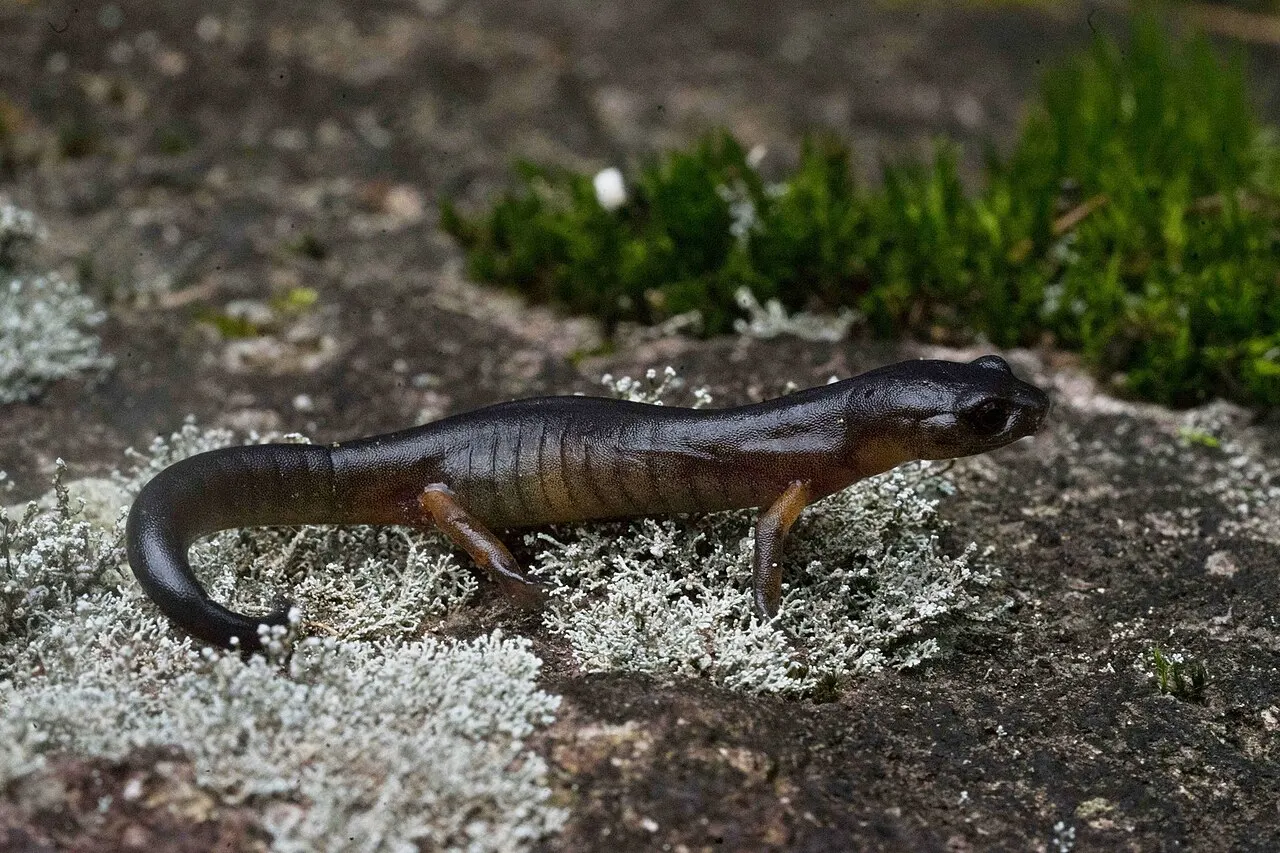
Endangered
Yellow-legged mushroomtongue salamander
Bolitoglossa flavimembris
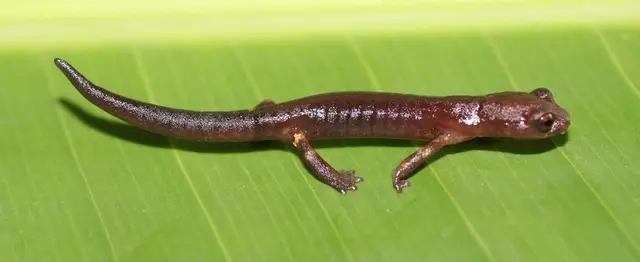
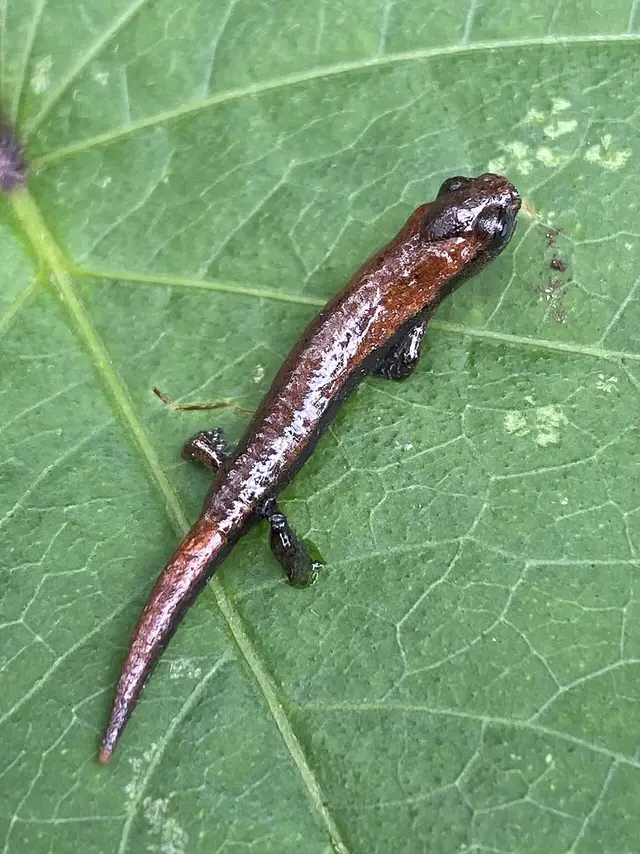
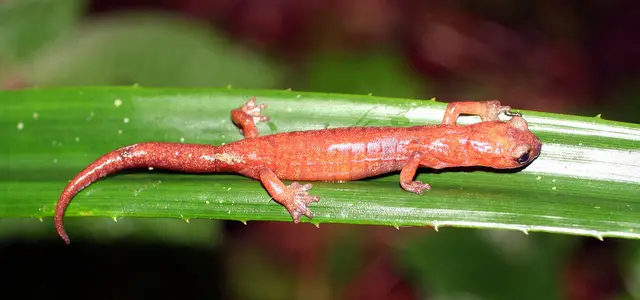
The yellow-legged mushroomtongue salamander (Bolitoglossa flavimembris) is a stout, tawny salamander with bright yellow limbs, living in cloud and pine-oak forest on the volcanoes of southwestern Guatemala and the far south of Chiapas, Mexico. The IUCN rated it Endangered in 2020, with a decreasing population.
How to recognise it
This is a large, heavy-bodied salamander. It was described in 1936 by the American zoologist Karl P. Schmidt, who noted a uniform tawny grey back, bright yellow limbs and dark feet, with broadly webbed fingers and toes. The tail is shorter than the body. His type specimen measured 99 mm from snout to vent with a 43 mm tail, and ten further specimens ranged from 50 mm to 115 mm.
The yellow limbs against the dark feet are the easy mark. Schmidt compared it with a smaller highland species, Oedipus morio (now Bolitoglossa morio), which has shorter webbing but often has yellow-spotted limbs, though not the uniform colour of this one.
Where it lives
Schmidt's type specimen came from Volcan Tajumulco in San Marcos, Guatemala, at 7,200 feet (about 2,200 m), collected in March 1934. The IUCN lists the species from Guatemala and the Mexican state of Chiapas, at elevations between 1,500 and 2,950 m. Within Guatemala it is known from the volcanoes along the southwestern highlands (Atitlan, Tajumulco and Tacana), and in Mexico from the slopes of Tacana. Its extent of occurrence is only about 2,753 square kilometres, and the assessment counts 1 to 5 locations. Among the 288 records in the GBIF database, 218 are from Guatemala and 67 from Mexico.
Some references describe its habitat as lowland moist forest. The IUCN and the original description both point to highland forest instead, and the IUCN lists moist montane forest as its only habitat.
Pins are Wikidata “endemic to” fields. Orange dots, when present, are GBIF occurrence tiles — survey bias included.
How it lives
Schmidt found this salamander on land rather than in the bromeliads that other salamanders on Tajumulco use. His specimens were all taken beneath stones or logs along a trail between 7,000 and 7,500 feet, and he saw the constant humidity of the cloud forest as the reason salamanders thrive there. The IUCN describes it differently, as living in vegetation (rarely in bromeliads) and under the bark of logs, in pine-oak and cloud forest, and says it does not occur in disturbed habitats. It breeds by direct development, so it does not need open water.
The IUCN treats it as non-migratory. The genus as a whole is made up of lungless salamanders that can shoot out the tongue to catch prey and shed the tail to escape a predator, though little has been written about this species' diet or breeding.
Why it is in trouble
The IUCN records a continuing decline in the area it occupies and describes severe forest loss to farming (including slash and burn), logging and settlement as the main threat, with expanding coffee plantations a particular concern in Guatemala. The structured threat list names housing and urban areas, small-holder farming and grazing, drought, herbicides and pesticides, and the unintended effects of small-scale harvesting, each scored as low impact so far.
A future threat is the salamander-eating chytrid fungus Batrachochytrium salamandrivorans, which has not been confirmed in the Americas. The IUCN scores it as a possible future threat across more than 90 percent of the range, which it identifies as highly suitable for the fungus.
What is being done
The species occurs in at least one protected area, the Refugio del Quetzal in San Marcos, where a conservation project is run by the Instituto de Historia Natural of Chiapas. It is listed under Mexican law in the Special Protection category. The IUCN lists site management, site and habitat protection and control of invasive species as actions needed, along with surveillance for the fungus, and research into its population size and trends. No recovery programme specific to this salamander is documented.
Sources
Written for this catalog in our own words from the sources below, checked against them on 12 November 2026. Population figures are estimates and carry the year they were made. Status and assessment year: IUCN. 2026. The IUCN Red List of Threatened Species. Version 2026-1. iucnredlist.org.