Endangered
Yellow-banded Ringlet
Erebia flavofasciata
The yellow-banded ringlet (Erebia flavofasciata) is a small brown mountain butterfly of the central Alps, recorded in Switzerland, Italy and Austria. The IUCN Red List listed it as Endangered in 2025, with a decreasing population. A broad pale yellow band across the underside of the hindwing gives it away.
How to recognise it
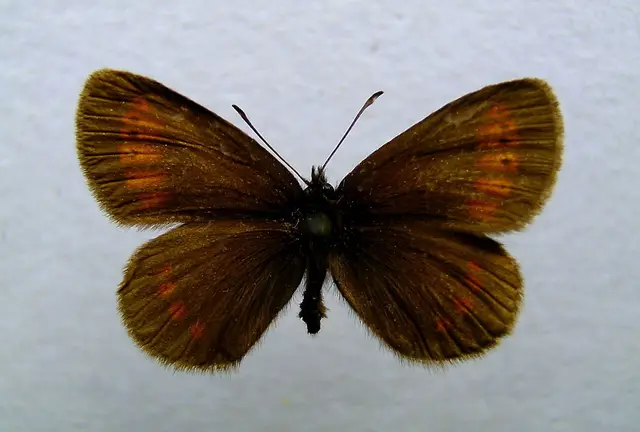
It is a modest butterfly, listed at about 28 to 36 mm across. The upperside is dark brown, with a narrow russet-brown band near the wing edge broken into spots, each carrying a small black dot. Females are noticeably paler than males.
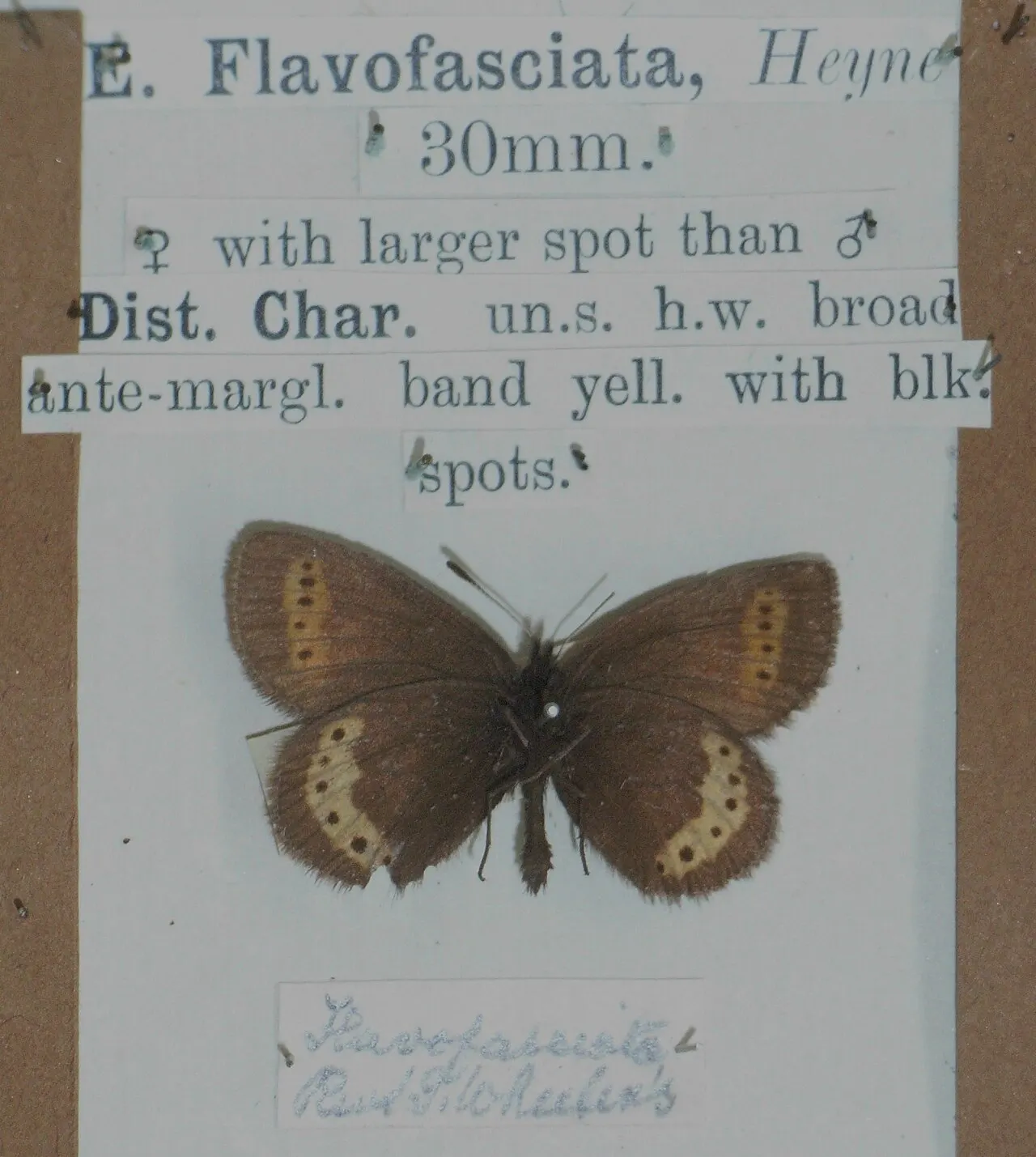
The underside is the giveaway. The hindwing is brownish grey with a wide straw-yellow band and a row of black dots, striking enough to identify the butterfly before it has even settled. In the Engadine a darker local form (named thiemei) was described long ago.
Where it lives
The first specimens were collected in July 1893 near the Campolungo Pass above Fusio, in the Ticino Alps of Switzerland, and the species was described by Heyne in 1895. It was later found around Pontresina in the upper Engadine. Today the IUCN lists it as native to Switzerland, Italy and Austria.
It lives on steep, sunny alpine grassland above the tree line. Published altitude ranges differ a little, from about 1,700 to 2,600 m in one European butterfly database, while the IUCN gives 1,400 to 2,800 m. The IUCN estimates its extent of occurrence at about 4,800 square kilometres, but the area it actually occupies is only about 340 square kilometres.
Pins are Wikidata “endemic to” fields. Orange dots, when present, are GBIF occurrence tiles — survey bias included.
How it lives
Adults feed on nectar in tall, flower-rich grassland. Females lay their eggs singly, settling low in shorter, grassy patches and dropping each egg to the ground. The caterpillars feed on sheep's fescue (Festuca ovina) and hibernate twice, so growth takes more than one year. Some older descriptions list the host plant as unknown.
Published sources give no firm flight period.
Why it is in trouble
The IUCN rates it Endangered because its range is small, split into fragments and shrinking. It records the main threat as habitat shifting and alteration, with conversion and degradation of its grassland as the stresses, though it says the reasons for the decline are not well known. Habitat loss, changes in agriculture and climate change are the likely causes.
The 2025 assessment records the population as decreasing and severely fragmented, with continuing decline in the area it occupies. In Italy the butterfly can be abundant where habitat suits it, but its habitat is deteriorating with climate change. No population count exists.
What is being done
The species occurs in at least one protected area. The IUCN lists site and area protection, site management and awareness work as the conservation actions needed. It is not covered by international legislation or trade controls.
Sources
Written for this catalog in our own words from the sources below, checked against them on 12 November 2026. Population figures are estimates and carry the year they were made. Status and assessment year: IUCN. 2026. The IUCN Red List of Threatened Species. Version 2026-1. iucnredlist.org.