Endangered
Xylotoles costatus
Xylotoles costatus
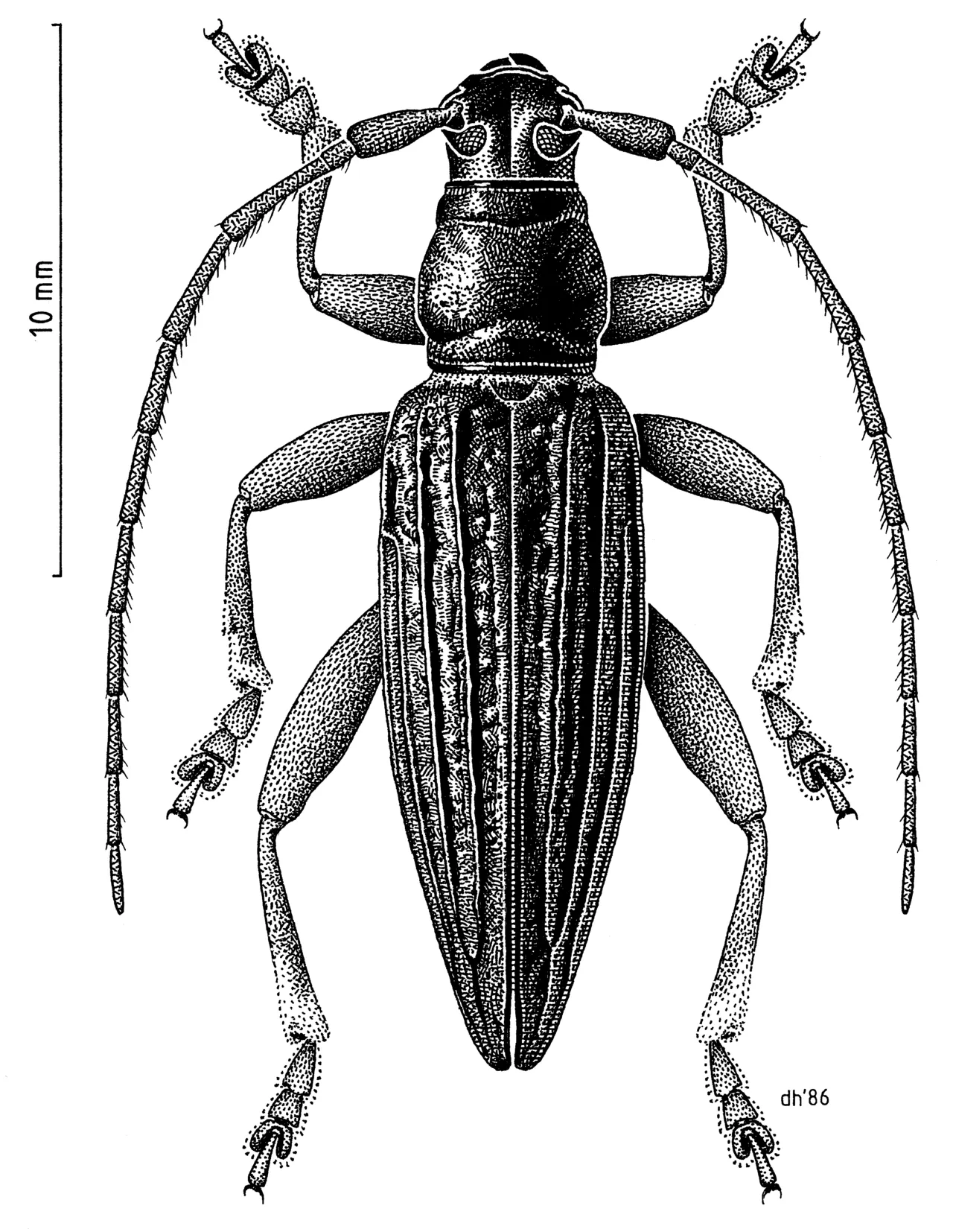
The Pitt Island longhorn beetle (Xylotoles costatus) is a flightless, blackish beetle with a bronze-green sheen, found only in New Zealand's Chatham Islands. Unrecorded for most of the 20th century, it turned up again on Rangatira (South East Island) in 1987. The IUCN Red List lists it as Endangered (2004).
How to recognise it
It is a longhorn beetle (family Cerambycidae), blackish with a variable green-bronze sheen. The few specimens seen measured 17 to 20 mm, making it the largest longhorn on the Chatham Islands.
It is easily confused with a close relative, Xylotoles traversii, which is also blackish with a green-bronze sheen. Costatus looks more bronze and has much more pronounced ridges on the wing cases. Traversii is smaller, 6 to 14 mm in one survey's collections, though smaller costatus could overlap that range. Any Chatham Islands Xylotoles longer than 16 mm is likely to be this species.
Francis Pascoe described it in 1875 from specimens sent to him by Henry Travers from Pitt Island, which gave the beetle its common name. The type specimen is in the Natural History Museum in London.
Where it lives
The species is endemic to the Chatham Islands. Every older record with a locality comes from Pitt Island, the latest positively dated collection being from 1906 to 1908. Searches there in 1990 and 1992 found none, though one 12-day survey turned up 46 Xylotoles traversii.
Nothing was collected after about 1910 until December 1987, when John Dugdale took a single beetle on Rangatira, a small island off Pitt Island's south-east coast. A second was found there in November 1992. Researchers concluded that the chances of rediscovering it on Pitt Island are small: it could be extinct there, present in very low numbers, or in habitat nobody has sampled.
Pins are Wikidata “endemic to” fields. Orange dots, when present, are GBIF occurrence tiles — survey bias included.
How it lives
Very little is known. The 1987 beetle was beaten from a dead ngaio branch tangled in vines, and the 1992 beetle was walking up the trunk of a Chatham Islands coprosma (Coprosma chathamica) at night. Neither find says much about what it needs.
Other Xylotoles larvae feed on dead twigs and small branches, so this species is assumed to do the same. Its rarity next to the common traversii suggests it may be more specialised. Because it is the larger beetle, its larvae might need thicker dead wood, which could be scarce in Rangatira's mostly young forest.
The adults are flightless and may spend much of their time on the ground.
Why it is in trouble
The only known population is on one small island, and the IUCN assessed it under criterion D, which applies to very small populations. Field teams on Rangatira in 1992 used branch traps, pitfall traps and beating, yet found only one costatus alongside numerous traversii.
A museum-specimen study reported that the Chatham Islands' protected beetles have contracted to the outer, predator-free islands. Because costatus spends time on the ground, mice are a risk on Pitt Island, where the ground-dwelling insect fauna has been badly depleted.
What is being done
The beetle is one of three Chatham Islands beetles listed on the Seventh Schedule of New Zealand's Wildlife Act, which gives it legal protection. It is reportedly ranked Nationally Critical in the country's own threat classification.
A 1996 Department of Conservation report recommended a study of related Xylotoles biology and carefully targeted visits to Rangatira by experienced staff to find beetles and larvae, since casual monitoring would reveal little until its habitat needs are known.
Sources
Written for this catalog in our own words from the sources below, checked against them on 12 November 2026. Population figures are estimates and carry the year they were made. Status and assessment year: IUCN. 2026. The IUCN Red List of Threatened Species. Version 2026-1. iucnredlist.org.




