Endangered
Xerosecta adolfi
Xerosecta adolfi
Xerosecta adolfi is a medium-sized land snail found only in the dry south-east of Spain, on the coastal plains of Almería province. Its 2026 Red List update, based on a 2022 assessment, classes it as Endangered with a decreasing population. Plastic greenhouses, farming and urban growth keep shrinking its habitat.
How to recognise it
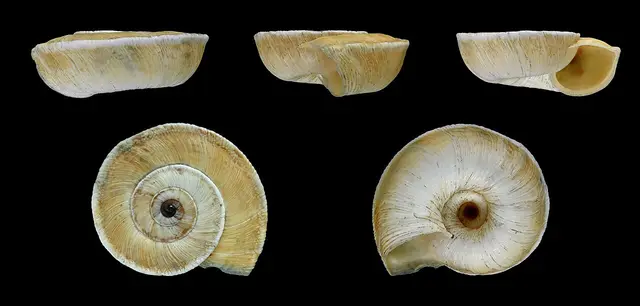
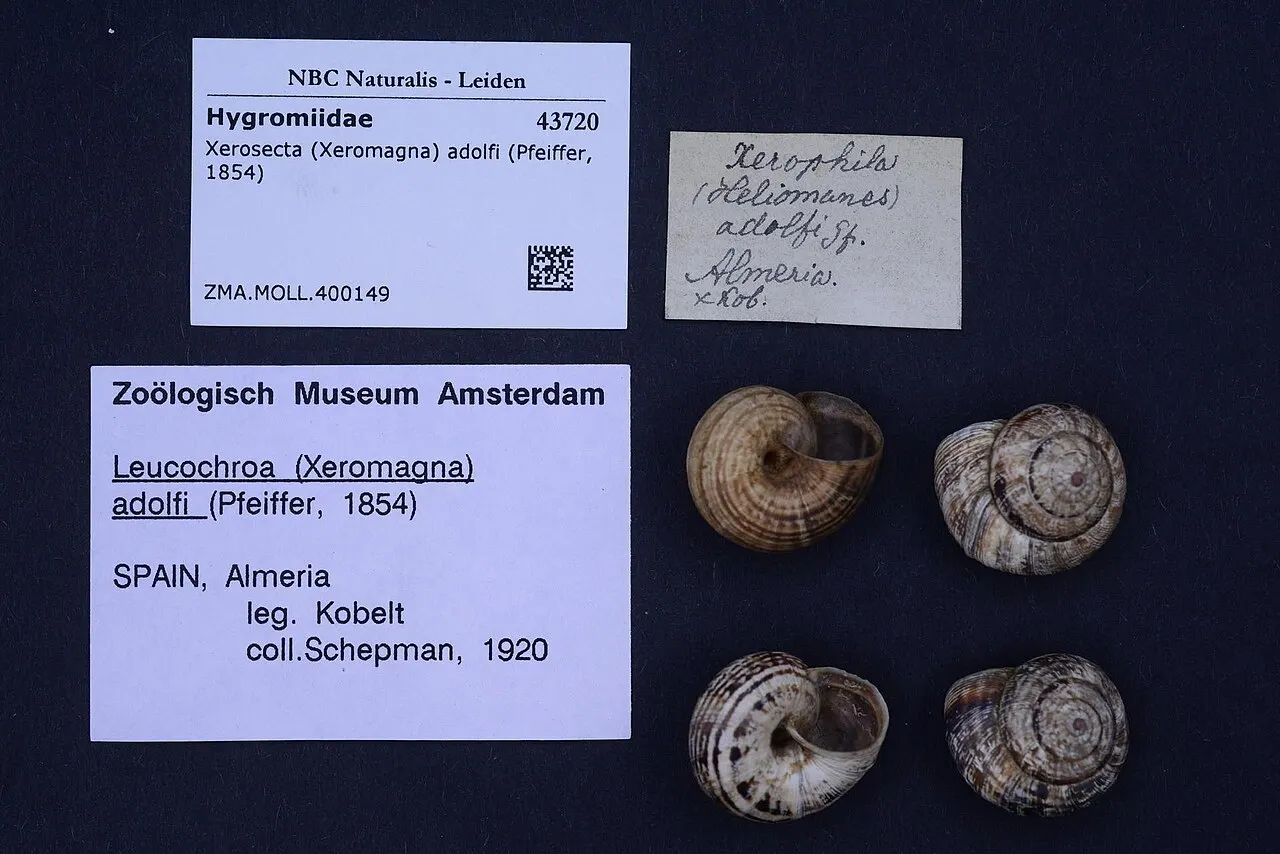
It's a rounded snail with a shell about 12.5 to 18.5 mm across and 9 to 13.3 mm tall, with roughly 5 to 5.75 whorls. The colour runs from brownish through cream to chalky white, and the shell has tightly packed fine ribs. It has no common name.
It looks a lot like a related species, Xerosecta cespitum. A 2006 Spanish atlas describes adolfi as somewhat sturdier and paler, with a last whorl less than twice as wide as the one before and a more pronounced rib pattern. Reliable identification needs anatomical study, not just a look at the shell. It was described by Ludwig Pfeiffer in 1854 and sits in the family Geomitridae, which older Spanish sources file under Hygromiidae.
Where it lives
The species is endemic to Spain, and in practice to Almería. The same atlas puts it on the plain of the Campo de Dalías (El Ejido) and in the Níjar depression, on limestone-derived ground below about 200 m. The 2026 Red List update counts 6 locations and gives an elevation range of sea level to 600 m. Records from Granada province are regarded as mistakes.
Its habitat is open steppe with grass and scattered low shrubs, plus disturbed roadside and rough ground. It reaches areas close to the coast but doesn't colonise dunes or salty ground, and it doesn't climb the neighbouring ranges, the Sierra de Gádor and Sierra Alhamilla. The Red List records Mediterranean-type shrubland as its major habitat.
Pins are Wikidata “endemic to” fields. Orange dots, when present, are GBIF occurrence tiles — survey bias included.
How it lives
Little is known of its life cycle. Like other snails of this hot, dry region it probably survives the harshest months by sealing itself in its shell and resting. Many of the shells examined in the 2006 survey had several very thick seals across the opening, which fits that idea.
Why it is in trouble
Plastic greenhouses are the biggest problem. In the Campo de Dalías about 85% of the land was in uses that don't allow continuous snail populations, and 82% of that was covered by plastic. The atlas calculated that building and farming cut the area the snail occupies by 8.5% between 1991 and 1999. In the Níjar plain, habitat loss to greenhouses was 4.1% over the same period, but the area under greenhouses grew by 34.5%.
The Red List now rates farming and ranching as the main threat, affecting more than 90% of the population, with pesticides and herbicides hitting more than half of it. Other pressures are groundwater pumping, tourism developments and, in the past, housing. Common snails such as Theba pisana, Rumina decollata and Otala lactea appear to be replacing it, because they cope better with human-altered land.
The population is severely fragmented. In the 2006 survey, more than half of the sites checked in the Níjar area had no sign of the species at all, even though the habitat looked suitable.
What is being done
Very little. In the 2006 atlas only one known site was in good condition, thanks to its place inside the Punta Entinas-Sabinar natural area, and the Red List records it in at least one protected area. The Red List notes no recovery plan, no monitoring scheme and no captive population. In 2005 it was proposed for listing as in danger of extinction in Andalusia's threatened-species catalogue.
The 2006 atlas proposed a recovery plan covering the western Almería coast, protection of the remaining shrubland (especially around Níjar) and control of new irrigation permits in the Níjar area. A 2020 bachelor's thesis at the University of Jaén on snails of southern Iberia again called for a conservation plan for this species.
Sources
Written for this catalog in our own words from the sources below, checked against them on 12 November 2026. Population figures are estimates and carry the year they were made. Status and assessment year: IUCN. 2026. The IUCN Red List of Threatened Species. Version 2026-1. iucnredlist.org.
- IUCN Red List assessment, Xerosecta adolfi (2022 assessment, published 2026)
- Atlas de Invertebrados Amenazados de España, Xerosecta adolfi (2006), MITECO
- University of Jaén bachelor's thesis (2020), diversity and distribution of pulmonate molluscs in southern Iberia
- Xerosecta adolfi, encyclopedia entry