Endangered
Xenosaurus platyceps
Xenosaurus platyceps
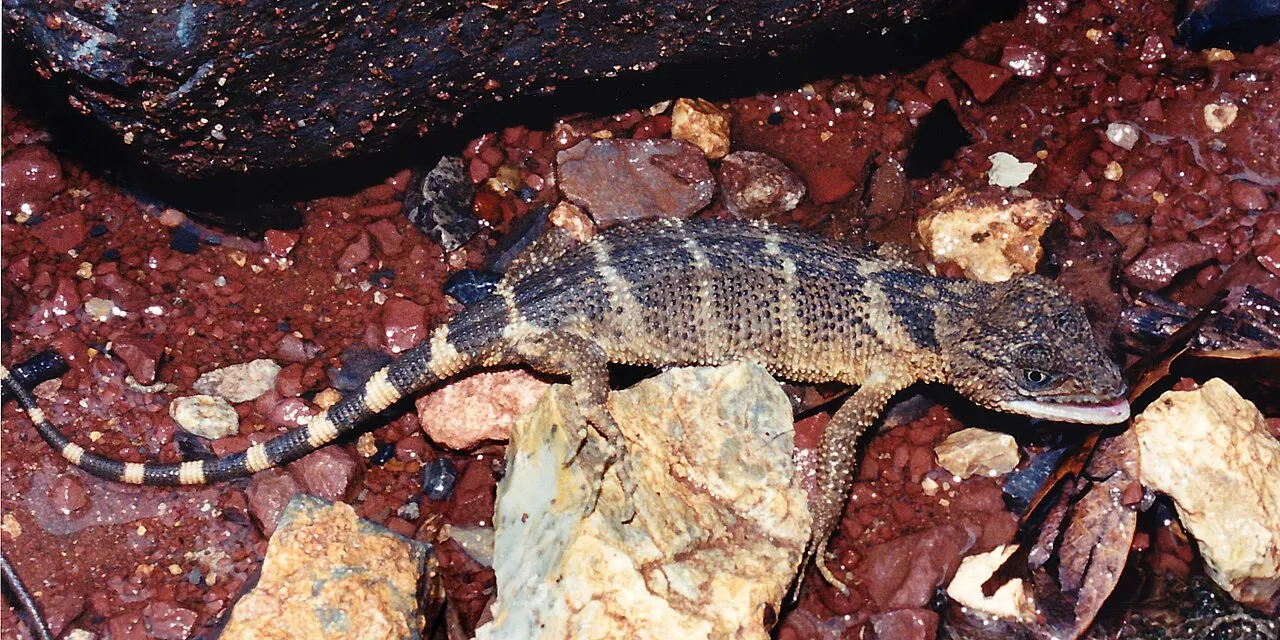
The flathead knob-scaled lizard (Xenosaurus platyceps) is a flat-bodied, crevice-dwelling lizard of the Sierra Madre Oriental in Mexico, known from Tamaulipas. The IUCN Red List assessed it as Endangered in 2007, with a decreasing population. Females give birth to live young rather than laying eggs.
How to recognise it
Knob-scaled lizards (family Xenosauridae) have flattened bodies and heads, a shape thought to help them live inside narrow rock crevices. The species name, platyceps, means flat-headed.
King and Thompson described it in 1968. The type locality is in Tamaulipas, 15.4 miles south-southwest of Ciudad Victoria on the road to Jaumave, at about 1,370 m (4,500 feet).
Where it lives
The IUCN records it from Mexico only. The Reptile Database lists it from Tamaulipas, in the Sierra Madre Oriental around Ciudad Victoria. The IUCN names dry subtropical scrub, dry savanna and rocky areas as its habitat, and a study of the Tamaulipas population describes lizards living in oak forest.
Its range has been trimmed by taxonomy. A 2004 study in Amphibia-Reptilia treated a Sierra Gorda population in Querétaro as X. platyceps, but in 2013 researchers described a new species, Xenosaurus mendozai, from the Sierra Gorda, and the Reptile Database now says X. platyceps is not in Querétaro. The IUCN assessment dates from 2007, before that split.
A 2018 climate-modelling study in Ecology and Evolution estimated about 2,168 square kilometres of climatically suitable area for X. platyceps, shrinking by about 26 percent by 2070 under a high-emissions scenario (RCP 8.5).
Pins are Wikidata “endemic to” fields. Orange dots, when present, are GBIF occurrence tiles — survey bias included.
How it lives
It shelters in rock crevices. The Reptile Database lists its reproduction as ovoviviparous, meaning the eggs develop and hatch inside the mother, so the young are born live.
Why it is in trouble
The IUCN lists large-scale and small-holder farming and ranching, and tourism and recreation areas, as ongoing threats, and records a decreasing population. Predation by feral cats is also reported.
The species reportedly lives in no protected area.
What is being done
The IUCN assessment lists site protection, site management, and awareness and communication as the actions needed. No conservation measures were recorded as already in place when the species was assessed in 2007.
Sources
Written for this catalog in our own words from the sources below, checked against them on 12 November 2026. Population figures are estimates and carry the year they were made. Status and assessment year: IUCN. 2026. The IUCN Red List of Threatened Species. Version 2026-1. iucnredlist.org.
- IUCN Red List assessment (2007), Xenosaurus platyceps
- Wikipedia, Xenosaurus platyceps
- The Reptile Database, Xenosaurus platyceps
- A new species of Xenosaurus from the Sierra Gorda Biosphere Reserve of Queretaro (Revista Mexicana de Biodiversidad, 2013)
- Lemos-Espinal, Smith and Ballinger 2004, Amphibia-Reptilia 25
- Berriozabal-Islas et al. 2018, Ecology and Evolution 8(14)




