Critically Endangered
Woundfin
Plagopterus argentissimus
This fish is endemic to the Virgin River of the southwestern United States.
Appearance
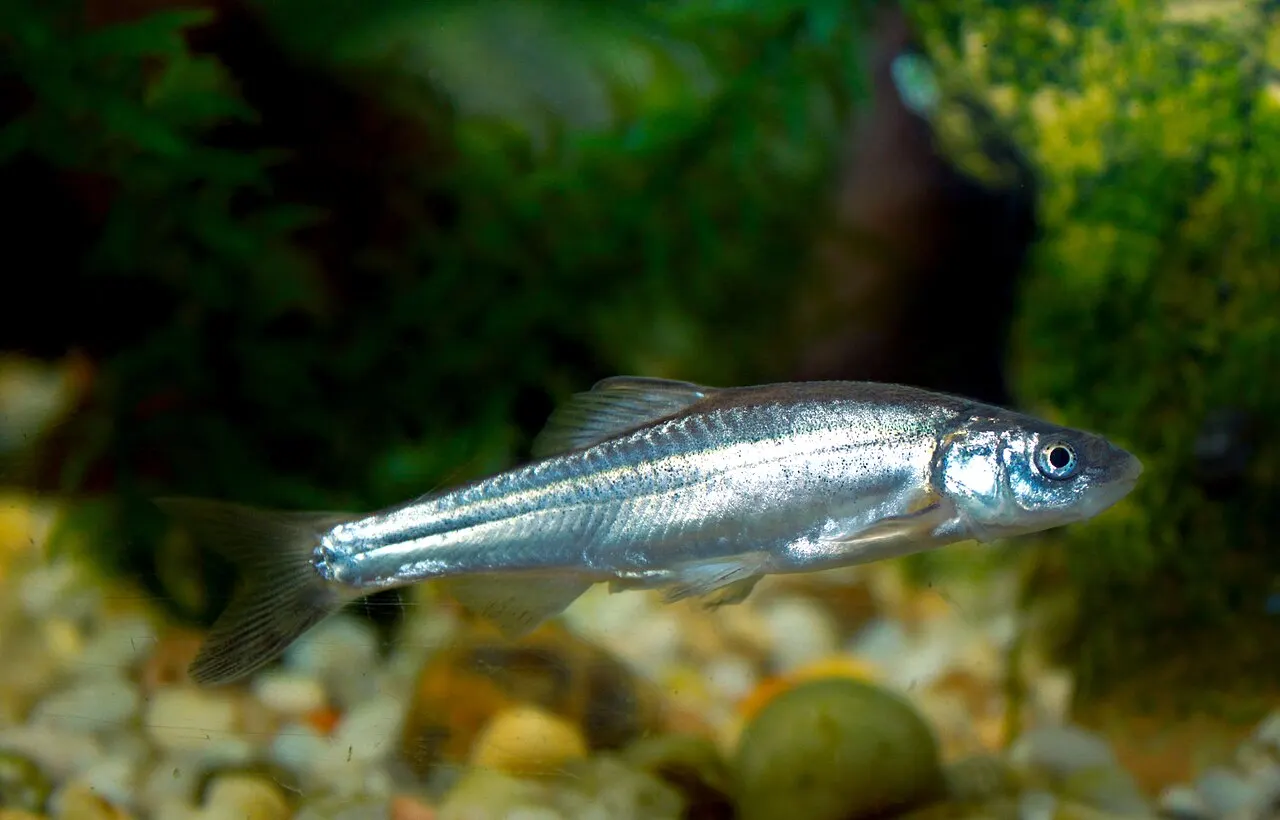
The Woundfin is a small slender, silvery minnow, with a flattened head and belly, long snout, leathery skin, and no scales. There are barbels on the corners of its lips, and its common name likely comes from the first spinous ray of its dorsal fin, that is sharp-pointed.
Its maximum length is rarely more than 7.5 cm (3.0 in).
Range and habitat
Historically, the Woundfin occupied much of the lower Colorado River basin, among them two tributaries, the Virgin River and part of the Gila River. Even so, habitat destruction through dams and water development has led to its extirpation from these regions. In addition, several introduced species, most notably the red shiner (Cyprinella lutrensis) have contributed to a decrease in the Woundfin's Virgin River population. It is typically found in warm, swift streams of high turbidity, preferring a stream speed of one to two feet per second and a depth of eight to eighteen inches.
Other listings include "Vulnerable" on the IUCN Red List and "Critically Imperiled" (the most critical classification) by NatureServe. Fish barriers have been erected to prevent re-colonization by red shiner, and has allowed the reintroduction of hatchery raised Woundfin.
Pins are Wikidata “endemic to” fields. Orange dots, when present, are GBIF occurrence tiles — survey bias included.
In crisis
Historically, the Woundfin also occupied the lower Colorado River from the Virgin to Yuma, Arizona, and the Gila River from Yuma to its confluence with the Salt River, but habitat destruction through water development (among them eight major dams that alter flow) and the introduction of several species (particularly the red shiner (Cyprinella lutrensis), that competes for food and is known to prey upon the Woundfin's eggs and young) have led to its extirpation in these regions as well as a decline in population in the Virgin River. Since 1970, the Woundfin has been listed as an endangered species. The United States Fish and Wildlife Service lists the population status as "declining." The Dexter National Fish Hatchery in Dexter, New Mexico studies the Woundfin in an effort to help conserve the species, and has successfully spawned the fish in captivity.
The only wild population of the species is in the Virgin River. With red shiner no longer a threat, low flows and high temperatures are the biggest threats still facing Woundfin.
Woundfin is Critically Endangered on the IUCN Red List (assessed 2013, criteria B1ab(i,ii,iii,v)). Confirm the official criteria and any later count on the assessment page.
Sources
Adapted from the English Wikipedia article on Woundfin (CC BY-SA 4.0; authors are listed in the article history; changes were made), Wikidata item Q2630710. Family and order context is original field-guide writing about the group, not a copied assessment of this one species. Not an IUCN assessment. Counts, when quoted, can change — confirm them on the recovery programme and on iucnredlist.org. Status and assessment year: IUCN. 2026. The IUCN Red List of Threatened Species. Version 2026-1. iucnredlist.org.




