Endangered
White-fronted Quail-Dove
Geotrygon leucometopia
The white-fronted quail-dove (Geotrygon leucometopia) is a shy, ground-feeding dove of the forests of Hispaniola, now found mainly in the Dominican Republic. The IUCN Red List assessed it as Endangered in 2020, with a small, declining population estimated at 600 to 1,700 mature birds.
How to recognise it
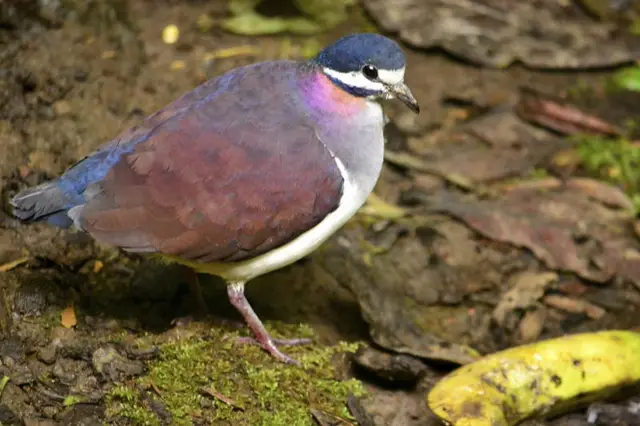
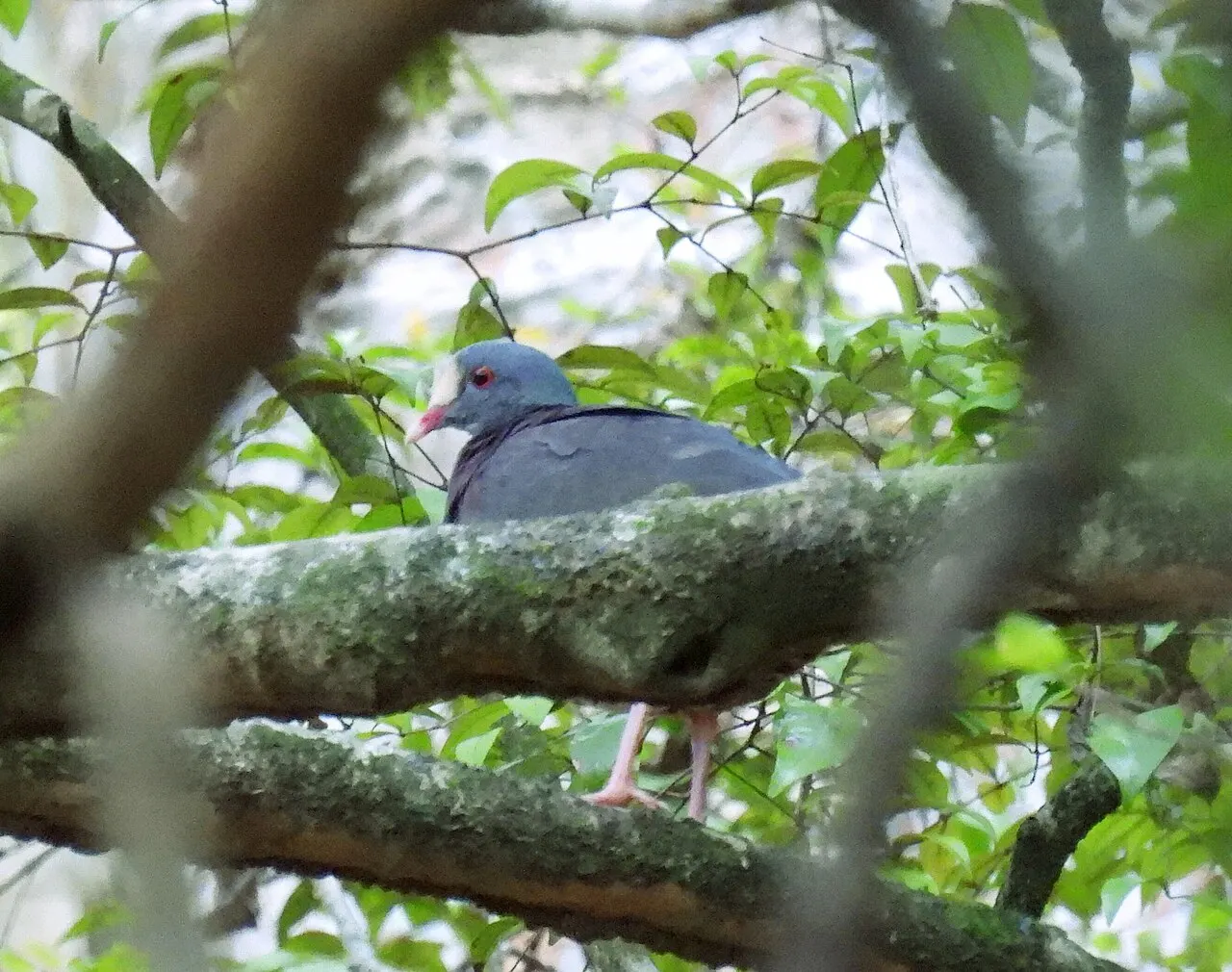
It's about 28 cm long and weighs roughly 170 g. The forehead is bold white on a slate-grey head, the upperparts have a purplish-blue sheen, the sides of the neck are purplish, and the eyes are red. Juveniles are browner and lack the purple gloss.
Chapman described it in 1917. It was long treated as the same species as the grey-fronted quail-dove of Cuba (Geotrygon caniceps), under the name grey-headed quail-dove, and is now regarded as separate.
Where it lives
The species is endemic to Hispaniola. It is recorded from the Dominican Republic, on the Sierra de Bahoruco and the Cordillera Central, and has probably disappeared from the Sierra de Neiba. A report from the 1920s describes a rare grey quail-dove near the summit of Morne La Selle in Haiti, but habitat destruction there has probably wiped out any population.
The IUCN estimates an extent of occurrence of about 14,200 square kilometres and 11 to 100 locations. It mostly lives in dense moist forest in the hills and mountains, up to roughly 1,700 to 1,800 m, and also uses lowland moist forest, swamp forest, coffee and other plantations, and some drier forest at low elevations.
Pins are Wikidata “endemic to” fields. Orange dots, when present, are GBIF occurrence tiles — survey bias included.
How it lives
It's usually seen crossing a forest trail or waiting quietly near a place to drink. It sings from a branch above the ground but can be very hard to spot. It eats seeds and small invertebrates such as insects and caterpillars, foraging on the ground and often along tracks.
Only one nest has ever been found, so breeding is poorly known. Birds are thought to breed from about January to August. Clutches are one or two eggs, rarely three, in a nest of twigs and leaves low in undergrowth or a tangle of vines.
Why it is in trouble
Forest clearing is the main pressure, especially around the border with Haiti, and clearing for commercial-scale farms has sped up on the Sierra de Bahoruco. The assessment lists small-holder and industrial farming, and hunting for food, which may still be a local problem.
The population is severely fragmented, and a decline of 30 to 49 percent is estimated for each of the past, present and future windows used in the assessment.
What is being done
Hunting was prohibited in the Dominican Republic in 1978, and several protected areas covering montane forest have been created across its range since. The species occurs in at least one protected area, and conservation sites have been identified across its whole range. There is no species recovery plan and no systematic monitoring scheme, and it isn't held in a captive breeding programme.
Sources
Written for this catalog in our own words from the sources below, checked against them on 12 November 2026. Population figures are estimates and carry the year they were made. Status and assessment year: IUCN. 2026. The IUCN Red List of Threatened Species. Version 2026-1. iucnredlist.org.