Endangered
Purple quail-dove
Geotrygon purpurata
The purple quail-dove is a plump, jewel-coloured pigeon that walks the floor of wet forest in the Chocó region of western Colombia and northwestern Ecuador. The IUCN Red List rated it Endangered in 2020, with a very small and shrinking population estimated at 600 to 1,700 birds.
How to recognise it
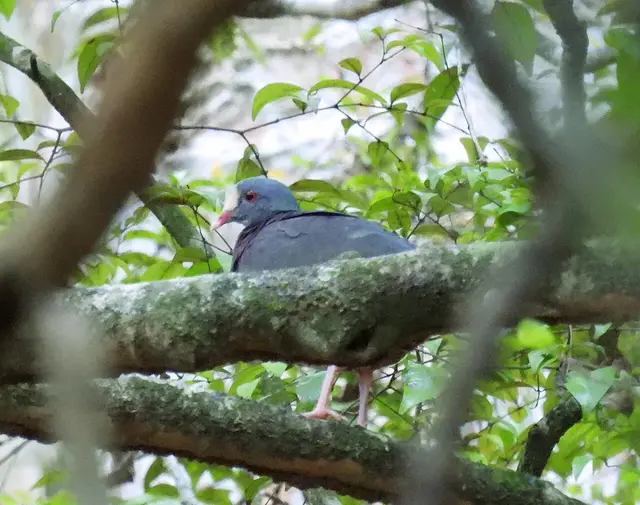
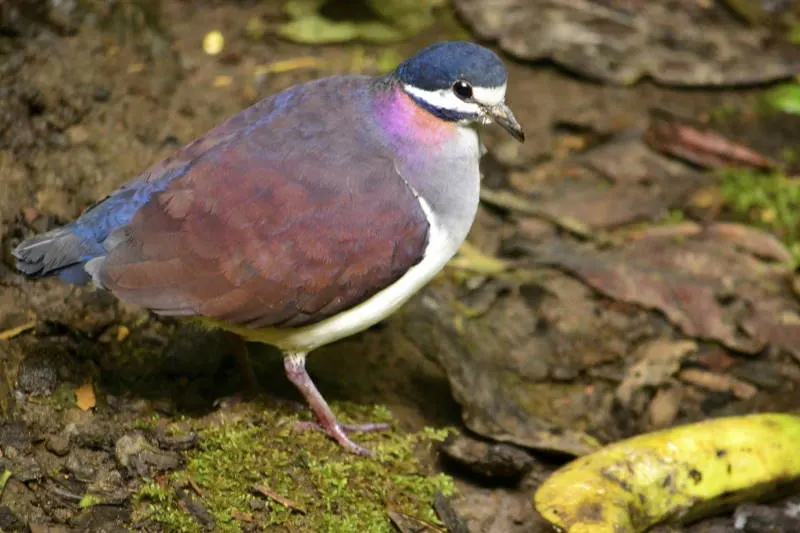
It's a stocky ground dove, 22 to 26 cm long and about 155 g. The male has reddish-brown upperparts with a purplish wash, rich reddish-purple wing coverts and a bright ultramarine back and rump. The crown and nape are indigo, the face and throat mostly white, and the sides of the neck shine golden green. The tail is blackish with white tips on the outer feathers, and the underparts are grayish white.
Females are duller, and juveniles duller still, with a fainter face pattern and no iridescence. The song is a long series of soft, hollow coos.
Where it lives
The species is restricted to the wet forests of the Chocó along the Pacific coast, from northwestern Colombia into northwestern Ecuador. It stays on the ground and in the undergrowth of primary and older secondary evergreen forest, in both lowland and montane moist forest. It isn't a migrant.
Elevation limits differ between sources. One account reportedly gives 200 to 1,100 m in Colombia but only up to 700 m in Ecuador, while the Red List assessment records a range of 600 to 1,100 m.
Pins are Wikidata “endemic to” fields. Orange dots, when present, are GBIF occurrence tiles — survey bias included.
How it lives
Purple quail-doves forage on the forest floor, alone or in pairs. Their diet hasn't been documented, though other quail-doves eat seeds and small invertebrates. Almost nothing is known about breeding. A male with enlarged testes was collected in Ecuador in June, which is about all the timing information that exists.
The Red List puts a generation at roughly 4.1 years.
Why it is in trouble
The population is small and judged to be declining. The 2020 assessment lists forest conversion to farmland, cattle ranching, plantations (oil palm in particular) and mining as threats, along with hunting of the birds themselves. The American Bird Conservancy adds that Chocó rainforest is being lost to agriculture.
The species was long treated as a subspecies of the sapphire quail-dove. It was split as a separate species in 2010, based on differences in plumage and song, so older population counts are hard to interpret.
What is being done
The Red List assessment records site protection and habitat management as actions in place, and notes that no species recovery plan exists. The American Bird Conservancy supports reserves that hold the species, including the Atuncela regional protected area in Colombia and the Rio Canandé and Mashpi Amagusa reserves in Ecuador. At Rio Canandé that work includes reforestation and ecotourism.
Sources
Written for this catalog in our own words from the sources below, checked against them on 12 November 2026. Population figures are estimates and carry the year they were made. Status and assessment year: IUCN. 2026. The IUCN Red List of Threatened Species. Version 2026-1. iucnredlist.org.