Endangered
Western Bristlebird
Dasyornis longirostris
The western bristlebird (Dasyornis longirostris) is a secretive, long-tailed songbird of the coastal heaths of south-western Australia. The IUCN Red List assessed it as Endangered in 2022, with a decreasing population estimated at 500 to 700 birds. It depends on dense, long-unburnt heath, which makes fire its biggest threat.
How to recognise it
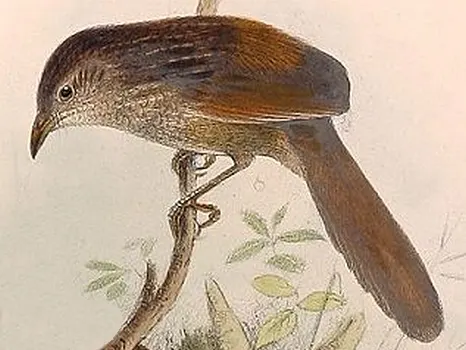
It's a small, brown, ground-loving bird with a long rufous tail crossed by darker bars. The back is dark brown mottled with grey, the face and throat are off-white or whitish, and the paler underparts carry fine dark scalloping. The eye is red.
Sources give different sizes: under 15 cm (BirdLife Australia), about 17 cm (Living Wonders), 17 to 20 cm (the Red List) and 18 to 22 cm (other references). Weight is roughly 26 to 39 g. It's usually quiet and hard to see, but it has a high, melodious song, often given from the ground, a low perch or occasionally the top of a shrub. John Gould described the species in 1841.
Where it lives
The western bristlebird is found only in Western Australia, in low, dense coastal shrubland and heath at elevations up to 50 m. It favours coastal dunes and cliffs east and west of Albany.
Today it survives at three sites: Two Peoples Bay Nature Reserve, Mount Manypeaks Nature Reserve, and Fitzgerald River National Park.
Pins are Wikidata “endemic to” fields. Orange dots, when present, are GBIF occurrence tiles — survey bias included.
How it lives
Pairs forage on or close to the ground, picking up worms, snails, insects and their larvae, plus seeds. Birds are usually seen in pairs, sometimes singly or in small family groups. They are sedentary, and their flight is weak and short, which leaves them exposed to predators once cover is gone.
The nest is a large dome of sedges, rushes and sticks, built low in the vegetation. The usual clutch is two dull white, finely spotted eggs.
Why it is in trouble
Fire is the main problem. The bird prefers heath that hasn't burned for some years, and more frequent or more intense fires, along with the predation that follows when cover is stripped, are the leading threats. Prescribed burning can also hurt if it happens during breeding or removes the seeding plants that provide food. Introduced predators gain access to the remaining cover after fires, and BirdLife Australia lists foxes, cats and rats among the invasive species concerns. A hotter, drier climate is expected to bring harsher fire weather.
How fast birds return after a fire varies by place. Moist heath at Two Peoples Bay was reoccupied two to three years after a burn, birds were found five years after fire between Boulder Hill and the Waychinicup River, and in northern Fitzgerald River National Park they were found in heath 14 to 28 years after fire.
Habitat can also fail without fire. At Two Peoples Bay, birds bred in a low-fuel buffer in the mid-1980s, but slashing changed the vegetation and the habitat was unsuitable by the early 1990s, according to a 2025 review in Pacific Conservation Biology. On the Mount Manypeaks ridge, where birds were found in the early 1980s after a 1979 fire, dense hakea later took over. The Red List rated the species Vulnerable in 2008 and Endangered in 2012, 2016 and 2022.
What is being done
The species is listed as Endangered under Australia's national environment law, and a recovery plan and a systematic monitoring scheme are in place. It occurs in at least one protected area, and species recovery, reintroduction and site management are among the conservation actions recorded for it.
Managers also have to balance fire needs. The species can reoccupy burnt ground sooner than the noisy scrub-bird, but its habitat turns unsuitable once the vegetation grows tall and dense, so reserves holding both birds involve trade-offs.
Sources
Written for this catalog in our own words from the sources below, checked against them on 12 November 2026. Population figures are estimates and carry the year they were made. Status and assessment year: IUCN. 2026. The IUCN Red List of Threatened Species. Version 2026-1. iucnredlist.org.




