Endangered
Vateria Flower Rasbora
Rasboroides vaterifloris
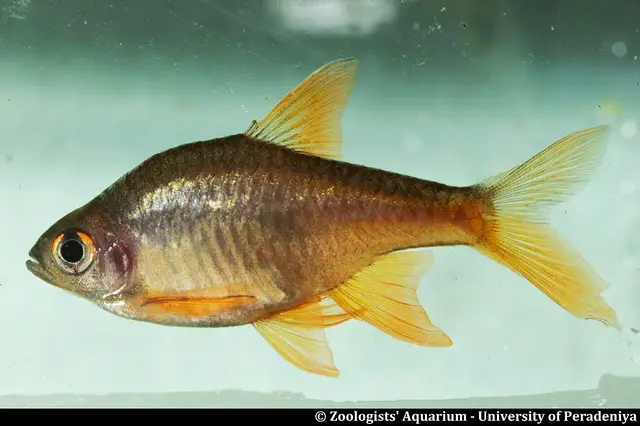
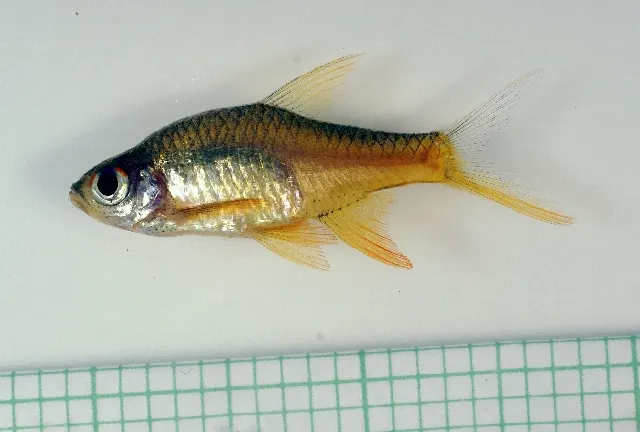
The vateria flower rasbora (Rasboroides vaterifloris) is a tiny red and orange fish from the rainforest streams of southwest Sri Lanka. The IUCN Red List assessed it as Endangered in 2020. Its range is small, forest clearance has degraded its streams, and it is also a hobby fish.
How to recognise it
This fish is at most about 4 cm long. Its colour varies from place to place: the body ranges from red or orange to bluish, and the fins may be red, orange or yellow. Adult males are smaller, slimmer and more colourful than females, especially when breeding.
It is also sold as the pearly rasbora and fire rasbora. Deraniyagala described it in 1930 as Rasbora vaterifloris. Four varieties named in the 1950s are now widely treated as colour forms. A 2018 taxonomic review also folded Rasboroides nigromarginatus, a fish from the Kalu basin, into this species.
Where it lives
It is found only in Sri Lanka. A 2013 study by Batuwita and colleagues narrowed it to the Kalu River basin, and the 2018 merger enlarged its range there. SeriouslyFish gives a wider spread across the Kalu, Bentota, Gin and Nilwala basins of the wet zone. The 2020 IUCN assessment gives an extent of occurrence of about 2,049 square kilometres, an area of occupancy of 108 square kilometres, three locations, and elevations from 18 to 355 m.
The IUCN lists shallow, slow-flowing streams as the habitat, and the species occurs in at least one protected area.
Pins are Wikidata “endemic to” fields. Orange dots, when present, are GBIF occurrence tiles — survey bias included.
How it lives
Its streams are shaded, clear or slightly tea-stained, soft and slightly acidic, with a silt or sand bottom covered in fallen leaves and twigs. Dense plants often grow along the banks. The fish feeds on small invertebrates, terrestrial insects and detritus.
It scatters its eggs among fine plants and gives them no care. In aquariums, eggs hatch in one to two days and the fry swim freely after three to five.
Why it is in trouble
Most of Sri Lanka's wet-zone forest has gone. SeriouslyFish puts the remaining old forest at 4.6 percent as of 2006. The IUCN lists a long set of ongoing pressures, with their impact still unknown: mining and quarrying, dams, soil erosion and silt, nutrient and pesticide run-off, storms and floods, recreation, and harvest for the pet trade.
Aquarium writers also report that the most brightly coloured wild fish seem to be becoming scarcer, possibly because collectors choose them (this is anecdotal). The IUCN records the trend as decreasing.
What is being done
The IUCN lists site and resource protection, awareness work and control of problem species as conservation actions, plus research on harvest, trade and population trends. No recovery plan or monitoring scheme exists, and no captive population is recorded in the assessment. SeriouslyFish reports several captive-breeding initiatives, but the species is delicate, ships badly and is uncommon in the trade.
Sources
Written for this catalog in our own words from the sources below, checked against them on 12 November 2026. Population figures are estimates and carry the year they were made. Status and assessment year: IUCN. 2026. The IUCN Red List of Threatened Species. Version 2026-1. iucnredlist.org.