Endangered
Rasboroides pallidus
Rasboroides pallidus
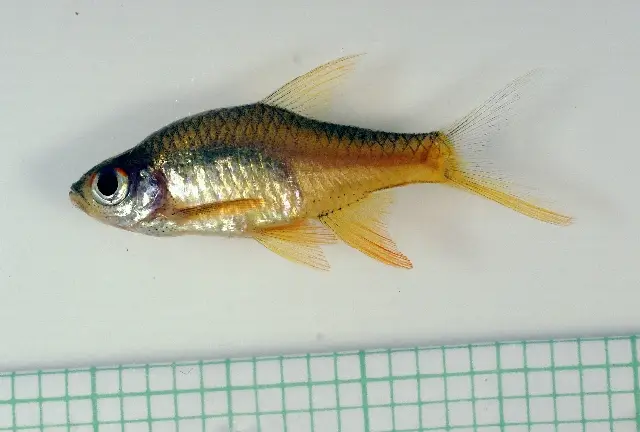
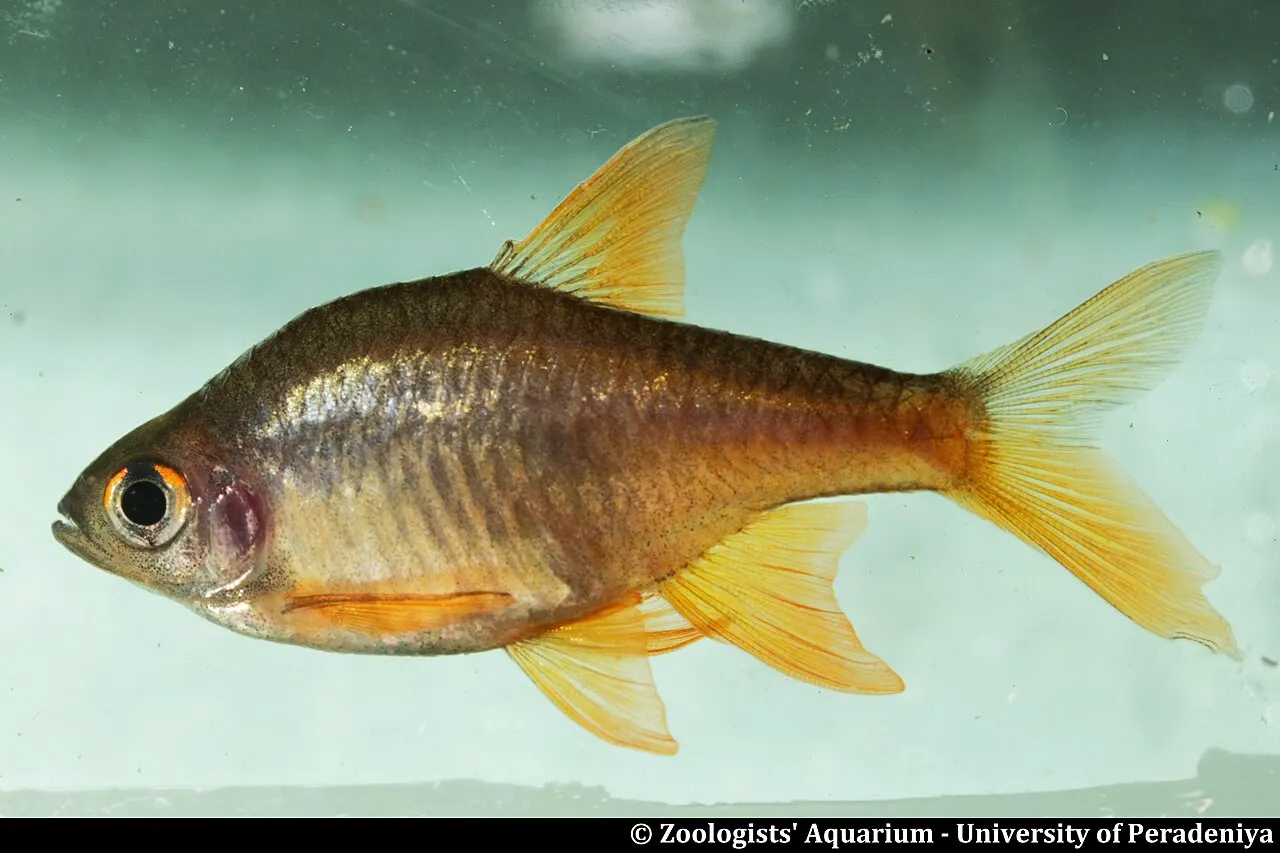
Rasboroides pallidus is a tiny freshwater fish, about 3 to 3.6 cm long at most, found only in a few shaded streams of southwestern Sri Lanka. The IUCN Red List rated it Endangered in 2019. Its living colours include orange and blue-grey, and part of its modern range comes from human releases.
How to recognise it
It's one of the Sri Lankan fire rasboras, small schooling fish with a slim, streamlined body. FishBase gives a maximum of 3.6 cm standard length. In a 2018 study, males measured 22 to 34 mm and females 22 to 29 mm.
Colour varies a lot. Living fish show at least four colour forms: orange (the most common), blue-grey, yellow and dull red. Two or three forms often share the same stretch of stream, and females are plainer than males.
Where it lives
Native populations occur in the Kalu, Bentara, Gin, Polathu-Modera and Nilwala river basins, all in the wet southwest of the island. The fish live in clear, shallow, slow-flowing streams under dense forest shade, over sandy-silt beds, often in groups of more than 100. They stay mostly in the upper half of the water, close to the banks.
The Red List gives the extent of occurrence as roughly 1,790 square kilometres, but the area actually occupied as only about 176 square kilometres, spread over four locations at 125 to 297 m above sea level (a 2018 study gives 17 to 231 m for native sites). The species occurs in at least one protected area.
Pins are Wikidata “endemic to” fields. Orange dots, when present, are GBIF occurrence tiles — survey bias included.
A fish that was described twice
Two populations live outside the natural range. One was introduced near Ginigathena, in the Mahaweli basin, in 1981 as part of a refuge experiment, and now covers about 5 square kilometres. The other was released at Suriyakanda, in the Walawe basin at about 980 m, around 2003, apparently by a conservationist acting in good faith.
In 2013 the Suriyakanda fish were described as a new species, Rasboroides rohani. A 2018 paper in PeerJ used genetics and measurements to show they were R. pallidus all along. The Catalog of Fishes reportedly follows that finding, though FishBase has listed R. rohani separately.
Why it is in trouble
The Red List records a decreasing population and continuing decline in habitat. Listed threats include farming, fertiliser and pesticide run-off, soil erosion and silt, mining and quarrying, dams, and storms and flooding. The assessment also lists pets and display animals as a use of the species, though it gives no figures.
Because the released populations have become established, the 2018 PeerJ team said pallidus warrants less conservation concern than a species confined to one stream. The IUCN assessment still rates the natural range as small, with only four locations.
What is being done
Little targeted work is recorded. The assessment says there is no recovery plan and no regular monitoring. It lists site protection and management, harvest management, invasive species control, awareness work and national policy measures as needed. The 2018 PeerJ team also urged Sri Lanka to prohibit unsanctioned releases of fish.
Sources
Written for this catalog in our own words from the sources below, checked against them on 12 November 2026. Population figures are estimates and carry the year they were made. Status and assessment year: IUCN. 2026. The IUCN Red List of Threatened Species. Version 2026-1. iucnredlist.org.