Endangered
Panay monitor
Varanus mabitang
The Panay monitor (Varanus mabitang) is a large, black, tree-dwelling lizard found only on Panay Island in the Philippines. Unlike almost every other monitor, it feeds on fruit and leaves. The IUCN Red List assessed it as Endangered in 2022 because its forest home is small, broken up and still being cleared.
How to recognise it
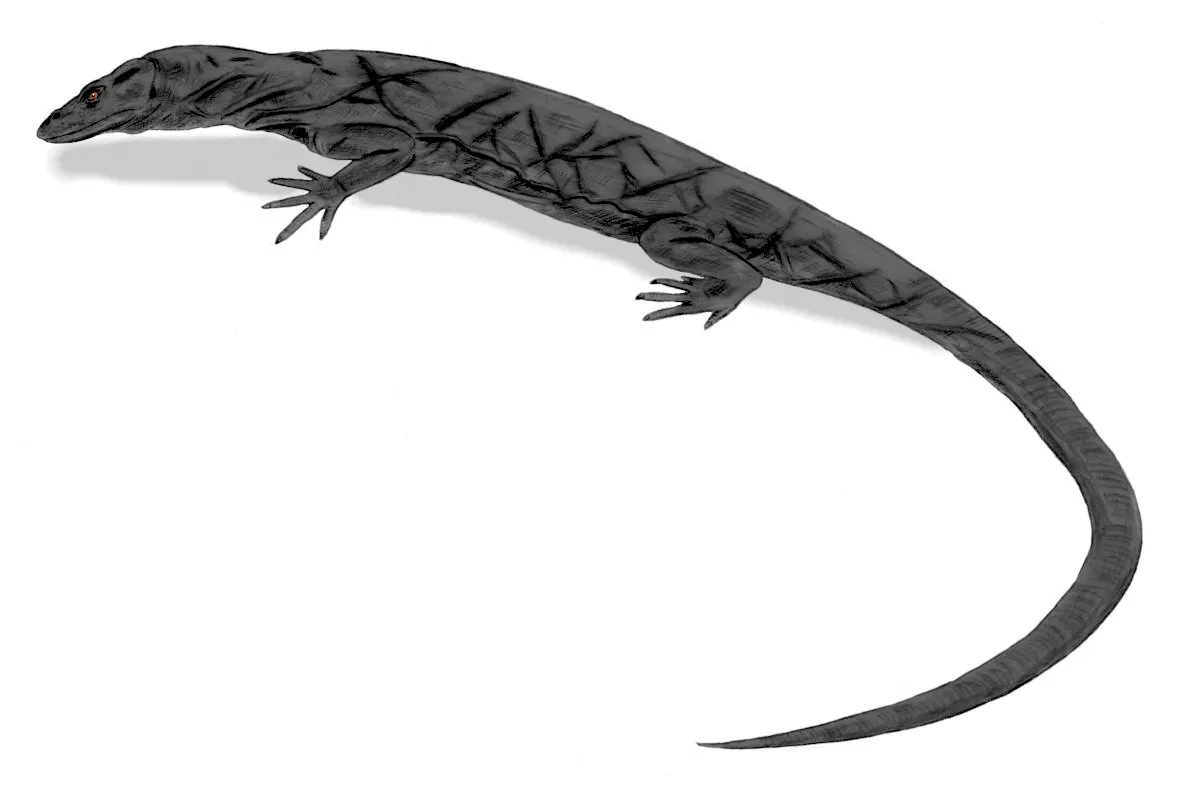
It's a big lizard, almost uniformly black, with at most a scatter of tiny yellow dots. A large animal photographed and weighed in 2000 measured 1.75 m in total length, with a body of 64 cm from snout to vent, and weighed 5.75 kg. The first specimen kept for study, a mature female, was smaller, at 1.27 m and 1.85 kg.
Its head has a slightly domed snout and bulging bumps over the temples, its scales are fine, and the tail is triangular in cross section. Its closest relative is the Philippine forest monitor (Varanus olivaceus) of south-eastern Luzon, which is greenish-grey and also eats fruit.
Where it lives
It occurs nowhere but Panay, in remnant forest in the north-western and western mountains. The first specimen came from South Pandan Forest, at about 250 m, in Antique Province. The Red List gives an elevation range of about 200 to 1,000 m and lists lowland moist forest as its habitat.
The IUCN puts its extent of occurrence at about 972 square kilometres and the area it actually occupies at about 180 square kilometres. It describes the population as severely fragmented and records no protected area where the species is known to occur.
Pins are Wikidata “endemic to” fields. Orange dots, when present, are GBIF occurrence tiles — survey bias included.
How it lives
The Panay monitor is highly secretive and spends most of its time in the high forest, hiding in tree holes or on branches. A former hunter who worked with the describers said it plays dead when caught.
Its diet is the surprise. The first specimen ate screw palm and fig fruit in captivity and ignored land snails, two animals passed seeds after capture, and the hunter reported seeds and leaf remains in the stomachs of others. When Maren Gaulke and Eberhard Curio described the species in 2001, they noted that no other monitor was known to eat leaves, and said its diet was exclusively plant-based at least in the first specimen. Later accounts describe it as feeding mainly on fruit.
Local people have long called it mabitang, which means something like big monitor lizard in a local dialect. Hunters first told the researchers about a rare black tree monitor in 1996, and it took until 2000 for scientists to see one.
Why it is in trouble
The main threat is loss of forest. The Red List names small-holder farming and shifting agriculture, and describes the population as declining. Illegal logging and slash-and-burn clearing in the lowlands are often cited as well.
People also eat it. The IUCN records use for food at household level, and some international trade as pets or display animals. A 2009 GMA News report called the hunting rampant, said the meat is treated as a delicacy, and said eggs were fetching around 200 pesos each. The Red List records the species as covered by international legislation and trade controls.
What is being done
The Red List lists harvest management, trade management, site protection, area management and habitat protection among the actions needed, and flags population trends, ecology and use as research needs. The describers of the species advised against collecting further specimens while its numbers were so low. No captive population or dedicated recovery programme has been documented.
Sources
Written for this catalog in our own words from the sources below, checked against them on 12 November 2026. Population figures are estimates and carry the year they were made. Status and assessment year: IUCN. 2026. The IUCN Red List of Threatened Species. Version 2026-1. iucnredlist.org.