Endangered
Thomas' Mastigure
Uromastyx thomasi
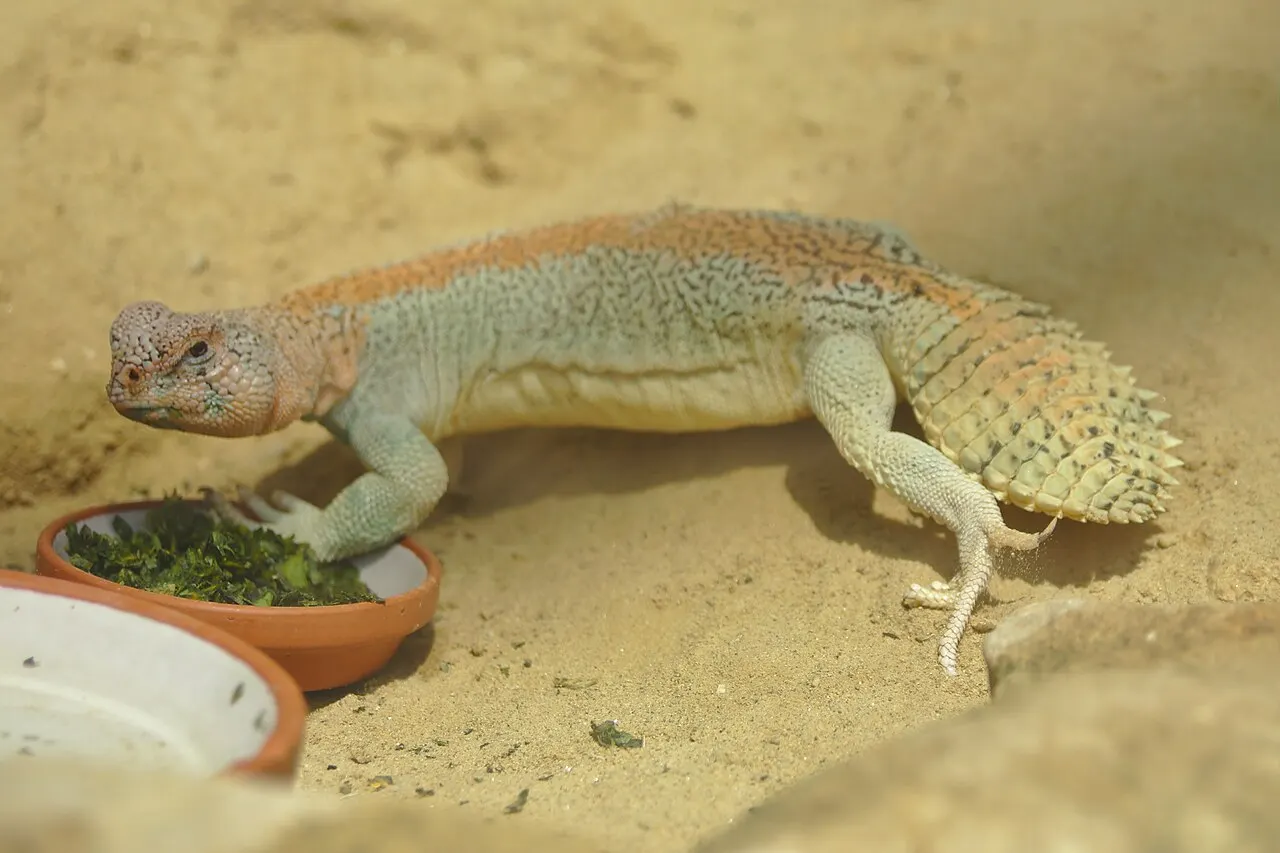
The Omani spiny-tailed lizard (Uromastyx thomasi), also called Thomas's mastigure, is a small, plant-eating desert lizard found only in Oman, along parts of the coast and on Masirah Island. It was listed as Endangered in 2023, and the IUCN records its numbers as falling.
How to recognise it
This is a small mastigure, with a captive adult photographed at under 15 cm in total length. Its tail is very short, broad and plump rather than long and spiny, and its face carries a complex pattern of bands.
H. W. Parker described the species in 1930 from two specimens, with the type from Bu Ju'ay in southern Arabia. It is named for Bertram Thomas. For decades little was published about it, and a review of museum material estimated that no more than about 30 specimens were known to science by 1998.
Where it lives
The species is endemic to Oman. A 2012 IUCN review of Arabian reptiles places it on the coastal plains northeast of Dhofar and on Masirah Island. A herpetologist's 2006 report puts the whole distribution at roughly 600 km long and up to 230 km wide, though mountainous parts of that area are unsuitable.
The 2023 assessment gives its habitat as hot desert and rocky ground, from sea level to about 500 m. It estimates the extent of occurrence at about 32,500 square km but the area it actually occupies at only 60 to 500 square km, spread over 4 to 5 locations.
Pins are Wikidata “endemic to” fields. Orange dots, when present, are GBIF occurrence tiles — survey bias included.
How it lives
Field work on stony, sandy plains with sparse plants found the lizards active between about 11 a.m. and 4 p.m. in late November, when the ground surface measured 37.5 to 51.1 degrees C. Burrows were 45 to 165 cm long, and the temperature in the upper part of them stayed near 30 to 34 degrees C, steadier than the surface.
It eats plants. Of 38 droppings examined, all held remains of just two plants, an Indigofera and a plantain (Plantago albicans), although six plant species grew in the habitat. No insect remains turned up.
Almost nothing is recorded about breeding in the wild. In captivity, females laid clutches of 9 to 16 eggs between May and September, and incubation lasted 81 to 101 days. Of 34 hatchlings from one year, only 4 were female, which led the keepers to suspect that incubation temperature influences sex.
Why it is in trouble
The IUCN lists small-scale grazing and farming, recreation, housing, oil and gas work and roads as ongoing threats. It also lists direct collection of the lizard, which it rates as the most rapidly acting of these pressures. The population is severely fragmented.
A 2018 overview of mastigures reported that recent surveys suggest the species is gone from the Omani mainland and survives on Masirah Island, where habitat destruction has caused local losses. Anecdotal 2012 reports suggest it may persist on the mainland, but those have not been confirmed. All mastigures have been on CITES Appendix II since 1977.
What is being done
The assessment records that 7 to 23 percent of the population lives inside protected areas, that international trade is regulated, and that awareness programmes have run. It lists harvest and trade management, habitat protection and education as needed actions. There is no recovery plan or systematic monitoring scheme.
A European captive programme began from animals imported to Germany in 1998, with first breeding in 2000. It held 33 animals in January 2007, and captive-bred young suffered high mortality at several of the keeping sites.
Sources
Written for this catalog in our own words from the sources below, checked against them on 12 November 2026. Population figures are estimates and carry the year they were made. Status and assessment year: IUCN. 2026. The IUCN Red List of Threatened Species. Version 2026-1. iucnredlist.org.




