Critically Endangered
Trondo mainty
Ptychochromoides betsileanus
The trondo mainty (Ptychochromoides betsileanus) is a cichlid found only in the Onilahy River basin of southwestern Madagascar. The IUCN Red List rated it Critically Endangered in 2020 and flags it as possibly extinct, with an occupied area of just 1 to 10 square kilometres at a single location.
How to recognise it
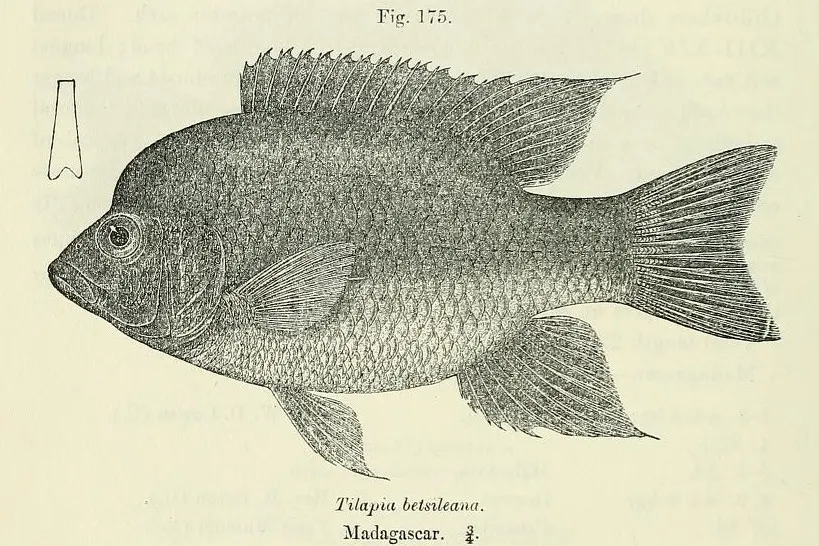
It's a fairly large cichlid, reaching 24 cm in standard length. FishBase notes a prominent fatty hump on the back of the head and gives 13 to 15 dorsal spines and 9 to 11 soft anal rays.
Boulenger described it in 1899 as Tilapia betsileana. Older texts may list it as Ptychochromis betsileanus. It is known by the Malagasy name trondo mainty.
Where it lives
The Onilahy is a 525 km river in southern Madagascar that reaches the sea at Saint Augustin, about 35 km south of Toliara. Its wetlands became a Ramsar site in 2017.
The basin holds just two endemic cichlids. This is one. The other, Ptychochromis onilahy, hasn't been recorded since 1962, when five specimens were collected, and is probably extinct.
FishBase describes the trondo mainty as endemic to central Madagascar, but the Red List and later sources place it in the Onilahy basin.
Pins are Wikidata “endemic to” fields. Orange dots, when present, are GBIF occurrence tiles — survey bias included.
How it lives
It's a bottom-dwelling freshwater fish. The Red List lists permanent rivers and streams as its only habitat and records it as non-migratory. FishBase gives a trophic level of 3.5, estimated from its closest relatives, but there are no detailed observations of what it eats or how it breeds.
Why it is in trouble
The 2020 assessment uses criterion B2ab(ii,iii): a tiny area of occupancy (1 to 10 square kilometres), a single location, and continuing decline in both the occupied area and habitat quality. The population trend is recorded as unknown and no population size is given.
Ongoing threats listed are fishing for unspecified reasons, bycatch from large-scale fishing and unspecified problem species. The pressures recorded are habitat degradation, direct mortality and competition. Published summaries say introduced species compete with and prey on it, but they don't say which ones.
What is being done
The assessment lists awareness and communications, site and area management, and habitat restoration as conservation actions, with no measures recorded as already in place. The river's wetlands have Ramsar status, though no source links that designation to this fish.
Sources
Written for this catalog in our own words from the sources below, checked against them on 12 November 2026. Population figures are estimates and carry the year they were made. Status and assessment year: IUCN. 2026. The IUCN Red List of Threatened Species. Version 2026-1. iucnredlist.org.




