Endangered
Collared laughingthrush
Trochalopteron yersini
The collared laughingthrush (Trochalopteron yersini) is a black-hooded, orange-brown songbird found only in the mountain forests around Da Lat in southern Vietnam. The IUCN Red List rated it Endangered in 2024. Its population is small and still falling, and wild birds are deliberately targeted by people.
How to recognise it
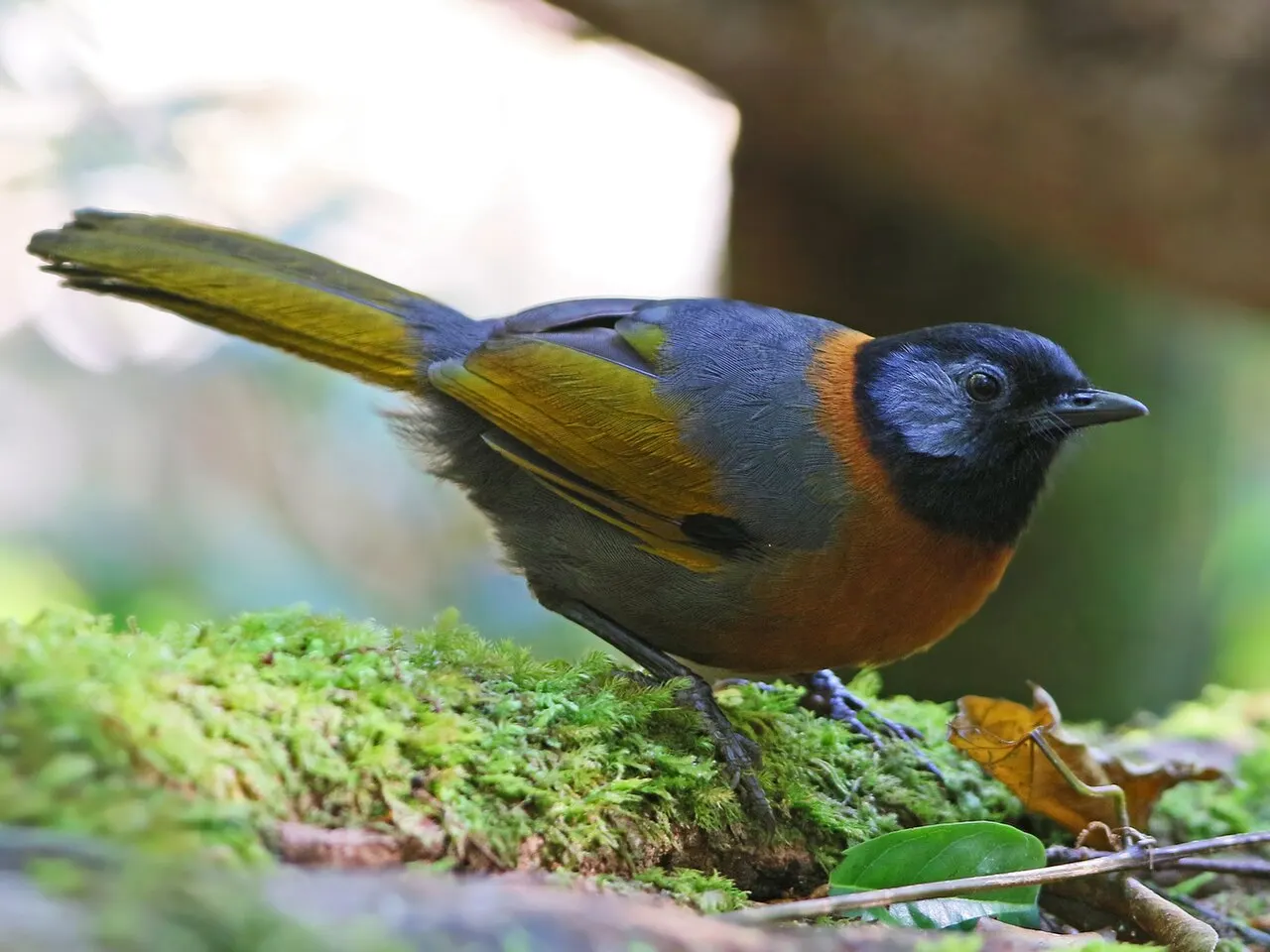
It measures about 26 to 28 cm from bill to tail. The head is black, the body orange-brown, and there is a silver patch over the ear. The wing feathers have bright golden to orange-olive edges. The song is a loud, rising whistle, often answered by low mewing notes.
It is a laughingthrush, one of a group of noisy, sociable forest songbirds, and it keeps mostly to dense undergrowth. The species was long listed as Garrulax yersini. Bird lists now place it in Trochalopteron, so older guides and websites may use the earlier name.
Where it lives
This bird is endemic to Vietnam, so no wild population exists anywhere else. It is confined to a small area of the Central Highlands around Da Lat. One bird-data site maps its range at about 719 square kilometres, and the IUCN estimates the area it actually occupies at 620 to 1,240 square kilometres.
It lives in moist evergreen mountain forest, including logged forest, and in high-altitude shrubland. The IUCN gives an elevation band of 1,500 to 2,440 m, and another dataset lists 1,400 to 2,440 m. It does not migrate.
Pins are Wikidata “endemic to” fields. Orange dots, when present, are GBIF occurrence tiles — survey bias included.
How it lives
Collared laughingthrushes feed mainly on invertebrates and move in small flocks. Birdwatching tour reports describe a small flock coming to a hide in Bidoup Nui Ba National Park, and a group of five taking mealworms near Da Lat.
The IUCN estimates a generation at about 3.6 years, and one dataset gives the age at first breeding as about 1.4 years. Little about nests and clutches appears in the sources available.
Why it is in trouble
The 2024 assessment estimates the total population at 2,000 to 10,000 birds and records a continuing decline, with the number of locations and the area occupied both shrinking. The assessed range holds between 2 and 10 subpopulations and 3 to 20 locations.
The one threat the IUCN lists is use in which the species itself is the target, meaning birds are caught deliberately. The assessment names population size, trends, life history, trade trends and threats as areas needing more study.
What is being done
The IUCN reports that conservation sites have been identified across the whole range and that the species occurs in at least one protected area. Bidoup Nui Ba National Park is one place where it is seen. The listed actions are site protection and policies and regulations.
As of the 2024 assessment there was no recovery plan, no systematic monitoring scheme, no captive population and no international trade controls.
Sources
Written for this catalog in our own words from the sources below, checked against them on 12 November 2026. Population figures are estimates and carry the year they were made. Status and assessment year: IUCN. 2026. The IUCN Red List of Threatened Species. Version 2026-1. iucnredlist.org.