Critically Endangered
Barrett’s Plant-louse
Trioza barrettae
Trioza barrettae, the Banksia brownii plant louse, is a sap-sucking insect about 3 mm long that lives only on feather-leaved banksia in the south of Western Australia. The IUCN Red List assessed it as Critically Endangered in 2015. Its fate is tied to a shrub that is itself dying back.
What it is
Despite the name, a plant louse is not a louse. It is a jumping plant louse, or psyllid, a sap-sucking true bug in the family Triozidae. Adults are tiny, about 3 mm, and range from green to orange. Wing veins place it in the genus Trioza, but telling this species from its relatives takes dissection of the genitalia, so expert opinion is needed. Taylor and Moir described it in 2014.
Where it lives
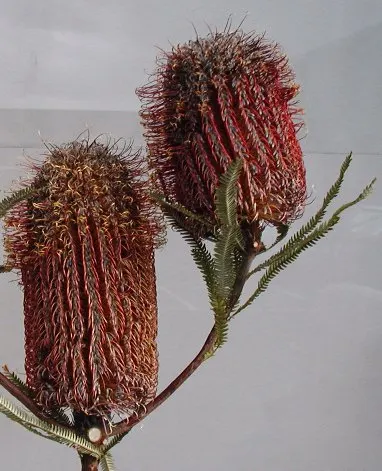
It has been found only on feather-leaved banksia (Banksia brownii), and intensive searches of other likely host plants turned up none. Conservation advice lists five subpopulations on the south coast of Western Australia, with a total area of occupancy of about 4 square km. The IUCN assessment counts 2 locations, records it from about 5 to 800 m above sea level, and gives an occupancy range of 2 to 8 square km. It disperses poorly, and no further specimens have been found even though other stands of the banksia exist along the south coast.
Pins are Wikidata “endemic to” fields. Orange dots, when present, are GBIF occurrence tiles — survey bias included.
Why it is in trouble
The louse can only be as secure as its host, and the host is declining. Feather-leaved banksia is itself Critically Endangered, falling in number as old plants die and fires are held back. Dieback disease caused by Phytophthora cinnamomi, aerial canker and Armillaria fungus attack the shrubs. Wildfire, inappropriate fire regimes, drought and a drying climate add to the pressure.
The IUCN estimates an 88 percent past reduction and lists dieback, tourism and recreation areas, recreational activities and suppressed fire among the threats, with dieback scored as the highest impact.
What is being done
On 10 October 2015, entomologist Melinda Moir collected six lice and moved them onto a translocated banksia population ahead of a regeneration burn at a natural population on 21 October. The plan was to return them once new seedlings had established. Federal conservation advice recommends surveying every known host stand, moving lice to other host populations, storing banksia seed, keeping strict hygiene against disease, and monitoring translocated colonies to see whether they take.
Sources
Written for this catalog in our own words from the sources below, checked against them on 12 November 2026. Population figures are estimates and carry the year they were made. Status and assessment year: IUCN. 2026. The IUCN Red List of Threatened Species. Version 2026-1. iucnredlist.org.




