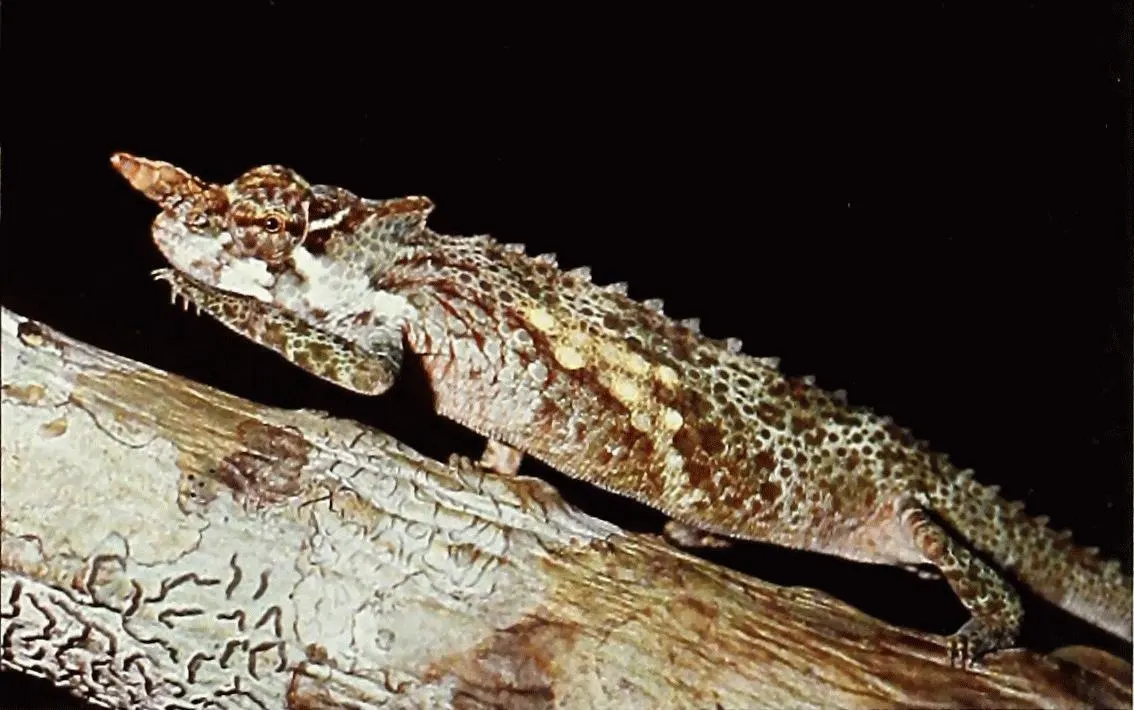
Endangered
Pfeffer’s Two-horned Chameleon
Trioceros pfefferi
Pfeffer's chameleon, also called the Bakossi two-horned chameleon (Trioceros pfefferi), is a small, brightly marked chameleon found only in the montane forests of Cameroon. The IUCN Red List classes it as Endangered (assessed 2015), with a decreasing population in forest that is being broken up by farming and collecting.
How to recognise it
Keepers' references put males at roughly 15 to 20 cm in total length, with a body of about 6 to 9 cm from snout to vent and a weight of 10 to 18 grams. Females are a little smaller. The tail is slightly longer than the body.
Males carry a well-developed rostral process over the nose that bridges two short, diverging horns. Females have only a small ridge there. The top of the head, the crests and the rostral are orange, sometimes with pale blue to violet scales, and the body can show red, blue, green, yellow, brown or orange. Both sexes have a brownish-orange to dark stripe through the eye, and a row of 10 to 13 spiky scales under the chin.
Where it lives
The species is endemic to Cameroon, along the Cameroon Volcanic Line. The type specimen came from Nyasoso on Mount Kupe, and it is also known from Mount Manengouba and, in small numbers, the Mbulu Hills. The IUCN lists it from montane forest at 1,100 to 1,900 metres, with an estimated extent of occurrence of 13,000 square kilometres and an area of occupancy of about 435 square kilometres.
The IUCN describes the population as severely fragmented, with the area it occupies still shrinking.
Pins are Wikidata “endemic to” fields. Orange dots, when present, are GBIF occurrence tiles — survey bias included.
How it lives
A field project in 2014 and 2015, funded by the Rufford Foundation and run by Walter Tapondjou of the Cameroon Herpetology Conservation Biology Foundation, sorted the region's endemic chameleons into those that favour less disturbed forest and those that tolerate fragmented habitat. Pfeffer's chameleon fell in the first group. It also perched higher than Perret's chameleon, which sat low on farms, house fences and forest bushes. Across the chameleons studied, about 95 percent of the diet was arthropods, mainly flies, then wasps and bugs.
The species lays eggs. Reproduction in the wild is poorly known, but captive females have laid clutches of 5 to 11 eggs, and eggs kept at 68 to 72 degrees Fahrenheit hatched after about 17 to 19 weeks.
Why it is in trouble
The IUCN lists three ongoing threats: small-holder farming, harvesting aimed at this species, and accidental harvest. Montane forest on the volcanic line is being fragmented by cultivation, and this chameleon favours intact forest. The Rufford project described it as really uncommon on Mount Manengouba, and reported only a small population in the Mbulu Hills.
The IUCN records it in at least one protected area and calls for site management and protection, harvest management and trade management. It notes that the species is listed as fully protected (Class A) under Cameroonian law, yet is still harvested and exported, and that animals appear in trade from Equatorial Guinea although the species is endemic to Cameroon. The Rufford project used its results to propose the Class A listing, ran awareness sessions in the villages of Nsoung on Mount Manengouba and Ekona Lelu on Mount Cameroon, and recruited some villagers to turn away chameleon hunters.
Sources
Written for this catalog in our own words from the sources below, checked against them on 12 November 2026. Population figures are estimates and carry the year they were made. Status and assessment year: IUCN. 2026. The IUCN Red List of Threatened Species. Version 2026-1. iucnredlist.org.




