Critically Endangered
Trigonostigma somphongsi
Trigonostigma somphongsi
Somphong's rasbora (Trigonostigma somphongsi) is a tiny copper-coloured fish from the lowland marshes and flooded rice fields of central Thailand. The IUCN Red List assessed it as Critically Endangered in 2011. It was feared lost for decades before small groups were found again in recent surveys.
How to recognise it
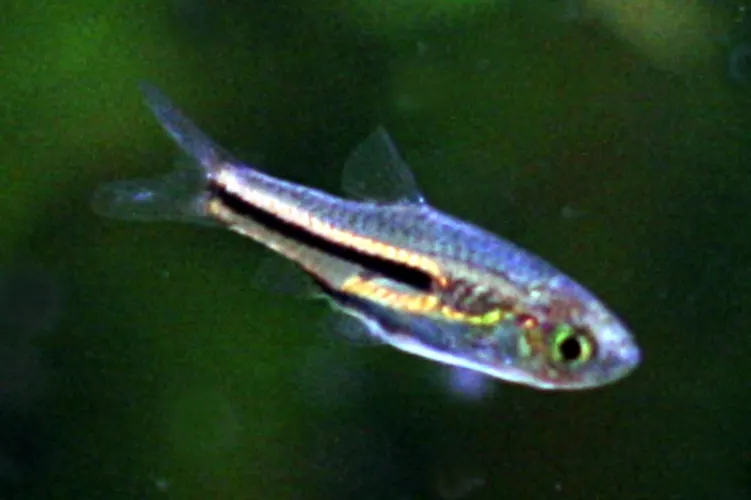
This is a very small fish, around 3 cm long, with a copper-hued body and a black stripe along its side. Males are brighter coppery, and females carry paler markings. It is smaller than the other rasboras that share its water, and it was first described in 1958 by Meinken. The species name honours Somphong Lek-aree, a Thai fish collector and aquarium trader.
Where it lives
The species is endemic to Thailand. The Red List records one location. It has been linked to freshwater lowland marshes rich in aquatic plants, with a range running from the Mae Khlong basin near Ratchaburi to the outskirts of Bangkok.
It reportedly prefers dense vegetation and slow or still water, in dark, neutral to weakly acidic habitats. Aquarium writers advise soft, acidic water for captive fish.
Pins are Wikidata “endemic to” fields. Orange dots, when present, are GBIF occurrence tiles — survey bias included.
How it lives
Wild groups are small. Practical Fishkeeping reports filmed fish in groups of just one to five, often mixed in with other small fish, while a close relative, Trigonostigma espei, can gather in shoals of hundreds. In the wild it eats small zooplankton, worms and insect larvae.
Sightings have been rare, and accounts differ on the dates. An IUCN story says it was presumed extinct in the wild for more than 30 years, with only the occasional fish turning up in mixed catches of small fish bound for aquarium buyers in Germany and Japan. Practical Fishkeeping says a small wild population was found in central Thailand's floodplains in 2014 and later declined as the habitat was damaged.
Why it is in trouble
The Red List gives the population trend as decreasing and records continuing decline in the area it occupies. It names housing and urban development as an ongoing threat, with other ecosystem modification and unintended effects of small-scale harvesting as past threats. The 2011 assessment used criterion A2ac, a population decline measured in the past and linked to loss of habitat.
Wider accounts add pollution, dams and irrigation canals that change how water moves, and pesticides and fertiliser that alter water chemistry. Two other fishes first found in the same region, Balantiocheilos melanopterus and Ambastaia sidthimunki, have reportedly disappeared from the area after its rivers were modified.
What is being done
A project run by the Seub Nakhasathien Foundation, funded by CEPF and IUCN, has been surveying Thung Pak Phi in Nakhon Nayok Province, described as the last major population. Fish were found in three key habitat areas during the dry season, and surveys are repeated twice a year, in drought and flood seasons. The latest survey in the 2023 IUCN story was in April 2023.
Local farmers grow an endemic rice once a year under flooded conditions, which lowers their use of fertiliser and pesticide and helps the fish. The foundation has also held workshops with the Royal Irrigation Department on water management. The privately owned site could be proposed as an Other Effective Area-Based Conservation Measure and possibly a Ramsar site. The Red List lists reintroduction and captive breeding among actions needed, and Practical Fishkeeping says the species currently suits breeding projects better than casual keeping.
Sources
Written for this catalog in our own words from the sources below, checked against them on 12 November 2026. Population figures are estimates and carry the year they were made. Status and assessment year: IUCN. 2026. The IUCN Red List of Threatened Species. Version 2026-1. iucnredlist.org.




