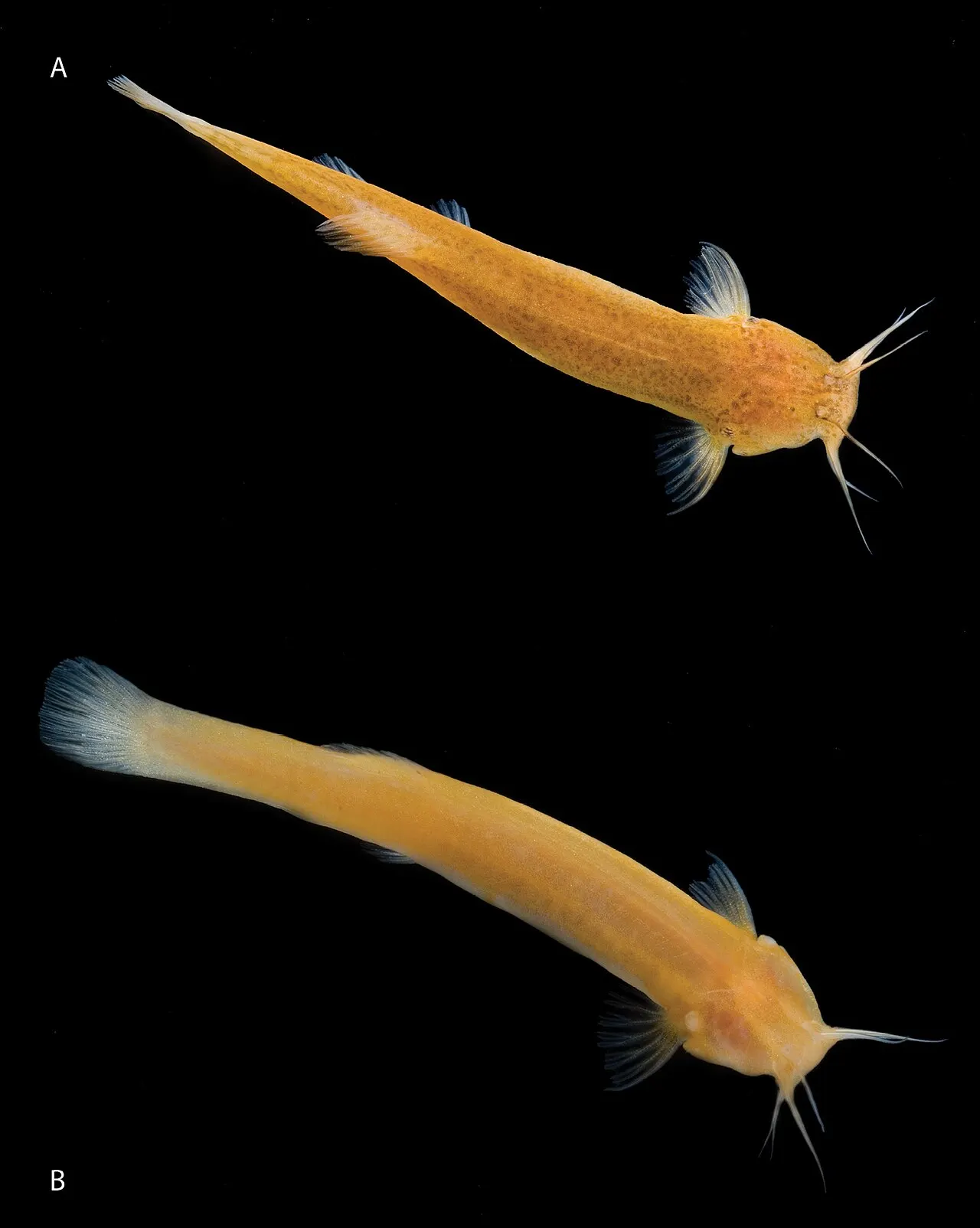
Critically Endangered
Trichomycterus itacarambiensis
Trichomycterus itacarambiensis
Trichomycterus itacarambiensis is a small cave catfish known from a single cave, Gruta Olhos d'Água, near Itacarambi in Minas Gerais, Brazil. The IUCN Red List rates it Critically Endangered (assessment dated 2018, published 2022), with a decreasing population and a tiny area of occupancy of about 4 square kilometres.
How to recognise it
It belongs to the pencil catfish family, Trichomycteridae, and its closest relatives appear to be T. paolence and T. proops. It is small. The original description measured a 47.3 mm holotype, and the paratypes ranged from 21 to 62 mm standard length. FishBase gives a maximum of 8.3 cm, and fish mature at around 4 cm.
Where it lives
The catfish has only been found in Olhos d'Água cave, a resurgence cave in Itacarambi that carries a permanent stream. It is found throughout the cave, but waterfalls upstream and canalisation downstream isolate it. The IUCN counts one location and records its habitat as karst and other underground water systems. The species occurs in at least one protected area, and a regional area-based management plan is recorded.
Pins are Wikidata “endemic to” fields. Orange dots, when present, are GBIF occurrence tiles — survey bias included.
How it lives
It is a carnivorous generalist. Earthworms and arthropods make up most of its food, including beetles, mayflies, flies and troglobitic isopods (cave-dwelling crustaceans). Most food washes into the cave in the wet season, and breeding is synchronized with the rains. In the dry season food is scarce, and the fish live partly off their own body tissue. The maximum reported age is 7 years.
Why it is in trouble
With one cave as its whole range, the species has very little margin. The IUCN assessment records a continuing decline, estimates a past reduction of 31 percent based on an abundance index, and lists drought as a threat.
A 1997 mark and recapture study reportedly put the population at 1,500 to 2,000 fish longer than 20 mm. A 2009 paper by Trajano, Secutti and Bichuette in Speleobiology Notes, titled as a population decline caused probably by reduced flash flooding, reassessed numbers against a count from 1994. It linked the fall to fewer floods carrying organic matter into the cave, and found the decline concentrated in one part of the cave, which they considered consistent with that idea. No current population total has been published.
What is being done
The assessment records an area-based regional management plan and notes the species occurs in a protected area. The 2009 study's own view was that no practical protective measure exists for a cause on that scale, and no captive breeding or other targeted recovery program is known.
Sources
Written for this catalog in our own words from the sources below, checked against them on 12 November 2026. Population figures are estimates and carry the year they were made. Status and assessment year: IUCN. 2026. The IUCN Red List of Threatened Species. Version 2026-1. iucnredlist.org.




