Critically Endangered
White-headed langur
Trachypithecus leucocephalus
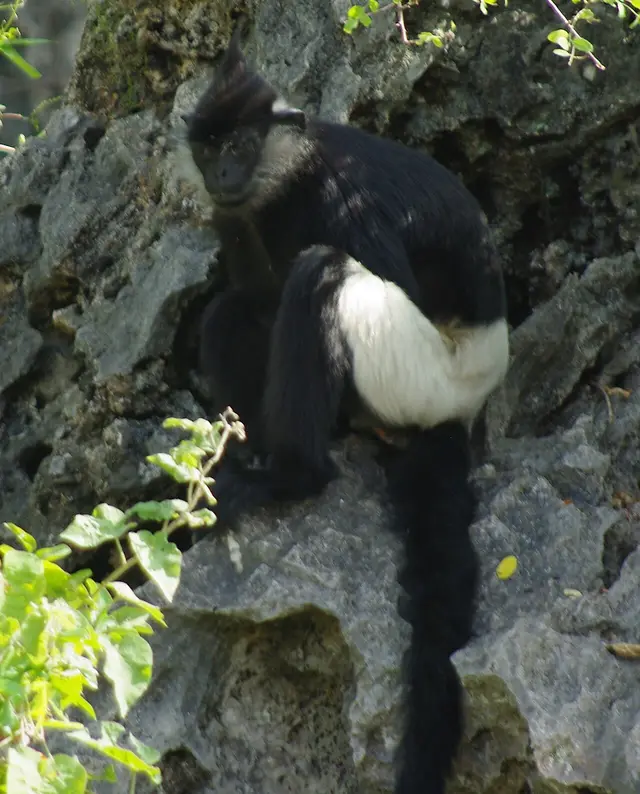
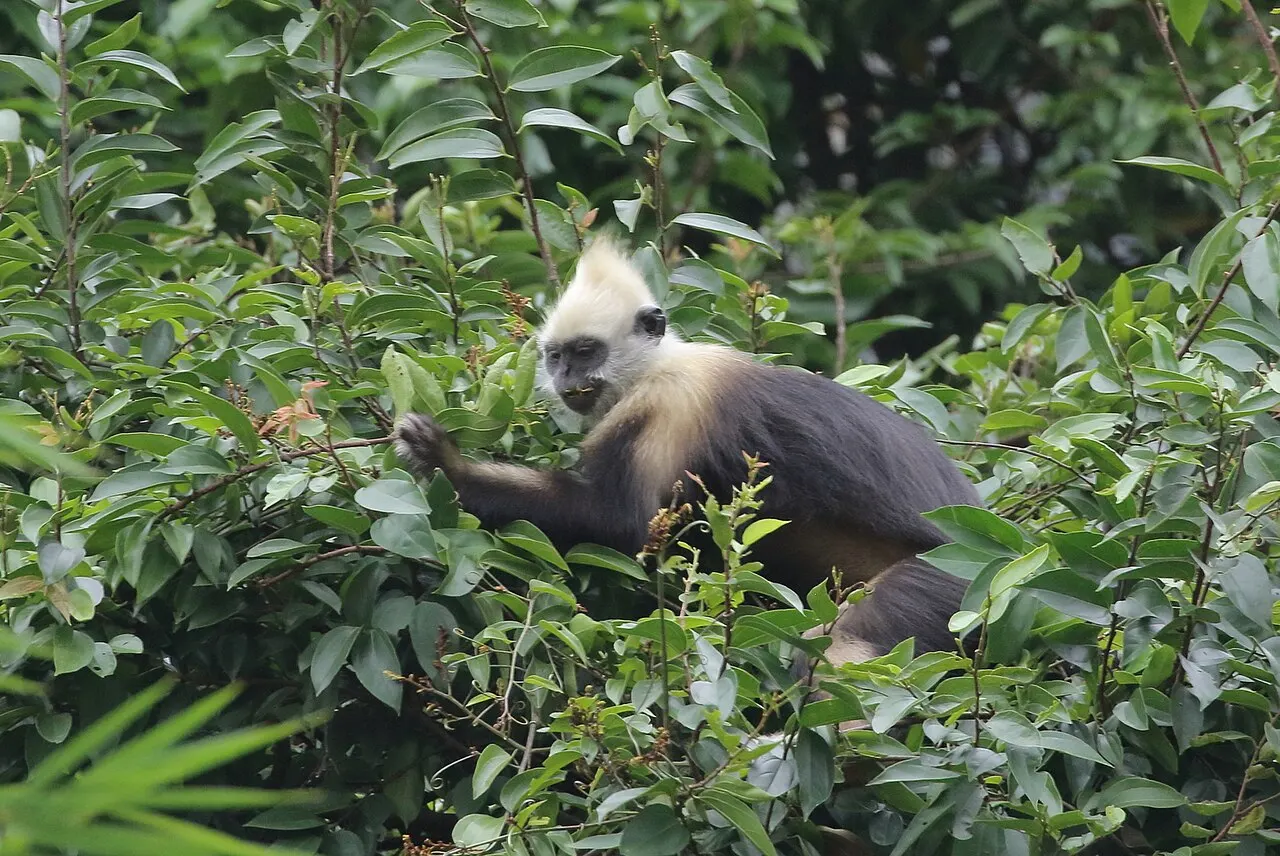
The white-headed langur (Trachypithecus leucocephalus) is a black monkey with a pale crown, found only in the limestone hills of Guangxi in southern China. The IUCN Red List rated it Critically Endangered in 2020. Counts range from a few hundred to about 1,000 animals, in small groups.
How to recognise it
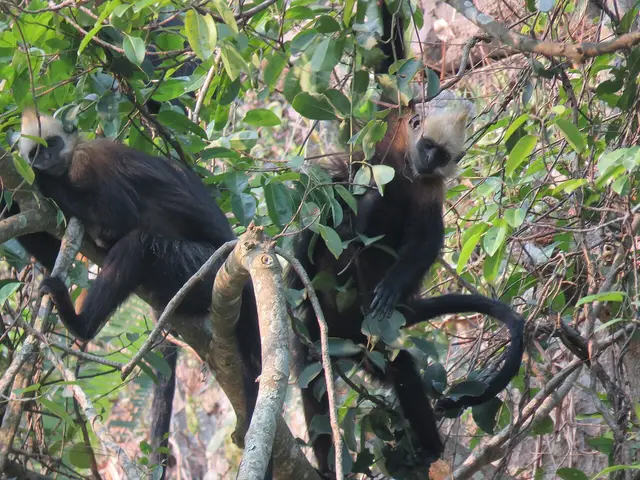
The body is blackish, while the crown, cheeks and neck are white. A related species, the Cat Ba langur of Vietnam, shows a golden version of that pattern instead. Adult males give three kinds of loud call (snorts, roars and wahoos), in long-distance sequences, according to a 2026 study in iScience.
Where it lives
It occurs nowhere but southwestern Guangxi, in a small area bounded by the Zuojiang River, the Mingjiang River and the Sifang Ridge. The IUCN assessment gives an elevation range of 100 to 1,200 m and a habitat of rocky ground such as cliffs and peaks. The Zuojiang separates it from the range of François' langur to the north.
Peking University researchers sampled 214 langurs from 41 social groups in the two main areas, Chongzuo and Fusui. Their 2017 study in Heredity found three genetically distinct populations (Chongzuo, Fusui Jiuchongshan and Fusui Buzun) with strong genetic structure between them.
Pins are Wikidata “endemic to” fields. Orange dots, when present, are GBIF occurrence tiles — survey bias included.
How it lives
It eats mostly leaves. In the Chongzuo White-headed Langur National Nature Reserve, young leaves made up 52.4 percent of the diet in 2013 and 65.2 percent in 2016, according to a 2021 study in Ecology and Evolution. Mature leaves serve as a fallback, eaten mainly in the dry season when new growth is scarce.
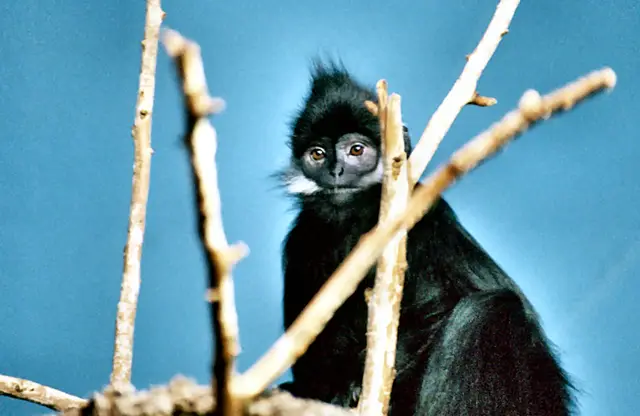
A 2008 study at Fusui found that white-headed langurs used the lower part of the forest, while François' langurs preferred the middle zone.
Why it is in trouble
Hunting is named as the main threat. Habitat loss to farming and more frequent fires add to the pressure, and in some areas released François' langurs reportedly hybridise with it. The IUCN lists a decreasing trend, with a population size of 230 to 250 in its supporting data and five subpopulations, the largest of 25 animals.
Counts differ by source and year. A 2017 Peking University release put the wild total near 1,000, while another account gives up to about 600, around 250 of them mature.
Genes are a second problem. A 2019 study in BMC Evolutionary Biology found nine mitochondrial haplotypes at Fusui but just one at Chongzuo, and little diversity overall. It concluded the low diversity mainly reflects a shallow evolutionary history and a recent founding of the Chongzuo group from Fusui, though numbers also fell during the last century.
What is being done
The species is a national first-class protected animal in China, and the IUCN notes it occurs in at least one protected area, and Chongzuo has a national nature reserve for the species. The IUCN assessment lists habitat restoration, habitat protection, education, awareness work and captive breeding among actions needed. Peking University researchers recommend restoring habitat vegetation, reducing human activity and building corridors between neighbouring patches.
A 2025 study in the American Journal of Primatology found that habitat sources shrank in 2000, 2010 and 2020 despite a notable population increase, and it identified 53 potential corridors.
Sources
Written for this catalog in our own words from the sources below, checked against them on 12 November 2026. Population figures are estimates and carry the year they were made. Status and assessment year: IUCN. 2026. The IUCN Red List of Threatened Species. Version 2026-1. iucnredlist.org.
- IUCN Red List assessment
- Wikipedia, White-headed langur
- Peking University news on a 2017 Heredity study
- Europe PMC record, BMC Evolutionary Biology 2019
- Ecology and Evolution 2021 (PMC8293718)
- Europe PMC record, American Journal of Primatology 2025
- Europe PMC record, iScience 2026
- Europe PMC record, American Journal of Primatology 2008