Endangered
West African torpedo
West African torpedo
West African torpedo, the West African torpedo or ringed torpedo, is a small electric ray of shallow sandy and muddy seabeds along the tropical coast of West Africa. It is little studied. The IUCN Red List lists it as Endangered (2021) after a decline linked to fishing pressure.
How to recognise it
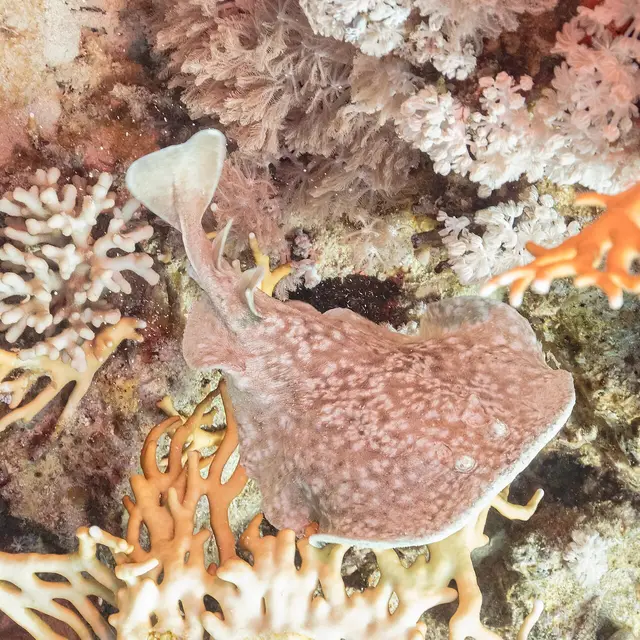
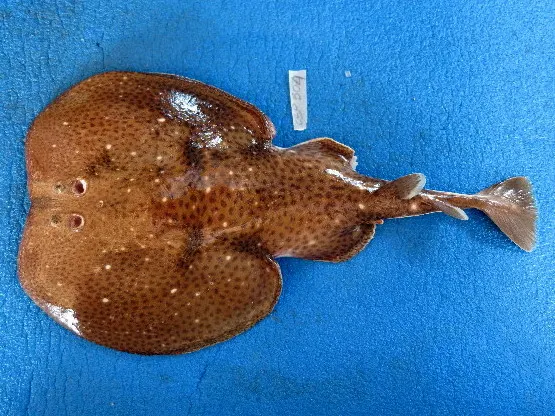
Like other electric rays, it has a rounded, fleshy disc that is slightly wider than long, a strong tail and two dorsal fins, the first broader than the second. The back is grey-brown or rusty-brown with small brown or white patches, and the underside is white. Its spiracles, the openings behind the eyes, are rounded, a feature reportedly not shared by other Torpedo species.
It stays small. Adult females measure about 35 to 50 cm and males 31.5 to 38.2 cm, and newborns average roughly 9.5 cm. FishBase gives a maximum of 40 cm for males, with males maturing at about 32 cm and females at about 35 cm.
Where it lives
The IUCN lists 16 countries: Senegal, Guinea-Bissau, Guinea, Sierra Leone, Liberia, Côte d'Ivoire, Ghana, Togo, Benin, Nigeria, Cameroon, Equatorial Guinea, Gabon, Congo, the Democratic Republic of the Congo and Angola. A 2022 report describes the known range as Mauritania to Angola, including São Tomé and Príncipe.
It lives on the continental shelf over sandy, muddy and sandy-mud bottoms, and in estuaries. The IUCN gives a depth range of about 15 to 50 metres. In 2022 the journal Oryx reported the first records from Cabo Verde: three sightings of five rays off Maio Island between 2019 and 2022, two of them in water 5 to 8 metres deep. The report is based on photographs and video, and its authors recommended examining a specimen to confirm the identification.
Pins are Wikidata “endemic to” fields. Orange dots, when present, are GBIF occurrence tiles — survey bias included.
How it lives
Little is known. It is presumed to eat small fish and invertebrates. Young develop inside the mother, nourished first by yolk and then by uterine fluid. The reproductive cycle can last about a year, reportedly with ovulation in May or June, a gestation of nearly six months and births in August or September.
IUCN data put generation length at 16 years, which means a slow recovery if numbers fall. FishBase rates its resilience as low.
Why it is in trouble
The Red List category rests on criterion A2d, a decline inferred from actual or potential levels of exploitation. The IUCN places the past reduction in the 50 to 79 percent band and lists the population trend as decreasing. Threats named are unintentional capture in both small-scale and large-scale fisheries, along with housing and urban development, aquaculture and commercial development along the coast.
In Cabo Verde, electric rays are generally discarded as bycatch with no commercial value, so they get little attention.
What is being done
Few measures target this ray. The assessment records no recovery plan, no systematic monitoring scheme, no harvest management plan and no identified conservation sites. It lists harvest management, site protection, trade management and species recovery as actions needed. The 2022 Cabo Verde report called for surveys around Sal and Boavista, which share Maio's shelf, and for research on the status of electric rays.
Sources
Written for this catalog in our own words from the sources below, checked against them on 12 November 2026. Population figures are estimates and carry the year they were made. Status and assessment year: IUCN. 2026. The IUCN Red List of Threatened Species. Version 2026-1. iucnredlist.org.