Critically Endangered
Tilapia flava
Tilapia flava
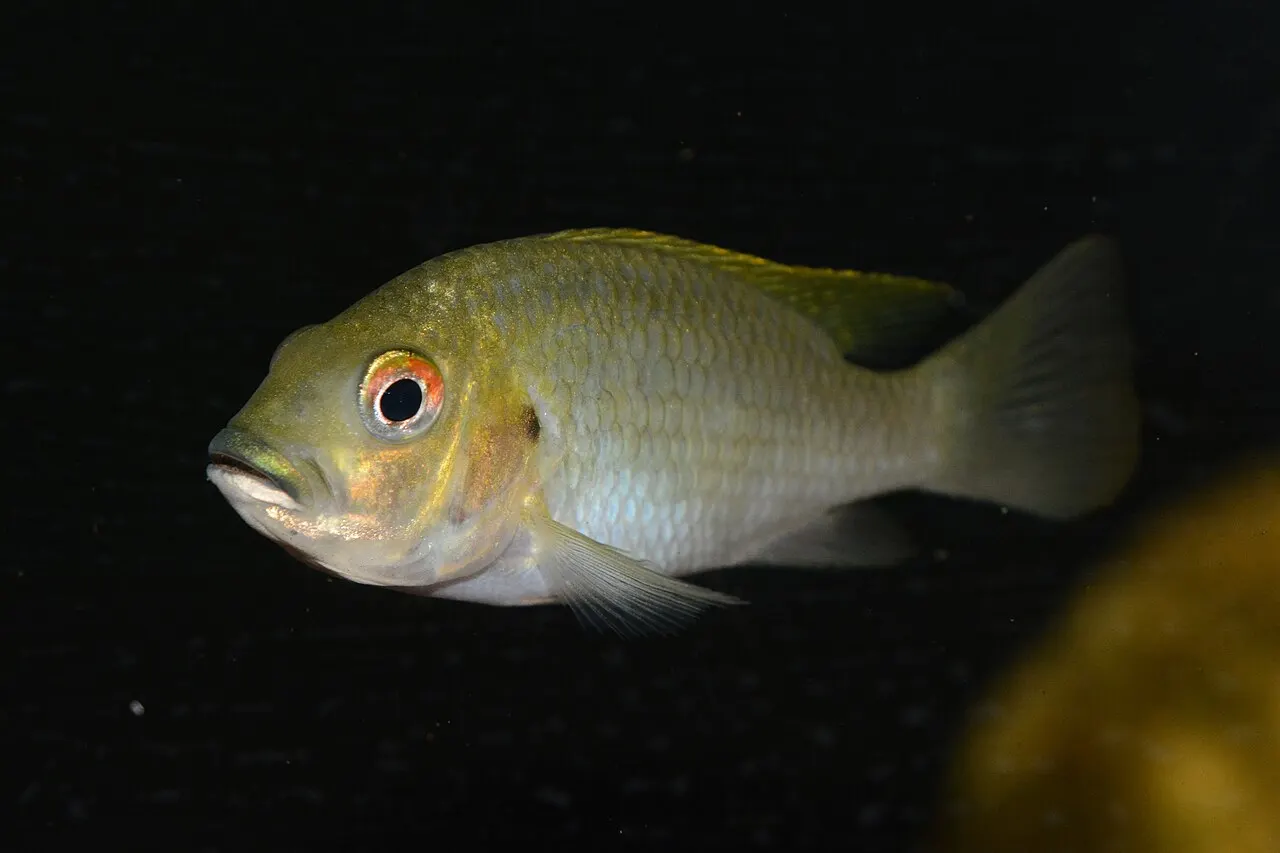
Tilapia flava, now usually called Coptodon flavus, is a small yellowish cichlid that lives only in Lake Bermin, a crater lake in southwestern Cameroon. The IUCN Red List assessed it as Critically Endangered in 2010, mainly because everything it needs is packed into one tiny, silt-prone lake.
How to recognise it
It's a small fish, with the largest recorded males reaching 8.2 cm standard length. The species name comes from the Latin for yellow, a nod to its usual body colour. It has a sturdy lower pharyngeal jaw (the throat bones cichlids use to process food) and markedly small gill rakers at the front of the gill arch.
Stiassny, Schliewen and Dominey described it in 1992 as Tilapia flava. A 2013 revision of the African tilapia group moved it into the genus Coptodon.
Where it lives
Lake Bermin is a roughly circular volcanic crater lake about 700 m across, with a maximum depth near 15 m. Sources give its area as either 58 or 110 hectares. It has no inflow and drains toward the Cross River system.
The IUCN counts a single location for this fish and estimates its extent of occurrence and area of occupancy at 0.5 square km. It lives in permanent freshwater lake habitat. Bermin holds nine endemic Coptodon cichlids, reportedly the highest number of endemic fish for its size recorded anywhere.
Pins are Wikidata “endemic to” fields. Orange dots, when present, are GBIF occurrence tiles — survey bias included.
How it lives
The fish eats mostly phytoplankton, along with higher plants and sponges. It spawns on a hard surface, usually sunken wood, at depths of about 1 to 2 m, and both parents guard the brood.
Why it is in trouble
The IUCN assessment lists soil erosion and sedimentation as an ongoing threat across more than 90 percent of the fish's range, with ecosystem degradation and fish mortality as the recorded effects. It also flags future volcanic activity as a risk. The population trend is listed as unknown, but the area of habitat is still declining.
The other Bermin cichlids face pollution and sediment from human activity. Carbon dioxide released from the lake floor has been raised as a further possible hazard, though a 1992 source judged the lake too shallow to hold very high amounts of gas.
What is being done
The IUCN assessment records no conservation actions in place and lists population trends and habitat trends as research needs. No protection or captive programme specific to this fish turned up in the sources checked.
Sources
Written for this catalog in our own words from the sources below, checked against them on 12 November 2026. Population figures are estimates and carry the year they were made. Status and assessment year: IUCN. 2026. The IUCN Red List of Threatened Species. Version 2026-1. iucnredlist.org.




