Critically Endangered
Three-coloured harlequin toad
Atelopus tricolor
The three-coloured harlequin toad (Atelopus tricolor) is a small, brightly marked toad of Andean streams and montane forest in Bolivia, with older records from Peru. The IUCN Red List rated it Critically Endangered in 2020. It went unrecorded after 2003, then turned up again on 1 January 2020.
How to recognise it
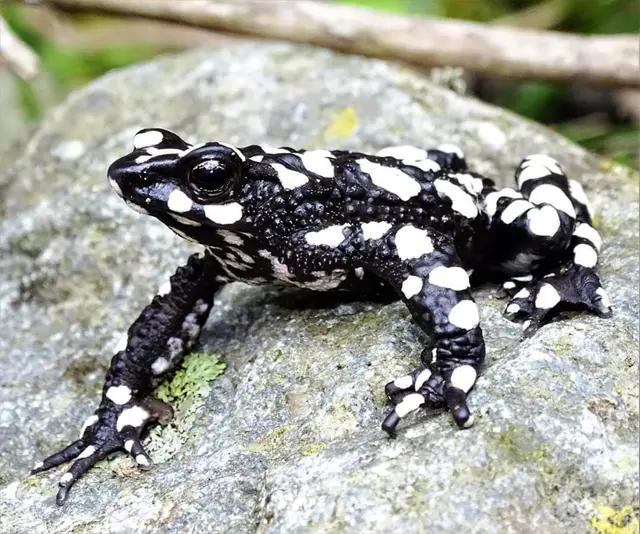
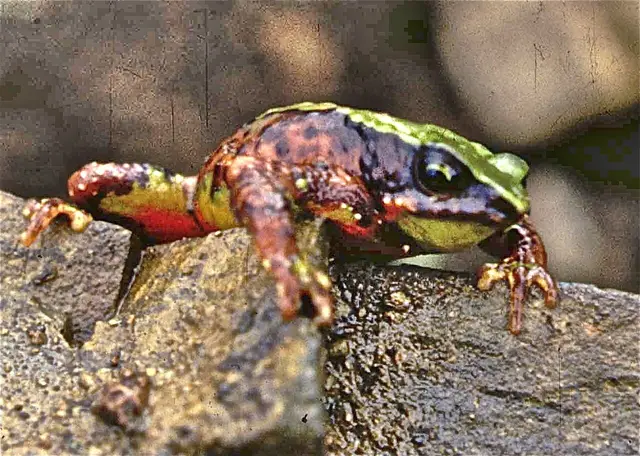
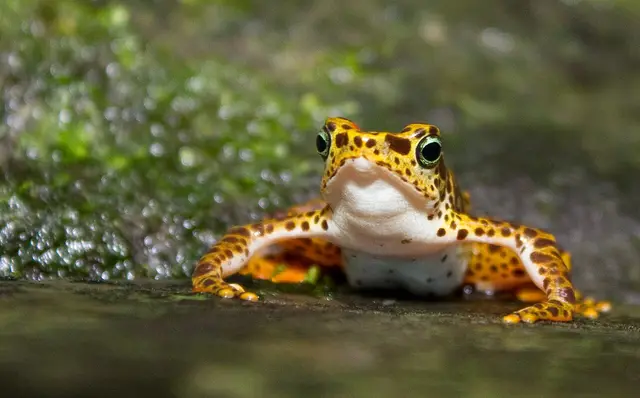
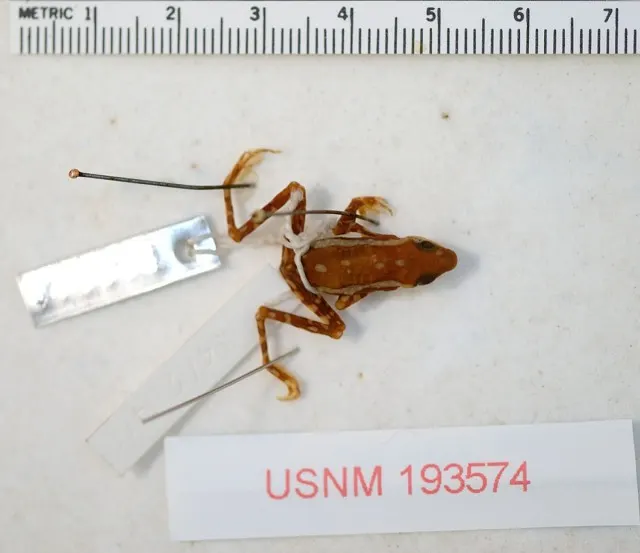
It's a slender harlequin toad with a pointed snout, no visible eardrum and long legs. A 2021 news report describes a yellow, black and red pattern, and gives adult length as roughly 23 to 34 mm depending on sex.
The photographer who found it in 2020 said it is the only harlequin toad in Bolivia with those colours. A Bolivian herpetologist also describes it as the only Atelopus species in the country, so the pattern is a reliable clue there.
Where it lives
The IUCN lists Bolivia as the country where the toad is still present and Peru as a country where it is possibly extinct. The 2021 news report quotes a Bolivian herpetologist saying there are no current records from Peru, so Bolivia may hold the only population. The estimated extent of occurrence is about 97,467 square km, and the toad has been recorded between 600 and 2,500 m above sea level.
Its habitats are subtropical or tropical moist montane forest and permanent streams, creeks and rivers, with plantations also listed. The recent sightings come from a stream near Caranavi, in the Yungas of La Paz department.
Pins are Wikidata “endemic to” fields. Orange dots, when present, are GBIF occurrence tiles — survey bias included.
How it lives
These toads are closely tied to water. They go to creeks to breed in the rainy season (roughly December to March), which helps explain why they are so hard to find in the dry months. The IUCN estimates generation length at 7 years and records the toad as not migratory.
Why it is in trouble
The 2020 assessment estimates a past population reduction of 80 to 90 percent, judged from direct observation, declining habitat and the effects of pathogens or other introduced agents. The population trend is decreasing. Chytrid fungus, which has devastated harlequin toads across Latin America, is the suspected cause of the earlier decline. Researchers say they do not yet know how the loss divides between disease and habitat clearing for farming and housing.
Habitat loss adds to it. Forest fragmentation linked to coffee, coca and fruit crops is reported in the Yungas, and water pollution from bottles, cans and detergents is another concern. The IUCN also lists small-holder farming and soil erosion among the threats.
Rediscovery and what is being done
On 1 January 2020, photographer Mauricio Pacheco found four adults beside a stream near Caranavi, the first record since 2003. One toad was lifted out briefly for photos and the rest were left alone. Researchers advised him on checking for chytrid without harming the animals, and the toads looked healthy.
Bolivian groups including the Bolivian Amphibian Initiative and Re:wild, with partners such as Durrell and the Atelopus Survival Initiative, went back to the site, found more toads and began assessing distribution and threats. A second phase was due to start in December 2021 and to involve nearby communities. Researchers also named captive breeding options as something to assess. The IUCN lists site and habitat protection, invasive species control and captive breeding among conservation actions.
Sources
Written for this catalog in our own words from the sources below, checked against them on 12 November 2026. Population figures are estimates and carry the year they were made. Status and assessment year: IUCN. 2026. The IUCN Red List of Threatened Species. Version 2026-1. iucnredlist.org.